Vinci II
The Rise and Fall of Civilizations
A Game by Philippe Keyaerts
Vinci II on Yucata.de
Vinci has been published in several languages and versions.
The rules are not the same in all languages, so Yucata.de has worked with the author to define a set of rules for the online version.
Philippe has also created with us new maps, civilization cards and variants.
Changes to the base game
- Civilization token Specialization has been removed. Diplomacy is used with 3 or more players. With 2 players, there is no diplomatic token.
- Every normal conquest requires at least one of your own pawns. Religion is the exception described below.
- Civilization token Medicine gives an extra pawn only in the reorganization phase.
- Legions provides its 7 additional pawns only for the expansion phase, and you need to use at least one player token.
- When selecting civilizations, you need to pay 1 victory point per skipped civilization. For this reason, you start the game with only 5 victory points.
- Surviving active defenders are redeployed automatically after the attacker’s reorganization and before scoring; Warband keeps them off board.
Introduction
A game of Vinci spans the growth and decline of civilizations in Europe from Prehistoric times to
the High Middle Ages.
During this long period of history, new tribes and civilizations made their mark upon the continent
in many ways. Wandering into Europe from across the Mediterranean, the Atlantic Ocean, and the
Ural River; or rising from the ashes of previous civilizations. The civilizations spread, made war
upon each other, assimilated each other, and eventually vanished to make room for new and
growing empires.
The players in Vinci control the destinies of several civilizations, each with different
characteristics. Each civilization quickly grows into a vast empire, but the expansion is not infinite.
Inevitably, there comes a time when a civilization can no longer grow, and falls into decline. Once
this happens, the player ignores the failing empire, and chooses a new civilization to start anew.
On Yucata, Vinci supports 2 to 5 players, depending on the map.
Contents
- Several game boards depicting Europe and different regions, divided into many provinces
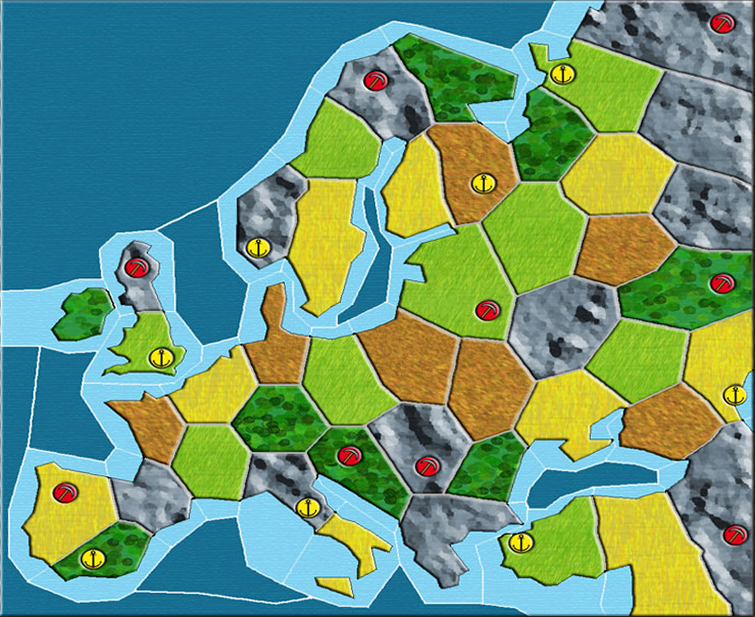
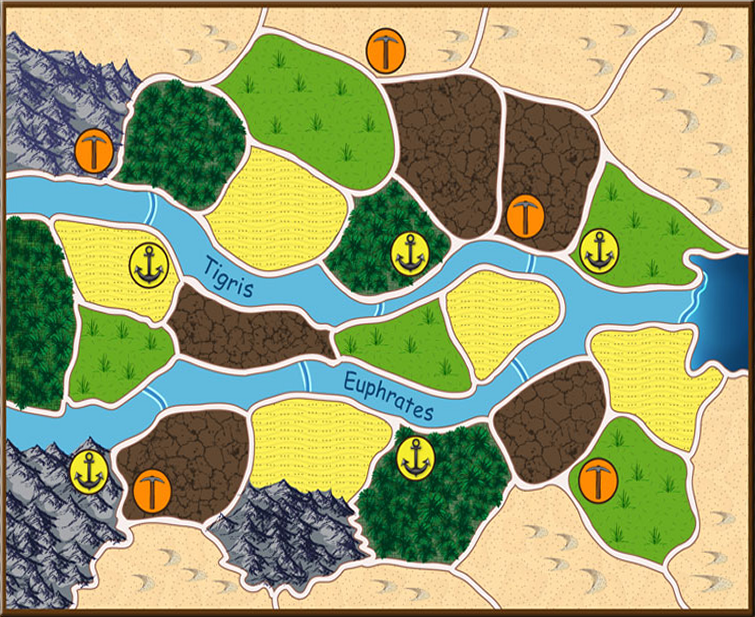
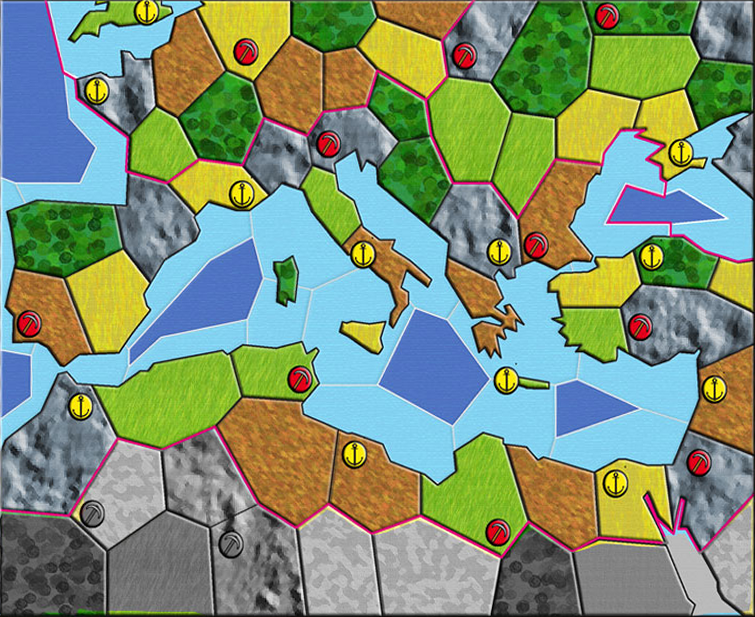
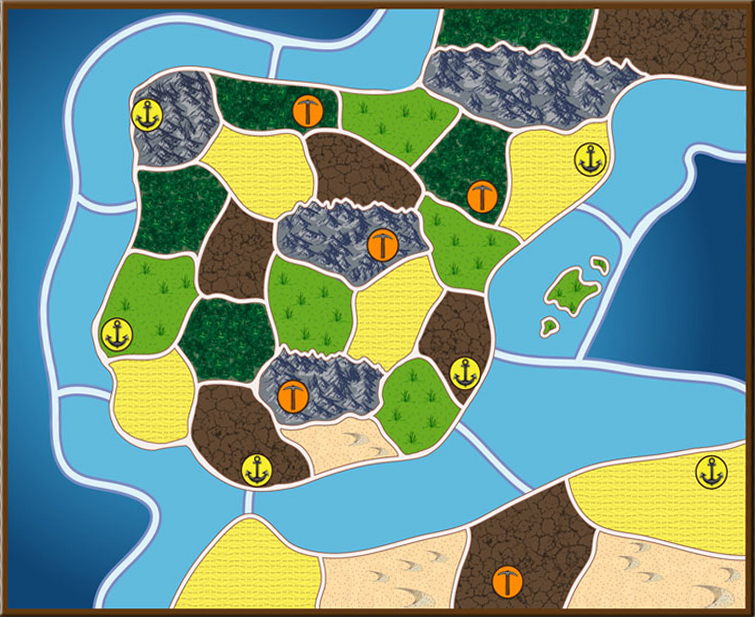
- Double sided wooden pawns in 5 colors, representing population. One side for active civilizations and another for civilizations on decline


- Brown wooden pawns representing neutral civilizations which cover the board at the
beginning of the game.

- White wooden pawns representing fortresses.

- 35 civilization tiles (larger counters) which show the different abilities of a civilization


- 1 cloth bag from which to draw civilization tiles at random
- Coin tokens to mark civilizations skipped.

The Basics of Vinci
The main object is to score as many victory points as possible. The more provinces controlled by a
player’s population, the more points the player receives.
A civilization begins with a specific number of population pawns. It will never receive more
(unless noted by a Civilization Tile, see below). The pawns allow the player to expand into new
provinces. To take over a new province, a varying number of pawns are needed depending on the
terrain of the province (mountains and forests offer natural defense and therefore require more
pawns), the number of defenders already there and the skills of the attacking and defending
civilizations. At the end of each expansion turn, the player redistributes the pawns of the active empire
among its conquered provinces to strengthen its defenses, then scores victory points.
On later turns, the player does the same thing, except that the civilization now has
fewer pawns available in order to conquer new provinces and defend against encroaching empires.
When a player decides that his civilization has become too weak, the player can declare the
civilization as being in decline. The player then chooses a new civilization which will enter play on
the next turn. The provinces still held by the civilization in decline continue to score points for the
player, until the provinces are conquered by other players.
At the beginning of each turn, there is an important choice to make: is it worth trying to expand the
current empire, or should you choose a new one?
The game continues until a fixed number of rounds, which depends on the number of players:
End of the Game
Each new civilization has 2 special abilities (there are 35 different possibilities) which give the
civilization various advantages (some civilizations score points more easily, and some are more
stable).
Over the course of the game, each player will control several civilizations, each from its formation
through its decline.
Setting Up
1. Each player chooses a color and starts with 5 victory points.
2. A brown pawn is placed in every province on the game board, except the gray mountain
provinces, yellow desert provinces and in the blue water zones (rivers and seas). These pawns represent the early inhabitants of
Europe and are not controlled by any players. These indigenous peoples will defend the
provinces that they occupy against the arrival of the players’ civilizations.
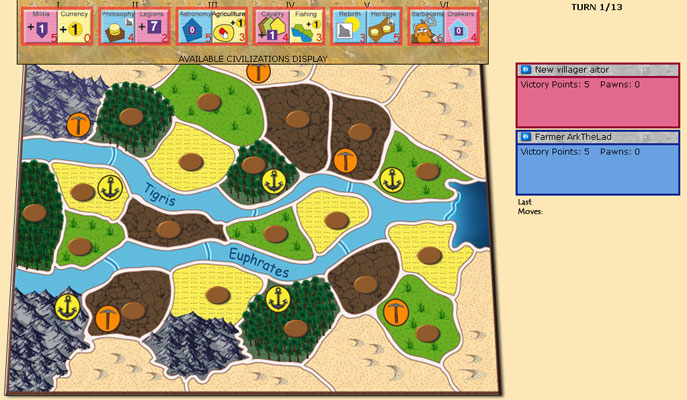
3. The civilization tiles are placed in the bag. Twelve of these tiles are then drawn at random in
pairs. The first pair is placed on the spaces marked ‘I’ on the top of the board, the second pair
is placed on ‘II’, and so forth. Each of these pairs of tiles represents the special abilities of one
of six civilizations ready to enter the game.
The available tiles depend on the setup: Diplomacy is omitted with two players. The Original map
omits Drakkar and Camels; Mare Nostrum with three or five players omits Camels.
The invitation option “Without Nomads / Culture” omits both Nomadic and Culture.
4. The starting player is chosen at random (players will then take their turns in clockwise order).
5. Each player takes his first turn, which consists of choosing their first civilization (see
Choose a new Civilization below), and only in this first turn, the player must immediately start the conquest phase.
Rules of the Game
Choose a new Civilization
Players choose a new civilization at the start of the game, and periodically during the game when
they decide to let their current empire slip into decline.
Start of the game
On his first turn, or after putting a civilization in decline, the player chooses a new civilization
from the six available at the top of the board.
If the player chooses the first civilization (the pair of tiles in space ‘I’), no victory points are gained
or lost for its position. Any coins already on the chosen civilization are still gained.
If instead the player passes over the first civilization, and chooses the second civilization (space
‘II’), the player must pay one victory point. Each
civilization further along the track costs an additional point (so civilization ‘III’ costs 2 points,
civilization ‘IV’ costs 3 points, and so on.).
For each civilization that was passed over, the player places a coin token on it. Each one of these tokens represents one victory point.

For example, if a player chooses civilization ‘IV’, the player pays 3 victory points (move back the
scoring marker), and places a coin token on civilizations ‘I’, ‘II’, and ‘III’. There may be several coin tokens
on a civilization. When a player chooses a civilization with one or more coin tokens on it, the player
gains 1 victory point for each token on the civilization.
Once a player chooses his civilization, that player takes the two civilization tiles, removes any
coin tokens that were on the civilization (taking as many points), and shifts the higher-numbered civilization pairs (along with
any pawns placed with them) to the left to fill the vacant space. Two new civilization tiles are
drawn and placed on the ‘VI’ space (giving the next player a choice between 6 civilizations.).
On Yucata, the replacement pair remains hidden and undrawn until the player explicitly reveals it
or finishes the turn. Revealing new tiles commits the preceding actions, so they can no longer be undone.
You must already have enough victory points to pay for the skipped civilizations; coins on the chosen pair cannot finance that payment.
Pawns of a new Civilization
Each time a player chooses a new civilization, the player receives a number of pawns in that
player’s color. This number is the sum of the two red numbers on the civilization tiles for that
civilization plus extra pawns depending on the map and the number of players.
Base population for every new civilization
| Map | 2 players | 3 players | 4 players | 5 players |
|---|
| Original | — | 10 | 6 | 4 |
|---|
| Euphrates & Tigris | 6 | 3 | — | — |
|---|
| Mare Nostrum | — | 6 | 6 | 6 |
|---|
| Hispania | 9 | 4 | — | — |
|---|
The base population is added to the two red numbers whenever a new civilization is chosen. “—” marks an unsupported player count. Mare Nostrum uses the map variant matching the player count.
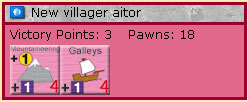 Example: In a 3 player game on original map, the civilization ‘Mountaineering + Galleys’ will give a player 18
pawns:
Example: In a 3 player game on original map, the civilization ‘Mountaineering + Galleys’ will give a player 18
pawns:
4 for Galleys + 4 for Mountaineering + 10 because there are 3 players.
In a 4 player game, the civilization would start with 14 pawns.
These pawns are all that the civilization will ever receive; no new pawns are added on future turns.
(Exceptions: Medicine, Culture and conversion through Religion.)
Note: a player is not limited to the 25 pawns provided with the game. In the rare case that more are
needed players can supplement their pawns by adding those of an unused color or the brown
pawns.
The effects of the 35 civilization tiles are explained later in the rules and on the summary sheets.
Course of a Turn
On each turn, the player must choose between two options: whether to expand the current empire,
or put it into decline and choose a new civilization to start on the next turn. The two options, and
their basic steps, are listed below. Each option is fully described in detail below that.
An expansion turn consists of these phases:
1. Collecting pawns or choosing a starting province.
2. Expanding the empire, heeding the rule of cohesion.
3. Reorganizing pawns and checking cohesion.
4. Counting Victory Points.
A declining turn consists of these phases:
1. Removing pawns from the player’s previous empire in decline (if there is one).
2. Removing all but one pawn per province in the newly declining empire (except with Philosophy).
3. Placing a ‘declining’ counter in each province.
4. Keeping the two civilization tiles with the declining empire; only their decline effects remain active.
5. Counting Victory Points.
6. Choosing a new civilization.
Expansion Turn
1. Collecting pawns or choosing a starting province
Collecting pawns
At the start of each turn, the player collects pawns from each of the occupied provinces of his
active empire, leaving one pawn behind in each province. The player may remove all of the pawns
from a province, but in doing so gives up control of the province. A province thus vacated will
belong to nobody and will cost its normal amount to re-conquer it. The pawns taken from the
board can then be used to expand into new provinces - so the more an empire expands, the less
strength it has for further expansion.
Choosing a starting province
When a player is entering a new civilization onto the board, all of the starting pawns for that
empire are available to expand. (See Expansion below).
A new civilization enters from the edge of the board. It grabs a foothold in one province, then
expands from that starting province into adjacent provinces.
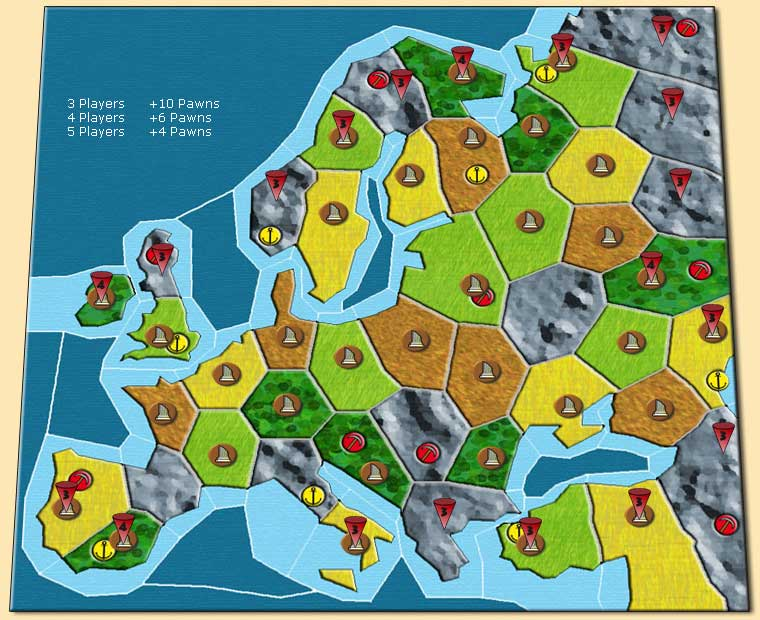
The starting province can be a land province that touches any edge of the board, or a land province
that can be reached from the edge of the board by crossing only one sea (dark blue) region. Thus, a
player can start in Scotland or Ireland, but not in France or Northern Italy. The sea regions (dark
blue) are never occupied. They can be crossed in order to start a new civilization, but are
otherwise impassable (exception: see the Astronomy civilization tile.)
On maps with controllable light-blue water provinces, an eligible border water province can also be the starting province.
The starting province must be conquered at its applicable cost, just like any later province
(see Expansion and the special conquest abilities).
2. Expanding the empire, heeding the rule of cohesion.
Expansion
Once the starting province is conquered, the civilization can expand into adjacent provinces, and
then keep expanding from the newly-conquered provinces. Any province that has been conquered
can immediately be used as a base for new expansion.
Note: Original map considered sea regions as part of the own provinces, but new maps made them independent regions.
Pawns are not moved around on the board. In order to take control of a new province, each player
uses pawns from his hand and adds them to the board in the new province (These pawns are either
the civilization’s starting pawns or the pawns just collected from the board.). The placed pawns
must remain in the province until reorganization, or until pawns are collected for Army’s second expansion.
Cost of a new Province:
To take control of a province, the player must use as many pawns as the province’s defense requires.
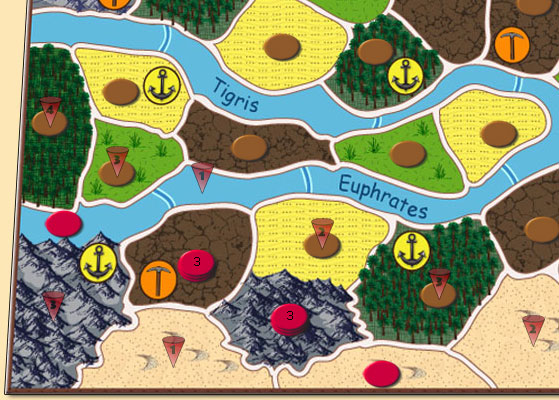
The Defense of the province is calculated as follows (defense can never be less than 1):
 Base Defense from Terrain
| Terrain | Base defense |
|---|
| Plains (yellow) | 2 |
|---|
| Meadow (green) | 2 |
|---|
| Normal (brown) | 2 |
|---|
| Forest (dark green) | 3 |
|---|
| Mountains (grey) | 3 |
|---|
| Deserts (light yellow) | 2 |
|---|
| Rivers (light blue) | 1 |
|---|
| Seas (dark blue) | Can’t be controlled |
|---|
+1 pawn for every neutral or enemy pawn currently residing in the province.
+1 if the province has a Fort (white disc).
-1 if the expanding player controls a mountain province adjacent to the target province.
Note: On some maps there are light blue regions that represent controllable seas. They have the same defence and rules as the rivers.
When an active civilization is conquered normally or through Espionage, it loses one pawn permanently
(exceptions: Nomadic and Drakkar). This
pawn is removed from the board and returned to the general stock. Neutral inhabitants also lose their pawn.
Any surviving active defenders are returned to other provinces controlled by their civilization
after the attacker’s reorganization and before scoring.
(Yucata implementation):
Surviving active defenders are distributed automatically, one at a time, to their least defended active
province after the attacker’s reorganization and before scoring. Ties are resolved by province number.
With Warband, surviving defenders remain off board until their own turn.
A conquered declining province loses all its pawns, including any retained through Philosophy;
it counts as one defeated pawn for Culture and, if it belongs to an opponent, one point for Slavery.
If a defending civilization loses all of its provinces, any surviving pawns are removed from the
board and may be used at the start of the player’s next turn to enter the board. These pawns enter
the board as if the player were starting a new civilization. However, no additional pawns are added
to this re-entering civilization.
Attacking civilizations never lose pawns.
Rule of Cohesion.
At the end of the expansion phase, a civilization must be connected; that is, the provinces
controlled by the civilization must be contiguous (it must be possible to travel between any two of
the civilization’s provinces by moving only through provinces of that civilization). This rule is only
applied at the end of a player’s turn. If a civilization is split by attacks from the other players, the
controlling player of the split empire gets a chance to reunite the civilization when it is once again
his turn.
If a player does not establish, or cannot reestablish cohesion by retaking some provinces, the player
may abandon some or all of the provinces when collecting pawns at the start of the turn. (The
player may collect those pawns and use them for expansion.)
If after expanding an empire, it is not cohesive, the owning player must reorganize his pawns in
such a way that cohesion is reestablished. Players must choose which portion of their non-cohesive
empire to abandon, remove the pawns from that portion, and place them back anywhere in a
cohesive portion.
The rule of cohesion does not apply to civilizations in decline, which may be broken up into several
parts.
3. Reorganizing pawns
Once a player finishes conquering, the player may freely redistribute all of the pawns of the active
civilization among the provinces controlled by that civilization. This is done to defend certain
provinces.
All of the pawns of a civilization must be placed on the board, including any leftovers which were
not used for expansion (there are often only one or two pawns left, because expansions cost dearly.)
The player must leave at least one pawn in each province.
4. Counting Victory Points
At the end of the turn, the player scores one point for each province controlled by his civilizations
(including his declining civilization, if any). Mountain, desert and river provinces, however, score 0 points. The
scoring marker is advanced around the outside of the board to indicate the new score.
Note: Some civilization tiles modify the points scored by a civilization.
Declining Turn
At the beginning of any turn, a player may abandon his current empire and declare it to be in
decline.
1. On Yucata, both civilization tiles stay with the declining civilization, including tiles without a decline effect.
They return to the bag only when this player next declares a civilization in decline.
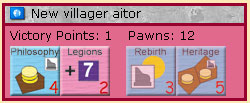
(Yucata implementation):
Only Agriculture, Livestock Breeding, Mining and Port Building with a broken-column symbol
continue to give scoring bonuses. Fortification keeps its forts, and Philosophy keeps the population pawns.
2. A player may not have more than one civilization in decline. Any remaining pawns from an
earlier declining civilization owned by the player are removed from the board (along with the
decline counters.) and returned to the player’s stock.
3. The player removes all but one pawn from each of the newly declining empire’s provinces and
adds a ‘Decline’ counter to mark the age of decline for that civilization. With Philosophy, all pawns remain instead.
4. The player scores points. The decline bonuses described above still apply; other active scoring bonuses no longer apply.
5. As on the first turn, the player then chooses a new civilization. This new civilization will be
added to the board on the player’s next turn, following the rules for starting a new civilization.
During a declining turn, there is no expansion.
A civilization in decline can have remnants on the board for several turns if it is not absorbed by
another empire. Each player scores points for the provinces of two civilizations - his active
empire, and his declining one (if any).
Note: These two civilizations are treated separately; civilization tiles of the active civilization do
not benefit the declining one, and vice versa. The active civilization and the declining civilization
of the same player may not come in contact. A player may conquer a province adjacent to his
declining empire, but the adjacent provinces of the declining empire must be immediately cleared
(the pawns removed from the board and returned to the player’s stock). THIS IS ONLY APPLIED TO NON-RIVER PROVINCES. You can be adjacent to your declined provinces as long as any of the provinces (active or decline) is a river.
Note: This does make it easier for the active empire to claim the old territory, as the province will
then be empty.
Special Case: It is possible that an active civilization can lose all of its pawns through enemy
attacks. The empire can be preserved (perhaps to keep an existing declining empire intact) or
declared in decline. It still takes, as usual, a complete turn to put the empire in decline. If
placed in decline, the previous declining empire is still removed from the board - even though
the new declining empire has no provinces. For one turn, the player will be completely off the
board.
End of the Game
The game ends when the game reaches a fixed number of rounds:
| Players | Rounds |
|---|
| 2 | 13 |
|---|
| 3 | 12 |
|---|
| 4 | 11 |
|---|
| 5 | 10 |
|---|
The player with the most points wins the game. If you finish on equal points, it is a tie.
There are no tiebreakers.
Civilization Tiles.
These tiles represent the abilities of each civilization. Playing to the strengths of your population is
one of the keys to victory. All of the modifiers on these tiles are cumulative.
Ground rule: civilization tiles supersede the normal rules.
If they are marked with the symbol of a broken column, the Agriculture, Livestock Breeding,
Mining and Port Building tiles remain active during an empire’s decline.
Agriculture. Plain provinces (yellow) earn +1 victory point. Agriculture comes in two
varieties, one with, and one without the symbol of the broken column.
Livestock Breeding. Meadow land provinces (light green) earn +1 victory point. Livestock
Breeding comes in two varieties, one with, and one without the symbol of the broken column.
Mining. Mining provinces (with a pickaxe) earn +2 victory points. Mining comes in two varieties,
one with, and one without the symbol of the broken column.
Port Building. Port provinces (with an anchor) earn +1 victory point. Port Building comes in two
varieties, one with and one without the symbol of the broken column.
Currency. Each province in the empire earns +1 victory point (including the mountains and deserts, but no rivers).
Slavery. Each enemy or neutral pawn eliminated from a province (except Fortification pawns)
earns +1 victory point. Only pawns that are removed from the board, and returned to the player’s
(or the neutral) stock pile are counted, not those that are relocated. This modifier applies to enemy
pawns from civilizations in decline as well.
Espionage. Once per turn, a province can be conquered at the cost of two pawns, regardless of
how heavily it is defended. All other modifiers are ignored (including province type, other
civilization tiles, etc.). Legions may pay part of these two pawns, but at least one normal pawn is required.
This ability may only be used once per turn, including both expansions with Army. Reachability and peace still apply.
Legions. The civilization receives seven temporary extra pawns for conquests at the start of its turn.
Each normal conquest or Espionage conquest requires at least one normal population pawn. Used Legions are removed immediately and cannot be reused that turn;
unused Legions expire before reorganization.
Fortification. Place a fort token (white disc) on each non-river province. Fort tokens give +1 defense and remain in decline.
Militia. Place a fort token (white disc) on each non-river province. Fort tokens give +1 defense and are removed when the civilization goes into decline.
Mountaineering. Conquering a mountain province (gray) costs one pawn less. These provinces
also earn +1 victory point.
Galleys. Expanding into a province next to a river or a sea costs one pawn less.
Weapons. Each expansion into a new province costs one pawn less.
Astronomy. Expansion may take place across one or more sea (dark blue) regions. Example:
Ireland to Norway, then to Southern Italy. Two provinces of an empire with Astronomy are
considered adjacent (for the rule of cohesion) if they are connected by one or more sea regions.
Note: Light blue sections of coastal
provinces are not considered sea; these may be crossed by anyone.
Barbarians. No special abilities, but there are a lot of them.
Diplomacy. At the start of a turn, this player may choose one opponent with whom they are at
peace. Neither player may attack the other until the start of the Diplomacy player’s next turn. This
applies only to active empires; declining empires may still be attacked normally. The opponent
with whom you are at peace may be changed each turn, or you may choose no player if you wish.
You may also choose to be at peace with a player who is not currently on the board.
On Yucata, explicitly choose an opponent or continue without peace before conquering.
Heritage. The active empire (with Heritage) may expand into provinces adjacent to the player’s
own declining empire without removing pawns from the declining empire. If the player wishes,
he may expand into his own declining empire’s province following the normal rules of
conquest. Conquering your own declining provinces is also allowed without Heritage;
Heritage prevents the automatic clearing of adjacent declining provinces.
Medicine. The civilization receives an extra pawn at the start of the reorganization phase, including on its first turn.
Messengers. This civilization can ignore the rule of cohesion. Conquests still follow the normal expansion rules.
Rebirth. The decline for this civilization is declared at the end of a normal game turn, after
counting victory points (instead of at the beginning of the next). However, the victory points are
counted only once. The player therefore does not spend an entire turn choosing his next
civilization.
Revolutionaries. This civilization may start in any province, not just on the edge of the board.
This starting province must be conquered normally. Bonuses from the civilization’s second tile,
such as Mountaineering or Galleys, are still applied where appropriate.
Nomadic. An active civilization loses no pawn when conquered normally or through Espionage;
all defenders survive. This protection ends in decline and does not prevent conversion through Religion.
Culture. At the start of reorganization, gain one pawn for every two population pawns defeated this turn (rounded down). Neutral pawns and conquests of your own declining civilization also count. Each conquered declining province counts as one defeated pawn, even if Philosophy left several pawns there. Conversions and surviving defenders do not count.
Religion. Conquer a province for 0 pawns and place a new pawn of your color in it from the stock.
The province must be within conquest range and contain exactly one population pawn of an opponent’s active civilization.
Forts do not prevent conversion. Use this ability once per own turn against each opponent, including both expansions with Army.
Drakkar. Conquering a river province costs one pawn less. An active civilization loses no pawn
when conquered normally or through Espionage in a river province. This protection ends in decline and does not prevent conversion through Religion.
Philosophy. Keep all pawns on the board when going into decline (may reorganize before going into decline).
Fishing. Each active province next to a river or sea earns an extra 0.5 victory points.
Add the bonuses for all eligible provinces, then round down the total; do not round each province separately.
Army. The player may take a second expansion phase, collecting all but one pawn from each active province again.
Reorganization, Medicine, Culture and scoring occur only once, after expansion is complete.
Warband. The player leaves only one pawn in each province during reorganization, the other pawns are off board until next turn.
Cavalry. Each expansion into new plain, meadow and normal provinces costs one pawn less.
Camels. Each expansion into new Desert provinces costs one pawn less. Get 1 Victory Point for each desert province.
Additional notes
Army: You are only able to pick up tokens leaving a province empty at the start of the first expansion.
So you can't expand into/from a province in the first expansion and then empty it at the start of
the second expansion.
+

Army + Legions: The 7 extra armies are only available once, not for each expansion.

+

Religion + Culture: When this player converts a pawn using religion, it does not count towards the culture bonus.
+

Religion + Slavery: When this player converts a pawn using religion, they do not earn the victory point from slavery.
v

Religion v Diplomacy: A player with religion is able to convert the pawn of a player with Diplomacy who has
declared them to be at peace.
v

Religion v Nomadic: The religion attack converts the pawn, so the nomadic player does lose a pawn.
v
Culture v Nomadic: When the culture player attacks the nomadic player, no pawn is removed so the culture
player does not get any culture bonus.
v
Slavery v Nomadic: When the slavery player attacks the nomadic player, no pawn is removed so the
slavery player does not earn the victory point from slavery.