
TARGI
A tactical desert duel for 2 players by Andreas Steiger
Game Idea and Objective
Unlike in other cultures, the men of the desert Tuareg people, known as Targi, veil their faces. The women, called Targia, do not wear veils. They own the household and have the final say in the tents. The various families are divided into tribes, headed by the Imascheren (nobles).
As leaders of a Tuareg tribe, players trade goods from near (such as dates and salt) and far (such as pepper) to obtain gold and privileges and to expand their tribe. Every round brings new offers. Goods cards are a means to an end to acquire the coveted tribe cards. These provide advantages during the game and valuable victory points in the form of silver crosses at the end.
Objective of the Game: Whoever has collected the most victory points at the end of the game wins!
Components
80 game cards in total:
45 Tribe Cards (desert sand front & Tuareg motifs)
16 Border Cards (border spaces 1–16)
6 Targi Figures
3 figures each in blue and white/grey
4 Tribal Markers
2 cylinders each for intersections
1 Robber Figure
Moves around the border
Goods Tokens
Dates, Salt & Pepper
Gold Tokens
Valuable currency
Silver Crosses
Victory Points (1, 3, 5)
Start Player Token
Traditional amulet
Game Setup
The 16 border cards (border spaces) form the fixed edge of the game board and are laid out in a square as shown in the illustration below. The numbers from 1–16 in the top left corner serve as orientation. The border spaces remain unchanged throughout the entire game.
Note: On the front sides, the functions of the border spaces are explained using symbols. On the back sides (underlined card names), the functions are described in text form.
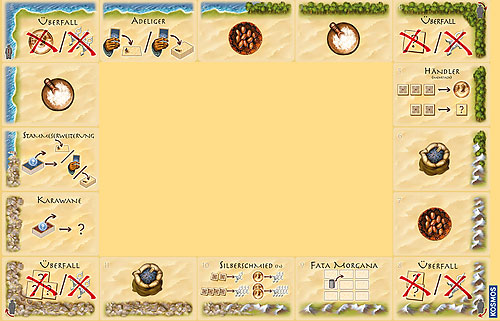
The fixed frame of 16 border cards arranged clockwise (1 to 16).
The goods cards and tribe cards are shuffled separately. In the 3×3 center grid, 9 randomly drawn cards are laid out alternatingly: 5 goods cards and 4 tribe cards.
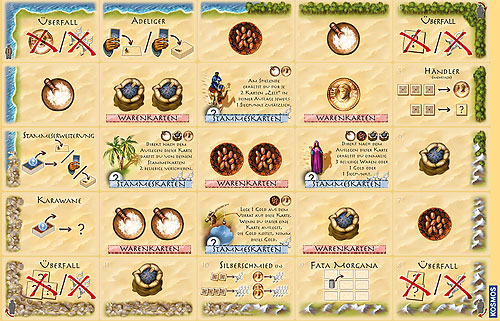
The completed game board: 16 border cards and the 3×3 center grid.
Note for playing online on Yucata:
To save space, the draw decks are not placed next to the board. By clicking on the deck icon

, you can check at any time how many cards remain in the draw deck.
Starting Equipment of the Players:
• Each player receives 3 Targi figures and 2 tribal markers in their color.
• Starting resources per player: 2 Dates, 2 Salt, 2 Pepper, 1 Gold as well as 4 Victory Points.
• The Robber starts on space 1 (“Noble”).
• The starting player receives the amulet as the start player token.
Gameplay
Each game round consists of 5 consecutive phases:
1
Advance the Robber 1 space
At the beginning of each round, the Robber moves one space clockwise (in Round 1, he starts on space 1 “Noble”).
No figure may be placed on the space occupied by the Robber. Whenever the Robber reaches a corner space (4, 8, 12, 16), a Raid takes place immediately (see details below).
2
Take turns placing Targi figures
Starting with the start player, players take turns placing 1 Targi figure at a time onto an unoccupied border space until all 6 figures have been placed.
Placement Restrictions:
- Not on the space occupied by the Robber.
- Not on the four corner spaces “Raid” (spaces 4, 8, 12, 16).
- Not on a space that already has one of your own or your opponent's Targi figures.
- Not on a space directly opposite an opponent's Targi figure!
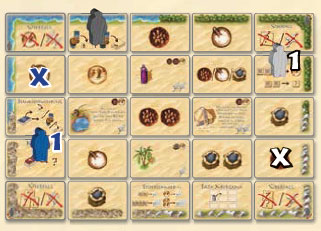
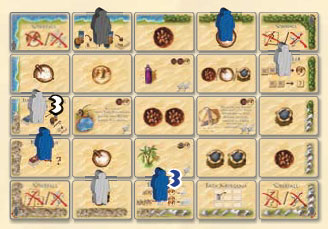
Example of placing Targi figures:
Blue places figure (1). White may then neither place on the same space nor on the opposite space marked with the white X.
Blue places figure (2). White places figure (2) opposite the Robber (this is allowed; only the Robber's space itself is blocked):
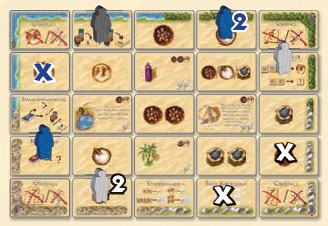
Finally, both players have placed all three of their Targi figures:
3
Place tribal markers on intersections
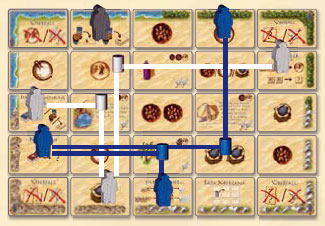
Now each player determines the intersections of their own Targi figures. If you imagine a straight line extending across the 3×3 center grid from each of your figures, you place a tribal marker wherever two of your own lines cross.
Special Case: If a player has placed two of their own Targi figures on opposite border spaces, there is only 1 intersection; that player may then place only 1 tribal marker.
Determining Intersections: The intersections of your own lines of sight determine the claimed cards in the center grid.
4
Execute actions
First, the start player executes all of their actions in any order they choose, followed by the opponent:
- Use a border space: Take back your Targi figure and carry out the action of the border space. The border card remains where it is.
- Use a center card: Take back your tribal marker and take/resolve the card:
- Goods card: Take the depicted goods/gold/victory points. The goods card is placed on the discard pile and is replaced face-down by a new tribe card.
- Tribe card: Pay its cost and immediately place it face-up into your 3×4 display (or take it into your hand as your 1 allowed hand card). The card is replaced face-down by a new goods card.
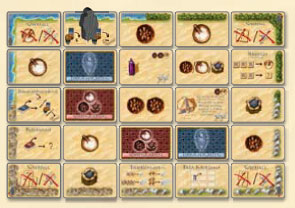
Replacing cards in the center grid: Used cards are immediately replaced face-down by a card of the other type.
5
Reveal new cards & end of round
After both players have completed all of their actions, all face-down cards placed in the center grid are flipped face-up. The start player amulet passes to the other player, and the next round begins by advancing the Robber.
Detailed Rules

Tribe Cards & Display
At the top right of each tribe card, you find its cost in goods and/or gold. At the bottom right are the guaranteed victory points (1–3 silver crosses). Many cards grant immediate one-time effects or ongoing benefits during the game.
Each player builds a personal display with their tribe cards consisting of 3 rows of at most 4 cards each. In every row, cards are always placed from left to right. You may build on multiple rows simultaneously.
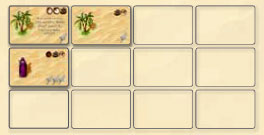
Your personal tribe display: Up to 3 rows of 4 cards each.
The 5 Tribe Card Symbols
Every tribe card bears one of five symbols. Complete rows of 4 cards award valuable bonus points during final scoring:

Well
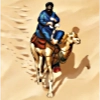
Camel Rider

Oasis

Targia
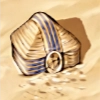
Tent
Bonuses for complete 4-card rows:
• 4 identical symbols in a row = +4 Victory Points
• 4 different symbols in a row = +2 Victory Points

Raids
When the Robber reaches a corner space (4, 8, 12, 16), both players must pay the required tribute (starting with the start player):
- Space 4: Surrender 1 Good OR 1 Victory Point.
- Space 8: Surrender 2 Goods OR 1 Victory Point.
- Space 12: Surrender 3 Goods OR 2 Victory Points.
- Space 16: Surrender 1 Gold OR 3 Victory Points (immediately triggers the end of the game).
Afterward, the Robber immediately moves on to the next border space (except on space 16) and the round continues as normal.
Goods and Gold Limit at the End of a Round
At the end of a round, a player may carry over at most 10 Goods and at most 3 Gold into the next round. Any excess resources must be returned to the supply (player's choice). During a round, this limit may be temporarily exceeded.
End of the Game and Scoring
The game ends after the round in which:
- at least one player has placed their 12th tribe card (full 3×4 grid), OR
- the Robber reaches the fourth Raid space (space 16).
Final Scoring:
1. Victory points from all collected silver crosses (tokens).
2. Victory points printed on the tribe cards in your display.
3. Bonus points from the effects of certain tribe cards.
4. Bonuses for complete rows (4 points for 4 identical symbols, 2 points for 4 different symbols).
Tie-Breaker: In case of a tie, the player with the most remaining Gold wins; if still tied, the total number of remaining Goods decides.
Meaning of the Border Cards

Space 1: Noble
You may place your hand card into your display by paying its cost. Alternatively, you may discard your hand card for free.

Space 5: Merchant
Trade 3 identical goods for 1 gold OR 2 identical goods for 1 other good of your choice. You may repeat trades as often as you like.

Space 9: Fata Morgana
Move one of your tribal markers from a card in the center grid to another unoccupied card in the center grid and use that card instead.

Space 10: Silversmith
Exchange goods or gold for victory points: 2 identical goods = 1 VP, 4 identical goods = 3 VP. 1 gold = 2 VP, 2 gold = 4 VP.

Space 13: Caravan
Reveal the top goods card from the draw deck and immediately take the depicted reward (1–2 goods, 1 gold, or 1 victory point).

Space 14: Tribal Expansion
Reveal the top tribe card from the draw deck. You may immediately play it by paying its cost, take it into your hand (if your hand is empty), or discard it.

Spaces 4, 8, 12, 16: Raid
No Targi figures may be placed on these corner spaces. Whenever the Robber reaches one of these spaces, both players must pay the required tribute.
Frequently Asked Questions (FAQ)
1.1
Are border cards considered goods cards?
No. Border cards are not goods cards. Whenever a tribe card refers to a goods card, it only means the cards laid out in the center grid (which say “Goods” on their back) as well as the goods cards drawn via the Caravan border card.
1.2
Is Gold considered a Good?
No. Gold is not a good (it is a precious metal / separate currency). Effects that refer to goods therefore do not apply to gold.
1.3
How many extra goods do I get from tribe cards with the text “In each round where you gain at least 1 Salt from a goods card, gain 1 additional Salt” (and analogously for Dates or Pepper)?
This means you receive only one additional good per round. The good is not doubled; instead, you receive a total of one extra piece. For example, if you gain two Salt from two goods cards in a round, this tribe card gives you a total of three Salt, not four.
1.4
Which space does the Robber start on at the beginning of the game?
At the start of the game, the Robber is placed on space 1 (Noble). As a result, the Noble is blocked for both players in the first round.
1.5
What can I do with a claimed tribe card in the center grid?
When you have marked a tribe card in the center grid with an intersection marker, you have four options:
- A (Play): Pay the required cost (goods and/or gold) and immediately place the card into your display.
- B (Take into hand): Take the card into your hand for free, provided you do not currently hold a hand card (hand limit: 1).
- C (Discard): Discard the card unused to the tribe card discard pile.
- D (Leave on board / forfeit action): If you cannot or do not wish to pay for the card, take it into your hand, or discard it, you may leave it unused. The action is forfeited and the card remains face-up in the center grid.
1.6
Can I use Card 40 to trade for Gold at a 1:1 ratio at the Merchant?
No. Tribe Card 40 allows you to trade goods at a 1:1 ratio instead of 2:1 at the Merchant. Since Gold is not a good (see 1.2), this discount applies exclusively to trading one good for another good.
1.7
How does the combination of Card 30 (pay nothing during a raid) and Card 32 (+1 VP after paying a raid tribute) work?
If you use Card 30 to pay nothing during a raid, you do not receive an additional victory point from Card 32. The bonus from Card 32 only triggers if you actually surrender goods, gold, or victory points to the robbers.
1.8
How does Tribe Card 44 (relocating cards in your tribe display) work?
With Card 44, immediately after placing it, you may move or swap up to 2 tribe cards within your display. You can move two cards one after the other to new positions (including empty spaces). Importantly, at the end of the move, there may be no gaps within the rows of your display (cards must always be placed continuously from left to right in the up to 3 rows of 4 cards).
1.9
When is the goods card discard pile reshuffled?
As soon as the goods card draw deck is exhausted and a new card needs to be drawn (whether to refill the center grid or via the Caravan), the discard pile is immediately shuffled thoroughly to form a new draw deck.
1.10
How does Tribe Card 41 (placing 1 Gold on the card) work?
The gold placed on Card 41 does not count toward your personal goods/gold storage limit at the end of a round. It is earmarked: you may use this gold exclusively to pay the building cost of future tribe cards (not for the Silversmith or during raids).
1.11
How does Tribe Card 39 (playing a hand card without the Noble by paying +1 Good) work?
With Card 39, once per round during your turn, you can play a hand card directly into your display without having to activate the Noble border card. The building cost of the card increases by one good of your choice in addition to its printed cost.
1.12
What happens during Raid 16 if a player can pay neither 3 Victory Points nor 1 Gold?
If a player cannot pay the required tribute of 3 victory points or 1 gold in full (e.g., because they have 0 gold and fewer than 3 victory points), they lose all of their remaining victory points. In this case, their opponent is awarded 3 victory points.