The game is played in nine rounds. Each round consists of three phases:

 Draw new bonus tile
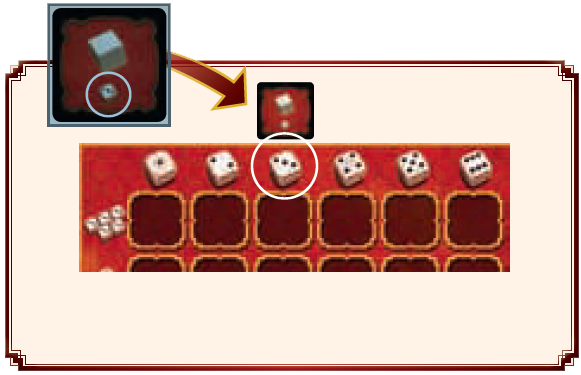 Each round starts with drawing the top bonus tile and
placing it face up above the column showing the same
dice as on the tile.
Each round starts with drawing the top bonus tile and
placing it face up above the column showing the same
dice as on the tile.
Bonus tiles not taken during the “score
points” phase in the previous round
remain above the corresponding column.
It is possible, that there are
multiple bonus tiles above the
same column.
 Player Turns
Starting with the start player each player takes one turn.
A turn consists of the following steps:
Play Card
First the player plays one card from his hand face up in front of him.
This card shows the number of victory points a player will score this round.
When a player has played the last card from his hand,
he takes another of his face down decks in his hands, if available.
Roll dice
Then the player rolls the dice in order to roll the best Pasch in
this round. A player can roll the dice three times. After each
roll he may set one or more dice aside and roll the other ones.
Set aside dice can be re-rolled in another dice roll.
On yucata the roll of the dice is
performed by selecting the blue dice icon
Action cubes: Players can discard action cubes to alter the result of their dice:
a. Re-roll: discard one action cube to re-roll any dice.
On Yucata this is performed by selecting the red dice icon.
b. Change value: discard action cube to raise or
lower the value of one die.
On Yucata this is performed by selecting the plus / minus signs.
Example:
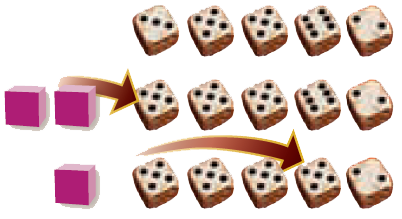 The result after Tom’s third roll is 3-5-5-6-2.
He discards three action cubes to raise the three to a 5 and
to lower the 6 to a 5, changing the result of his turn to a
“four of a kind with fives”.
The result after Tom’s third roll is 3-5-5-6-2.
He discards three action cubes to raise the three to a 5 and
to lower the 6 to a 5, changing the result of his turn to a
“four of a kind with fives”.
Important: A player can’t change a 6 in a 1 and vice
versa by using only one action cube.
Place Disc
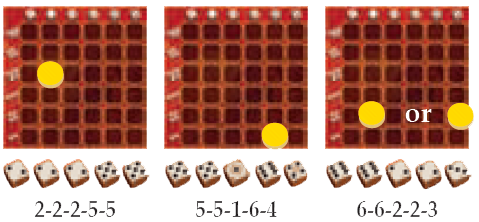
After his third dice roll, the player must place his disc on
the game board to mark his dice result. The disc is placed at
the intersection of the row showing the rolled combination
(e.g. a triple) and the column showing the dice creating this
combination (e.g. 6-6-6). In case of two doubles, place the
disc in any of both columns showing the dice creating this
combination. In case of one double + one triple, place this
disc in the column showing the triple in this combination.
If a space is occupied, the disc is placed on top of the disc
already present. If a player didn’t roll a valid Pasch, he places
his disc next to the game board. If another player also failed
to roll a valid Pasch this round, his disc is placed on top of the
disc(s) next to the game board.
Example of rolling dice:
Nicky rolls 2-3-4-4-5. She
decides to set aside both fours and re-rolls the other dice.
This time she rolls 2-6-6. The two sixes are set aside and
she re-rolls both fours again with the other die left. With
these three dice she rolls: 4-5-6. Her dice result after her
third roll is: 4-5-6-6-6. She has made a “three of a kind
with sixes” and places her disc on the corresponding
space on the game board.
Examples of marking results:
 Score points
After all players have taken their turn, the victory
point cards played this round are given to the players.
The player with the lowest Pasch takes all -1 VP cards, if
available. The player with the best Pasch takes the card with
the most VP. The player with the second best Pasch takes the
card with the second most VP, and so on until all played cards
are distributed. These cards are placed in the VP pile in front
of each player. Place your second disc on top of your VP pile,
so you don’t take these cards in your hand by mistake.
The value of a Pasch is determined by its position on the
board: a disc placed in a higher row beats a disc in a lower
row. If there are discs in the same row, the disc placed in a
more right position beats a disc in a more left position. In case
of a tie the top disc wins.
The player with the best Pasch in the column with a bonus
tile also gets the bonus tile. If nobody gets the bonus tile, it
remains in place and can be taken in another round. If there
are two bonus tiles in one column, a player can win both tiles.
After all victory point cards are distributed, the discs are
removed from the board and a new round starts.
The player with the best pasch will be the new start player.
Other player follow in clockwise order.
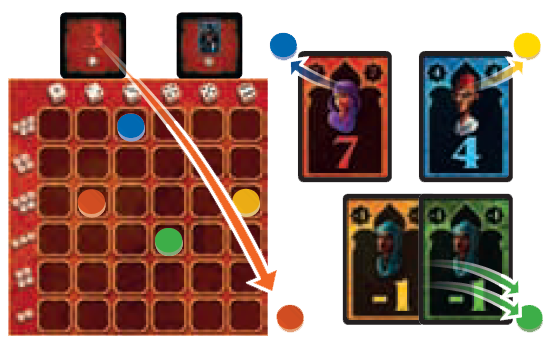
Example:
Green’s disc is on the lowest position. He gets both
-1 VP cards. Blue has the best Pasch and gets Orange’s card
worth 7 VP. Yellow has the second best result and takes the
Blue’s card. Now there aren’t any cards left for Orange, but
since his disc is in the highest position of the second column
he gets the bonus tile above this column. This tile will score
3 VP at the end of the game.