
In P’achakuna, you act as traders who transport natural dyes ("resources")
through the ever-changing Andes with their most loyal companion - their llama.
The player with the white llamas only moves through the green valleys,
while the player with the black llamas can only climb over the barren mountains.
By rotating the double layered hexagons, both players build their very own paths.
As a trader, you only make profit by delivering resources to the villages with high demand.
With spare resources, you can buy more llamas or additional turns for rotating tiles.
The player that gathers all 7 resources first, wins the game.
|
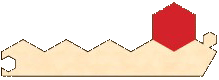
6 Frame pieces
A village in every corner
|
|
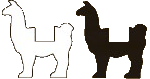
6 Llamas
3 per player, 2 colors
|
|
|
54 Terrain tiles
24 neutral tiles, 15 mostly flat tiles and 15 mostly mountainous tiles
|

|
42 Demands
Two-tone, kept in an opaque
Cloth bag
|

|
|
1 White village
For the center of the board
|

|
3 Wooden rocks*
For marking rotated Terrain tiles
|

|
|
57 Resources*
8 pieces per color, 7 colors,
1 brown piece
|

|
1 Assembly plan
For setting up the modular board
|

|
* The supply of Resources and Rocks is unlimited, so if it runs out during
the game, just take something else to represent the missing component.
In P‘achakuna, you act as a trader and transport bags filled with natural dyes and white wool through the Andes
together with your llama. If you deliver these resources to a village with a high demand, you are allowed to keep
a small amount of the dyed yarn. The player that gathers all 7 yarns first creates their own colorful,
traditional costume and therefore wins the game.
Board
|
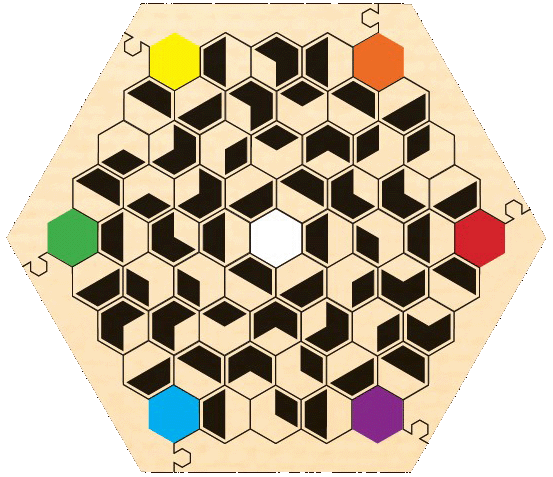
The board is set up in the middle of the table. The frame is assembled from the 6 Frame pieces.
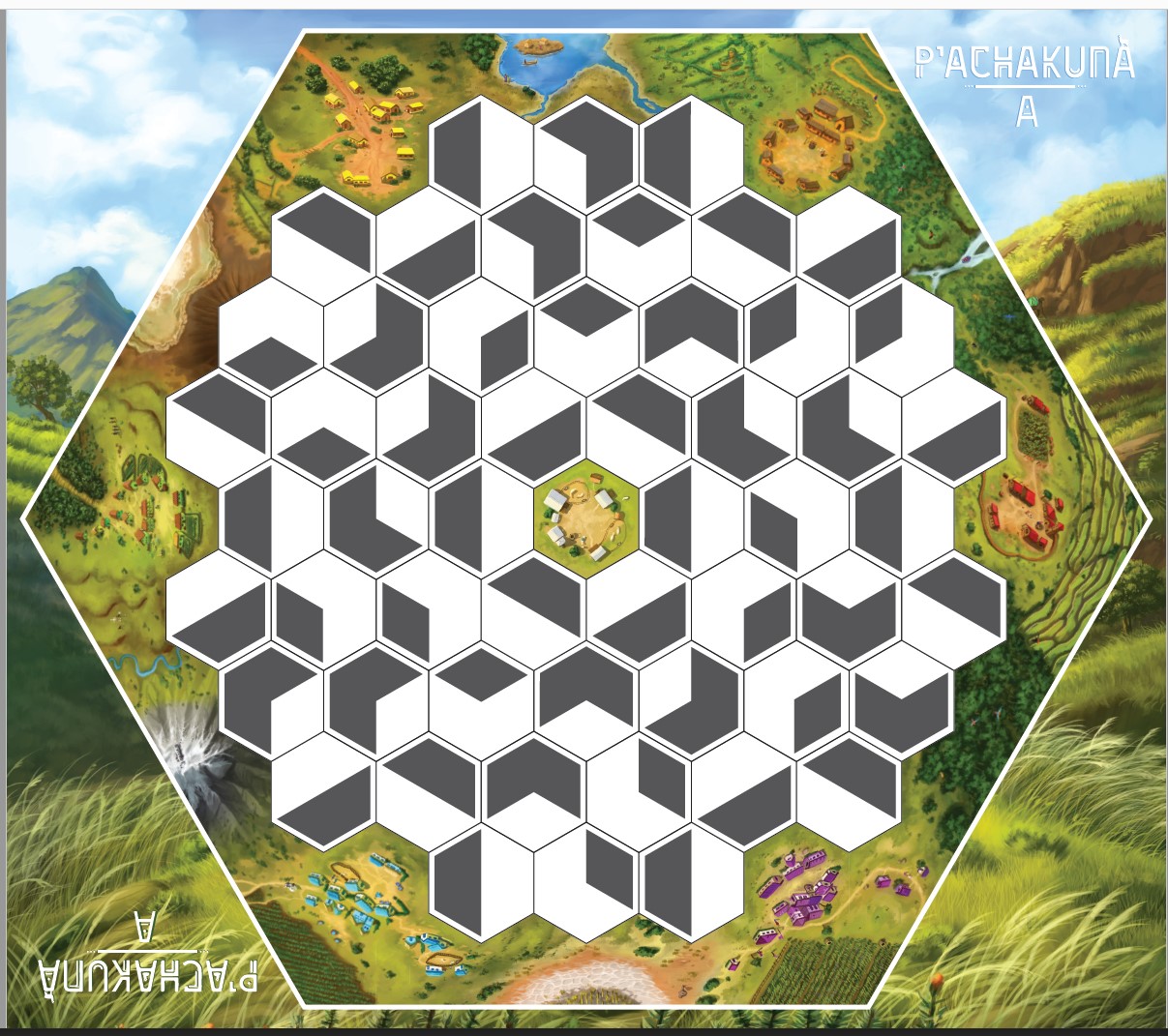
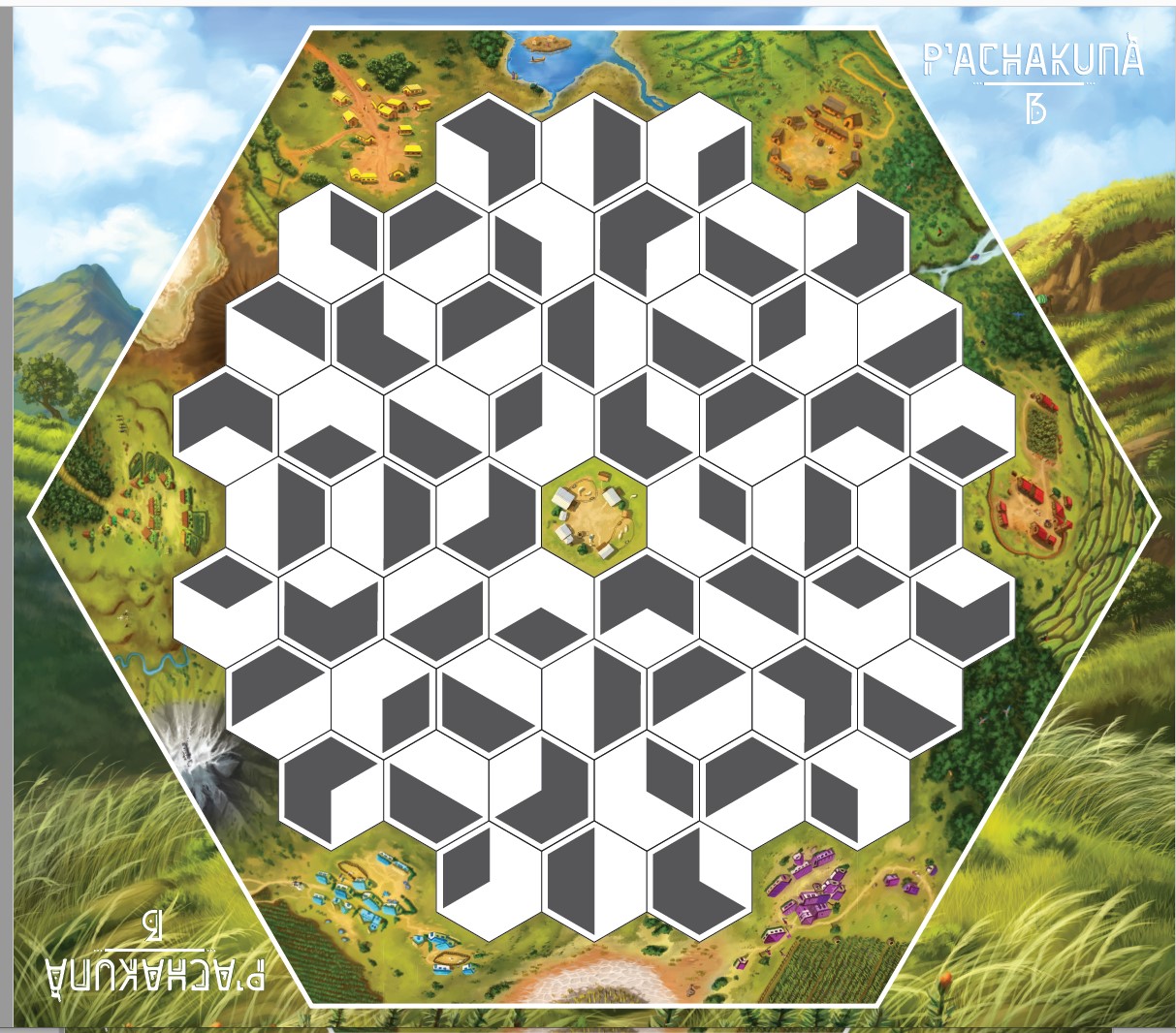
The Terrain tiles are assembled according to the Assembly plan (Variant A or B).
The Assembly plan can be used directly as a base on which the individual Terrain tiles can be placed.
For each village, a Demand is drawn at random from the Cloth bag and put on the corresponding village.
Demands cannot be the same color as their village, i.e. a red village cannot have a red Demand.
If such a Demand is drawn, it is put back into the Cloth bag and a new Demand is drawn.
No white Demand may be on the board at the beginning of the game.
Next to the board, the Resources are arranged by color in stockpiles (= General supply).
|
|
Player
The players each decide on a color.
Each player receives one Llama of their color, which is placed on the central White village with a white Resource on its back.
The remaining Llamas are put aside.
The white Llama moves only through the valleys, while the black Llama moves only over the mountains.
White begins. Black gets the one brown Resource,
which like all Resources can be used to buy Llamas or additional rotations.
The players take turns. One turn consists of the following actions,
which take place one after the other:
1. Rotate
The player can rotate one Terrain tile at will (0-360°),
i.e. change its orientation. Further rotations with other Terrain tiles can be performed
by the player spending 2 Resources per additional rotation from their Personal supply.
Terrain tiles that are occupied by a Llama cannot be rotated.
After rotating, the player marks all Terrain tiles rotated in this turn with a Rock
and removes all other Rocks. Such rotated Terrain tiles marked with a Rock may not be rotated by the opponent
in their upcoming turn.
2. Moving
|
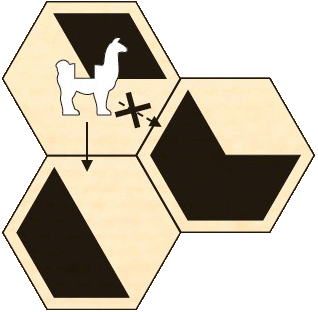
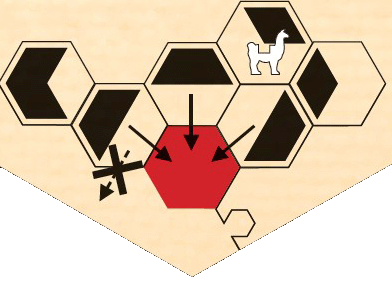
The players must move each of their Llamas at least one Terrain tile
– only when on villages may Llamas rest several turns. The Llamas may move to any Terrain tile or village
on the board that has an uninterrupted path from the starting point of the Llama (regardless of distance).
However, if a village is crossed on the way, the Llama must stay there
for the rest of the turn and may not move any further.
|
|
|
With the exception of the villages,
Llamas are not allowed to move on the Frame pieces.
Villages are accessible to both players and can be entered from 6 directions (central White village)
or from 3 directions (villages on the Frame pieces).
Several Llamas may be on one village or Terrain tile at the same time.
|
|
3. Trade
For every Llama that rests on a village after moving,
the player can trade, i.e. sell Resources, and buy Llamas.
Sell:
|
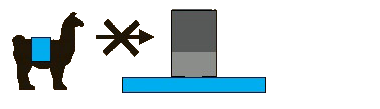
If a Llama is on a village
that does not have the same color as its Resource,
it may now sell the Resource
.
There are three different cases:
|
|
|
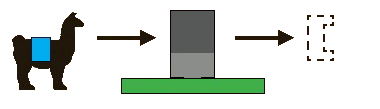
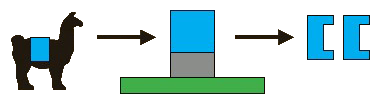
i. If a Llama has a Resource which is not shown on the Demand flag
of the village, it can sell it (i.e. the Resource goes back into the General supply),
but it receives nothing in return. The Demand flag of the village is then removed.
|
|
|
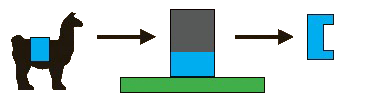
ii. If a Llama has a Resource which is shown on the lower/smaller Demand flag,
it can sell it. The traded Resource is added to the player‘s Personal supply.
The Demand flag of the village is then removed.
|
|
|
iii. If a Llama has a Resource that is shown on the upper/larger Demand flag,
it can sell it and adds 2 pieces of the traded Resource to the player’s Personal supply.
The Demand flag of the village is then removed.
|
|
Since the Demand of a village is removed after each sale, a player can only sell a Resource once per turn in a village.
Removed Demands are placed next to the board and do not return to the Cloth bag.
If, by trading, players receive a Resource that they do not yet have, they put it into one of the 7 cutouts in front of them.
Other Resources of the same color are placed in front of the players. Players’ Personal supplies consist
of both the Resources they have put into the cutouts and the Resources that are placed loosely in front of them.
Buy:
In exchange for 4 Resources from their Personal supply, a player can buy one Llama of their color.
The new Llama is placed on the village where it was bought. A player can own a maximum of 3 Llamas.
The Llamas are moved independently.
At Yucata.de the actions "Moving", "Sell" and "Buy" are carried out one after the other for each Llama (if applicable).
This means that after the first llama has moved and, if applicable, sold a resource or bought another llama,
the next llama can be selected and the actions "Moving", "Sell" and "Buy" can be carried out.
The actions must be performed in this order for each Llama. If an action is skipped,
it cannot be performed later with that Llama. For example, if the "Sell" action is selected
without having moved first, the llama cannot be moved afterwards.
4. Refill
At the end of the turn, missing Demands are renewed by random drawing
from the Cloth bag, always following the rule that a Demand must never be the same color as the corresponding village.
When the Cloth bag is empty or when there is no valid Demand left, all used Demands are added back into the bag.
In addition, the player equips all the Llamas that have previously sold their Resource
or were newly bought with a new Resource matching the color of the village.
The first player with at least one of each of the seven Resources (except for the brown one)
wins the game. Resources that are still being transported by Llamas are not counted.
Assembly plans:
|
Variant A
|
Variant B
|
Background:
In Quechua, the language of the Andes, the word ‘P‘achakuna’ means ‘textiles’.
The dyeing of llama and alpaca wool using natural resources has a long tradition
in Peru and Bolivia and is still practiced today. With the colored yarns,
the local people weave their unique costumes, which differ from region to region.
The people are proud of their origins and their colorful clothes decorated with woven
patterns and embroidery. The seven villages in P’achakuna each concentrate on one natural dye.
Wool from white llamas, sheep or alpacas serves as the starting point for each colored yarn
but is also used undyed. In Quechua white wool is called ‘Yuraq Millma’.
The colors black and brown, called ‘Yana’ and ‘Ch’unpi’, do not have to be created by
dyeing either, since they are also available as natural wool colors.
Yellow, called ‘Q’ello’, is produced from the ball-shaped
flowers of the ‘Qolle’ tree (Buddleja coriacea).
The color orange, ‘Killmu’, is produced from strips of the deeply orange bark of the
‘Yanali’ shrub (Bocconia frutescens).
Cochineals (Dactylopius coccus), small insects that live on opuntia (cacti),
are crushed to acquire an intense red (‘Puka’).
The color purple, called ‘Kulli’, originates from purple corn (Maíz Morado).
From the leaves of the indigo plant
(Indigofera tinctoria), a beautiful blue (‘Anqas’) is obtained.
The color green, called ‘Q’omer’,
is obtained from leaves of the ‘Ch’illka’ shrub (Baccharis latifolia).
This wide range of natural colors is impressive and showcases the creativity
of the local people and their close bonds with their natural environment.
And this list is far from comprehensive; each valley has its own dyes,
and the colors are also mixed to create new colors or darker and lighter tones.
An almost infinite number of color variations can be produced with this precious knowledge.
To sell a resource, click on the resource on the llama.
If a sale is possible, the resource will be briefly animated.
To buy a llama, click on one of the llamas that is not yet
in the game. It will be marked
if it is possible to buy a llama.
|
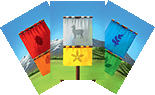
Demands that have already been drawn can be viewed
by clicking on this icon.
|
|
If a player receives one or more resources during a trade, the traded resource is automatically placed in the cutout,
provided that there is no resource of that colour there yet. If there is already a resource of that colour in the cutout,
the traded resources are automatically added to the hand.
When rotating additional Terrain tiles and buying additional Llamas,
the resources that must be spent are automatically removed from the hand,
provided the player has enough resources in their hand.
If a resource must be discarded from a cutout, the player can choose the resource.
|
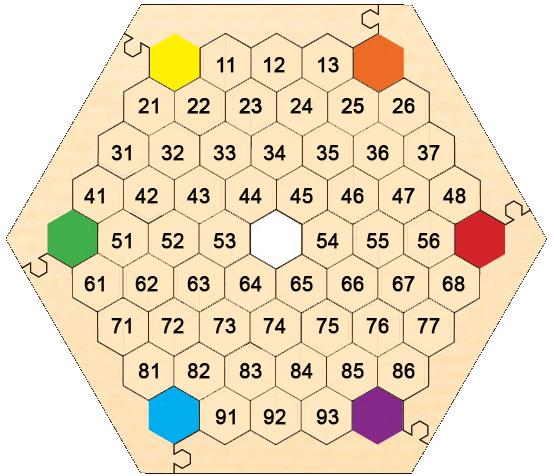
The Terrain tiles are numbered as follows: The first row contains the numbers 10,
the second row the numbers 20, and so on.
Within each row, the fields are numbered consecutively from left to right.
|
|