If you are reading these rules for the first time, ignore the text along the right hand side. These rules serve as a summary to help you quickly familiarize yourself with the game.
Show
→ summary only
→ detailed version only
→ both summary and detailed version

Glory Islands
The year is 1660. On the island of Tortuga, a haven for Caribbean rogues, the pirates from the
ships in port are boasting about their skills. It seems that no one can agree on which ship is the
fastest, which crew is the most skilled, and which captain is the most feared.
As the quarrel gets louder and louder, one pirate finally makes himself heard above the rest: “I propose a contest! The captain and
crew who win shall be proclaimed the best pirate ship in the Caribbean!”
Before long, the crews are ready, the wind is right, and the sails are unfurled. The contest starts with the legendary shout,
“To the Glory Islands!”
Glory Islands is played over a series of rounds in which
players simultaneously play sailing cards from their hands. The card
values define the turn order, how far ships can move on the board,
and where a player’s pirates may be placed on the board. Depending on
where they are placed, pirates may receive glory, treasure tokens, or
barrels. The cards may also provide bonus actions that players can
use to gain an advantage over their opponents. When pirates occupy
all of the spaces on an island, the player with the most pirates on
that island will gain the most glory.
The game is over when one or more pirate ships have completed
the route around the islands. The player with the most glory is
crowned the “King of the Pirates”!
-
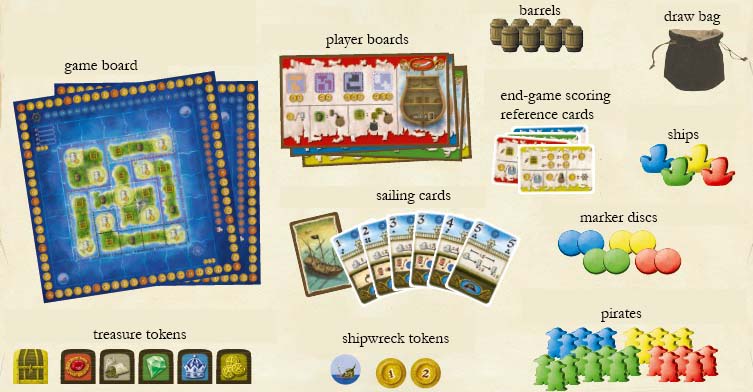
1 game board (double-sided)
-
4 player boards
-
8 barrels
-
1 draw bag
-
24 sailing cards (6 per player color)
-
4 end-game scoring reference cards (1 in each player color)
-
4 ships (1 per player color)
-
8 marker discs (2 per player color)
-
35 treasure tokens (7 each of ruby jewelry, spices, emeralds, sapphire crowns, and gold doubloons)
-
10 shipwreck tokens (used for mini-expansion)
-
23 pirates (5 per player color, with 3 additional green pirates for two-player games)
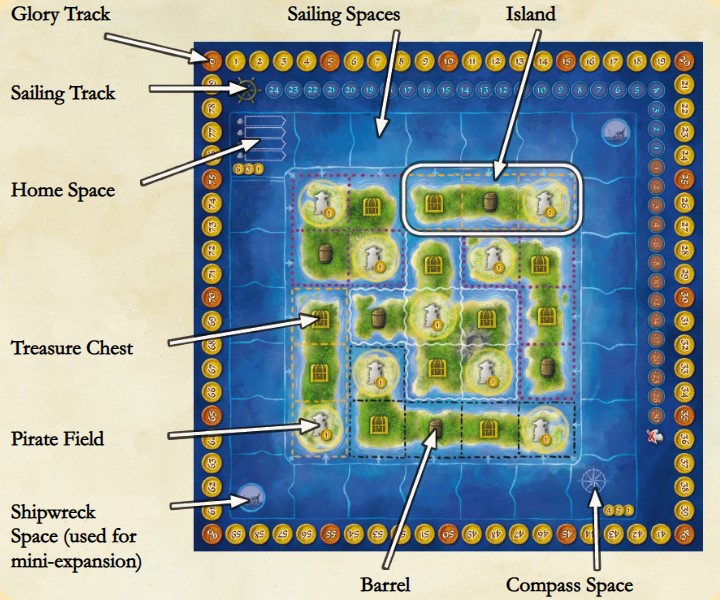
The Sailing Track:
Players use the sailing track to indicate the number of sailing
points they spend as they move their ships around the islands. The
number of sailing points used is shown on the sailing card played on
each turn. Each player will gain or lose points equal to the value
shown on the space where their marker is at the end of the game.
On yucata is the sailing track on the left side of the board.
Instead of on the glory track the achieved points are shown in the player area.
For a two-player game, please read “Two-Player Rules”
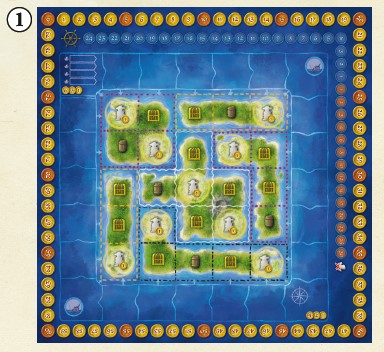 1Place the game board in the center of the playing area. For your first game, we recommend that you use the front side
of the game board. The back side of the board has a storm in the center space
instead of an island. (The rules for the back side of the board may be found on Special Rules for the Back Side of the Game Board.)
1Place the game board in the center of the playing area. For your first game, we recommend that you use the front side
of the game board. The back side of the board has a storm in the center space
instead of an island. (The rules for the back side of the board may be found on Special Rules for the Back Side of the Game Board.)
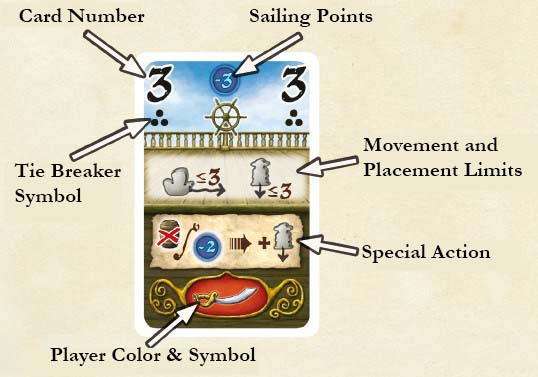
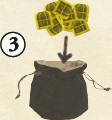
2Sort the 24 sailing cards by player color into 4 decks (the player color is indicated at the bottom of each sailing card).
Each deck should contain 6 cards with values 1, 2, 3, 3, 4, 5.
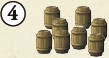
 3Place the 35 treasure tokens into the draw bag and mix them thoroughly.
(If playing with 2 or 3 players, only put 30 markers in the draw bag.
Put 1 of each type of treasure back in the box.)
3Place the 35 treasure tokens into the draw bag and mix them thoroughly.
(If playing with 2 or 3 players, only put 30 markers in the draw bag.
Put 1 of each type of treasure back in the box.)
 4Put the 8 barrels into a general supply.
5Provide each player with:
- 1 Player board
-
1 barrel and the following components of their chosen
color:
-
- 6 sailing cards
- 5 pirates
- 2 marker discs
- 1 ship
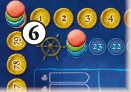 6Each player then places one of their marker discs on the “0” space of the (outer) glory track, where
players will track their score during the game, and one on the “24” space of the (inner) sailing track.
6Each player then places one of their marker discs on the “0” space of the (outer) glory track, where
players will track their score during the game, and one on the “24” space of the (inner) sailing track.
 7Each player places their ship on the “Home” space of the game board and forms a personal supply
with their 5 pirate figures. (There is no difference between the 4 home spaces.)
7Each player places their ship on the “Home” space of the game board and forms a personal supply
with their 5 pirate figures. (There is no difference between the 4 home spaces.)
The game is ready to begin!
-
Play Sailing Cards
Each player selects one card from their hand and places it
face-down on the table. The players then simultaneously reveal their
cards.
-
Spend Sailing Points
Each player moves their disc a number of spaces on the sailing track equal to the number of sailing points printed on the card.
-
Determine Turn Order
The player who played the highest-numbered card goes first, followed by the player who played the second-highest card, and so on.
If two or more players reveal a card with the same value, turn order among the tied players is determined by the tiebreaker symbols on the cards.
-
Resolve Actions
Each player will now resolve the following actions in turn order, as established in the previous step:
a. Move Ship
b. Place Pirates
c. Collect Reward
d. Activate a Special Action (optional)
e. Scoring Islands
-
End of Round
a. Swap Cards (if applicable)
b. Discard Cards
c. Return Cards to Hand (if applicable)
The game is played over a series of rounds until one or more
of the pirate ships have completed the route around the islands. A
ship has achieved this when it lands on or passes the Home space on
the game board.
Each round is completed by following these steps:
1. Play Sailing Cards
-
Each player selects one card from their hand and places it
face-down on the table. The players then simultaneously reveal their
cards. This card determines the turn order for this round, how far
their ship can move, and where they can place pirates on the
islands. Once the turn order has been established, players take
turns executing their actions.
2. Spend Sailing Points
-
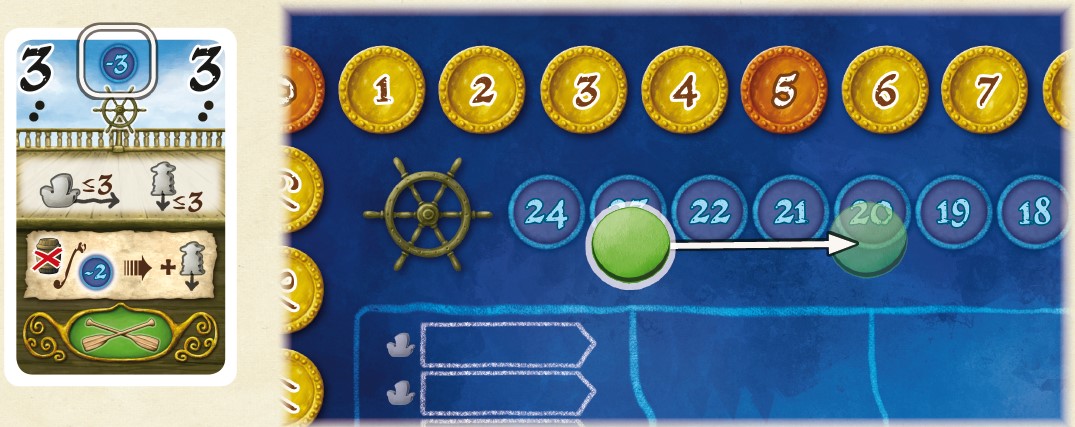 Each player moves their disc a number of spaces (not points)
on the sailing track equal to the number of sailing points printed
on the card they played (each circle on the track is one space). If
a player’s ship reaches the last space on the sailing track (after
the “-30” space), their recklessness has sunk their ship, and they
are eliminated from the game.
Each player moves their disc a number of spaces (not points)
on the sailing track equal to the number of sailing points printed
on the card they played (each circle on the track is one space). If
a player’s ship reaches the last space on the sailing track (after
the “-30” space), their recklessness has sunk their ship, and they
are eliminated from the game.
3. Determine Turn Order
-
The player who played the highest-numbered card goes first,
followed by the player who played the second-highest card, and so
on.
-
If two or more players reveal a card with the same value, turn
order among the tied players is determined by the tiebreaker symbols
on the cards. The symbols are ranked from highest to lowest. If
there still is a tie, the player with the black symbol goes first.
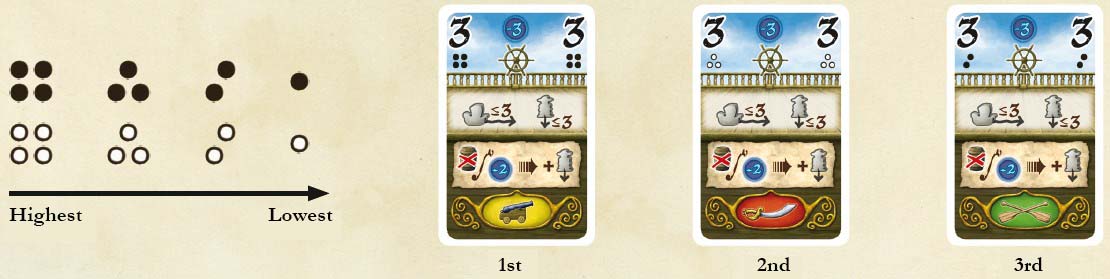
All of the players (Anna (red), Beth
(green), and Connor (yellow)) have revealed cards with a value of 3.
To determine the player order for the round, they must use the
tiebreaker symbols on the cards. Beth’s card has two symbols

,
Anna’s card has three symbols

, and Connor’s card has four symbols

;
therefore, Connor will go first. Anna will go next, followed by
Beth.
4. Resolve Actions
Each player will now resolve the following actions in turn
order, as established in the previous step:
a. Move Ship
-
The player moves their ship around the board in a clockwise
direction. Multiple ships may occupy the same space.
-
The player must move their ship at least 1 space, and at
most, the number shown on the card played.
-
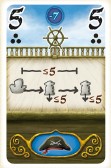 The 5-value card has a special ability that allows a ship
to make a stopover. This means that the player can move their ship,
place a pirate (see “Place Pirates”), move their ship
again, and then place a second pirate. If a player uses this
ability, that ship’s total movement for the turn cannot exceed 5
spaces. The player must move their ship at least one space before
placing the first pirate. To place the second pirate, the player
must move their ship at least one additional space.
The 5-value card has a special ability that allows a ship
to make a stopover. This means that the player can move their ship,
place a pirate (see “Place Pirates”), move their ship
again, and then place a second pirate. If a player uses this
ability, that ship’s total movement for the turn cannot exceed 5
spaces. The player must move their ship at least one space before
placing the first pirate. To place the second pirate, the player
must move their ship at least one additional space.
-
 Whenever a player has finished moving their ship, check for
pirates on pirate field spaces in that ship’s row or column.
Whenever a player has finished moving their ship, check for
pirates on pirate field spaces in that ship’s row or column.
Each pirate on a pirate field space in that row or column earns one
glory for its owner. This effect happens even if the ship is
controlled by the player who owns the pirate.
The glory is not
awarded on the stopover that is allowed by the 5-value card. The
glory is only awarded when the player has finished moving their
ship.
Special case: If a ship completes
its movement in a corner space, check for pirates on Pirate Fields
spaces in the corresponding diagonal.
-
Whenever a ship stops, its controlling player must place
one pirate from their supply onto an empty island space in that
ship’s row or column.
-
If the ship stops in a corner space, the pirate must be
placed along the corresponding diagonal.
-
The value of the active player’s sailing card determines
the maximum number of spaces away from their ship that this pirate
may be placed. That card’s value will be used for all pirates that
the player places during this turn.
-
If all spaces within the range have already been taken, the
pirate must be placed on the next available space in that row or
column (or diagonal in the case of the ship stopped in a corner
space). In the unlikely event that there is no available space to
put a pirate in the row, column, or diagonal, the player loses the
ability to place one.
-
If a player runs out of pirates in their supply, they must
remove any one of their pirates from the board and then place it in
a new, legal space as though it came from that player’s supply.
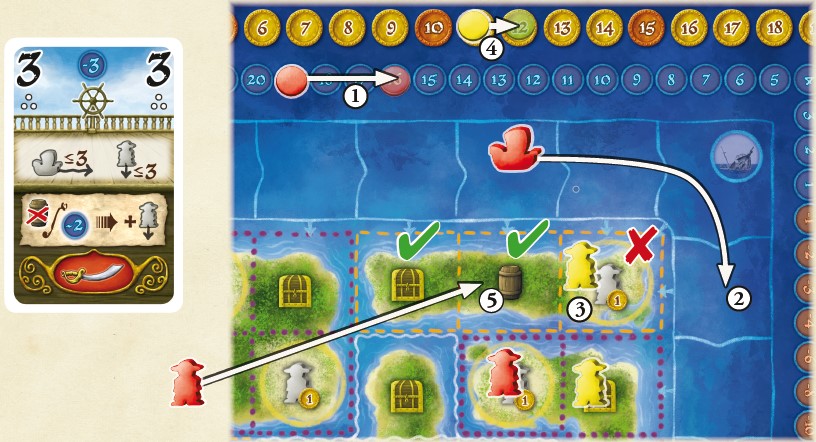
Anna (red) plays a 3-value card. She moves 3 spaces on the sailing
track to match the -3 shown on the card.1 Then, she moves her ship.
She chooses to move her ship the full 3 spaces.2 Because there is
another player’s pirate on a pirate field in the row where her ship
ended its movement3, that pirate’s controlling player, Beth
(yellow), gains 1 glory.4
Now, Anna must play one pirate on an island
space that is within 3 spaces of her ship because she played a card
with a value of 3. She cannot place her pirate on a space that
already has one, so she must choose between the other two spaces.
She chooses to place her red pirate on the barrel space and takes
one barrel from the supply.5
c. Collect Reward
Whenever a player places a pirate, they also collect the
corresponding reward:
-
 Pirate Field: The
player immediately receives 1 glory. While a pirate remains on that
space, its owner receives 1 glory whenever a ship stops on that row
or column (or diagonal in the case of the ship stopped in a corner
space).
Pirate Field: The
player immediately receives 1 glory. While a pirate remains on that
space, its owner receives 1 glory whenever a ship stops on that row
or column (or diagonal in the case of the ship stopped in a corner
space).
-
 Treasure Chest: The
player immediately draws 2 treasure tokens from the bag, chooses
one to keep face-down on their player board, and returns the other
token to the bag.
Treasure Chest: The
player immediately draws 2 treasure tokens from the bag, chooses
one to keep face-down on their player board, and returns the other
token to the bag.
-
 Barrel: The player immediately takes 1 barrel from the supply.
There is a limited supply of barrels; if the supply is exhausted, a
barrel cannot be collected until the supply is replenished. Each
player can hold a maximum of 3 barrels.
Barrel: The player immediately takes 1 barrel from the supply.
There is a limited supply of barrels; if the supply is exhausted, a
barrel cannot be collected until the supply is replenished. Each
player can hold a maximum of 3 barrels.
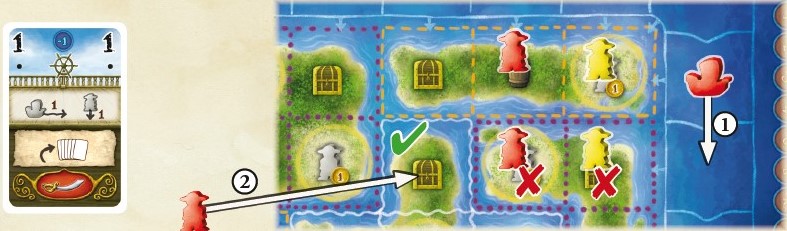
On her next turn, Anna (red) now moves her ship using her 1-value
card. She must move her ship, so it moves to the next space.1
Anna
receives 1 glory since her red pirate is located in the row and is
occupying a pirate field space.
Anna is required to place a pirate
on an island space that is within 1 space of her ship. Because she
cannot place a pirate on the first space (it is already occupied by
a pirate), she must place it on the next available space that is
closest to her ship. In this case, that is the third space away from
her ship, and this is where she must place her pirate.2 This is a
treasure chest space, so she draws two treasure tokens from the bag
and chooses one token to keep. She returns the other token to the
bag.
d. Activate a Special Action (optional)
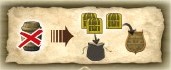 2-value card: The player may return 1 barrel to the supply
to immediately draw 3 treasure tokens and keep 1, returning the
remaining 2 tokens to the bag.
2-value card: The player may return 1 barrel to the supply
to immediately draw 3 treasure tokens and keep 1, returning the
remaining 2 tokens to the bag.
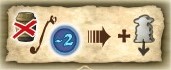 3-value card:The player may return 1 barrel to the supply
or spend 2 sailing spaces to place a second pirate on this turn.
The second pirate’s range is still 3 and follows the same placement
rules as placing the first pirate.
3-value card:The player may return 1 barrel to the supply
or spend 2 sailing spaces to place a second pirate on this turn.
The second pirate’s range is still 3 and follows the same placement
rules as placing the first pirate.
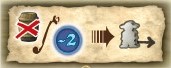 4-value card:The player may return 1 barrel to the supply
or spend 2 sailing spaces to move one of their already-placed
pirates to any empty space on the board; the player then
immediately receives the corresponding reward for the new space.
4-value card:The player may return 1 barrel to the supply
or spend 2 sailing spaces to move one of their already-placed
pirates to any empty space on the board; the player then
immediately receives the corresponding reward for the new space.
e. Scoring Islands
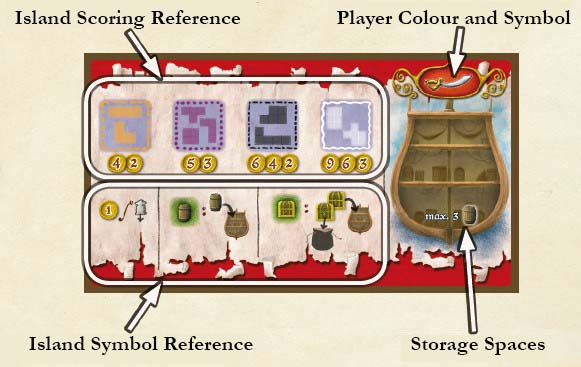
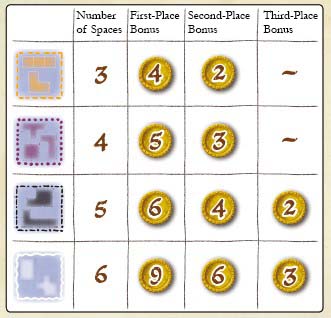 If one or more islands have all of their spaces occupied by pirates,
those islands are now scored. Count the number of each player’s
pirates on the scoring island and use the chart shown here and on the
player boards to determine how many points each player scores.
If one or more islands have all of their spaces occupied by pirates,
those islands are now scored. Count the number of each player’s
pirates on the scoring island and use the chart shown here and on the
player boards to determine how many points each player scores.
-
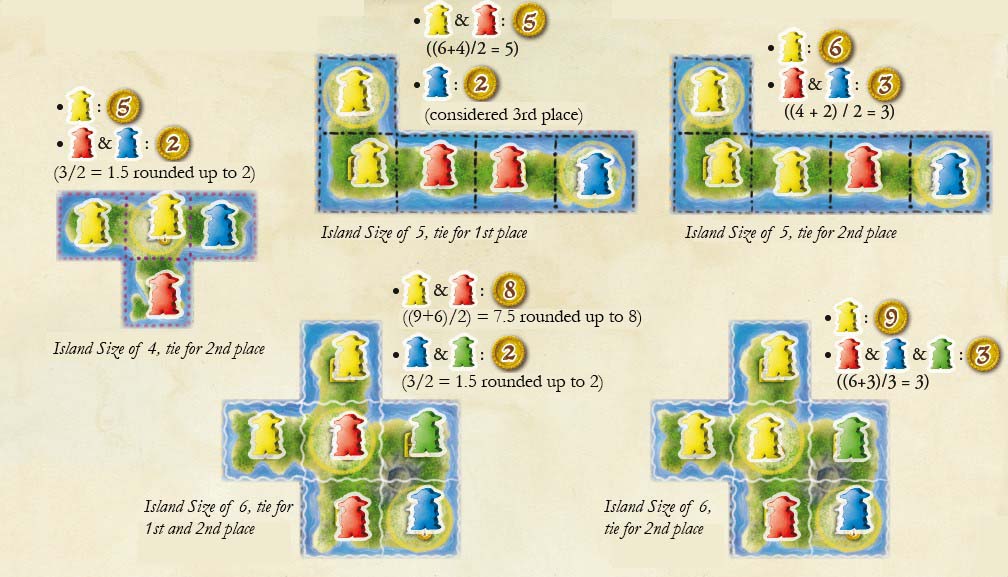
If there is a tie for first place, add the glory for the
first- and second-place bonuses and divide them equally between the
tied players; round up if necessary. If the island has a
third-place bonus, it is awarded according to the rules for
third-place points as shown.
-
If there is a tie for second place, add the glory for the
second- and third-place bonuses (if applicable) and divide them
equally between the tied players; round up if necessary. No points
are awarded for third place in this case.
-
If third-place points are awarded, and there is a tie for
third place, divide the third-place glory bonus evenly among the
tied players; round up if necessary.
-
If there is a tie for first between all participating
players
, all glory bonuses are added up and divided equally between
the participating players, rounding up if necessary.
The player who
triggered that scoring receives one extra glory.
-
After scoring an island, return all pirates on that island
to their players’ supplies.
Scoring Examples:
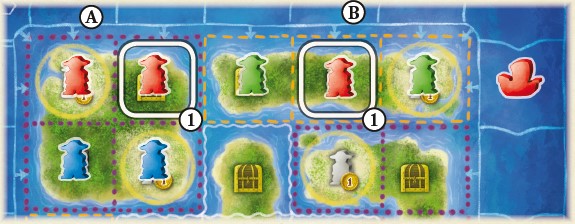
This is the situation after Anna’s (red)
turn. She placed two pirates on two different islands using a 3 card.1
Using the special ability of the 3 card, she was able to pay a
barrel to place a second pirate on this turn. Because each island
that she affected is now full of pirates, both islands will now be
scored.
Anna decides to first score the 4-space island on the left. A
Anna (red) and Jeremy (blue) both have 2 pirates on the island, so
they are in a tie for first place. The island has 4 spaces, so first
place is worth 5 glory and second place 3 glory (as shown above).
In
this case, the glory for both first and second place are added
together (5+3=8) and then divided equally between both players
(4 glory each.) Because all participating player’s tied, Anna
receives 1 additional glory because she placed the final pirate onto
that island. Anna scores a total of 5 glory, while Jeremy scores 4 glory.
The next island to score is the 3-space island on the right.
B
Anna (red) has one pirate compared to two pirates for Beth (green).
A 3-space island scores 4 glory for first place and 2 glory for
second place. In this case, Beth scores 4 glory, and Anna scores 2
glory.
Now that both islands have scored, all of the pirates from
both of these islands are removed and returned to the appropriate
player’s supply.
Additional Scoring examples
5. End of Round
a. Swap Cards (if applicable)
-
If two or more players revealed cards with the same
value, the tied card with the highest-ranking symbol is swapped
with the tied card showing the lowest-ranking symbol. If all four
players revealed cards with the same value, the players with the
two middle-ranked cards must also swap with each other.
b. Discard Cards
-
Each player then places one card into their own discard
pile:
-
If they did not swap cards with another player, they
put the card they played this turn in their discard pile.
-
If they received a card in a swap on this turn, they put the card
they received in the swap in their discard pile.
c. Return Cards to Hand (if applicable)
-
When a player plays a 1-value card, that player returns
all cards from their discard pile to their hand, including the
1-value card. Important: Because card swaps between players can
happen, players will sometimes have cards in their supply that do
not match their player color.
-
Ships are permitted to stop in corners. A player stopping in a corner must place a pirate along the adjacent diagonal line.
Pirates on Pirate Fields along a diagonal still receive glory whenever a ship stops on a corner.
-
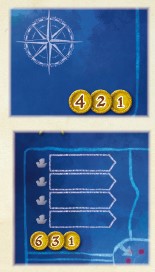
The first player to pass or land on the compass space immediately receives 4 glory. The second player to do
so receives 2 glory, and the third player to do so receives 1 glory.
-
The first player to pass or land on the Home space immediately receives 6 glory. The second player to
do so receives 3 glory, and the third player to do so receives 1 glory. As soon as the first Home bonus is
awarded, finish the round and then proceed to game-end scoring.
-
Ships are permitted to stop in corners. A player stopping in a corner must place a pirate along the adjacent diagonal line.
Pirates on Pirate Fields along a diagonal still receive glory whenever a ship stops on a corner
-
The first player to pass or land on the compass space immediately receives 4 glory. The second player to do
so receives 2 glory, and the third player to do so receives 1 glory.
-
The first player to pass or land on the Home space immediately receives 6 glory. The second player to
do so receives 3 glory, and the third player to do so receives 1 glory. As soon as the first Home bonus is
awarded, finish the round and then proceed to game-end scoring.
-
Each player receives 1 glory for each barrel they have
remaining.
-
Each player receives 1 glory for each of their pirates
remaining on the game board.
-
Players gain or lose glory equal to their positions on the
sailing track.
-
Players reveal their treasure tokens. For each set
of 1, 2, 3, 4, or 5 different treasures, players receive 1, 3, 6,
10, or 15 glory.
In addition to the glory that each player earned during the
game, players earn or lose glory for each of the following items:
-
Each player receives 1 glory for each of their pirates
remaining on the game board, regardless of which type of space it
is placed on.
-
Players gain or lose glory equal to their positions on the
sailing track.
-
Players reveal their treasure tokens. For each set
of 1, 2, 3, 4, or 5 different treasures, players receive 1, 3, 6,
10, or 15 glory.
A player may score more than one set of treasure tokens, but
each token may only score as part of a single set.
-
Each player receives 1 glory for each barrel they have
remaining.
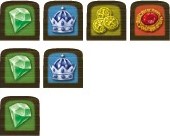 At the end of the
game, Anna has seven treasure tokens: 3 emeralds, 2 crowns, 1
doubloon, 1 ruby.
At the end of the
game, Anna has seven treasure tokens: 3 emeralds, 2 crowns, 1
doubloon, 1 ruby.
She makes a set of 4 (1 each of emerald, crown, doubloon, and
ruby) and scores 10 glory. She can also make a set of 2 (1 emerald
and 1 crown), which scores 3 glory. Finally, she can score the
remaining emerald as a set of 1, which scores 1 glory. Her total
score for treasure tokens is 14 glory.
The player with the most glory has won the race and is crowned
the “King of the Pirates”.
In a two-player game, the legendary Captain Henry Morgan joins
in to compete for the crown of the Pirate King. Henry Morgan acts
like a third player, using the green player pieces.
The set up for Henry Morgan is the same as a human player
except that he gets eight green pirates instead of the usual five.
Henry Morgan starts without a barrel, and he cannot gain barrels
during the game. Shuffle his deck of green sailing cards and place
them face-down in his playing area.
After both human players have selected their cards, turn over
the top card of Henry Morgan’s deck and place it into his discard
pile. If he has only one card left, he shuffles his discard pile with
the remaining card to form a new draw pile. (He does not draw his
hand back when he plays a 1 card like a regular player.)
Henry Morgan always moves his ship as far as the value shown on
his card. He pays sailing points just like the human players. When
Henry Morgan reveals a 5-value card, he moves his ship 1 space,
places a pirate, and then moves 4 more spaces and places a second
pirate; Henry Morgan will always place his pirates on the nearest
available space of a row or column. If Henry Morgan’s supply of
pirates runs out, he does not move them. He does not place a pirate
in this case.
When drawing treasure tokens, Henry Morgan receives a single
face-up token in his play area.
When Henry Morgan places a pirate on a barrel space, he
immediately receives 2 glory instead of a barrel.
Henry Morgan never uses special actions.
Count Henry Morgan’s score as you would for a human player. The
player (including Henry Morgan) with the most glory wins.
A storm rages in the Glory Islands!
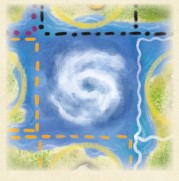 If a player places a pirate on the storm space (center), they
immediately move this pirate to any empty space on the board. The
player then receives the reward from that space (glory, barrels, or
treasure) as usual.
If a player places a pirate on the storm space (center), they
immediately move this pirate to any empty space on the board. The
player then receives the reward from that space (glory, barrels, or
treasure) as usual.
The pirate may not stay on the storm space.
GAME COMPONENTS AND SETUP
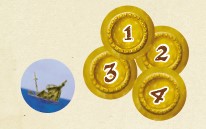 There are 10 shipwreck tokens with the following values: 1x
value 4, 3x value 3, 4x value 2, and 2x value 1.
There are 10 shipwreck tokens with the following values: 1x
value 4, 3x value 3, 4x value 2, and 2x value 1.
Mix all 10 tokens and form 2 stacks of 5 tokens each, face-down
so that the shipwreck side of the tokens is visible. Place one stack
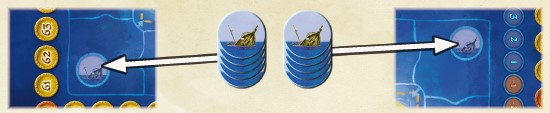 on the upper-right corner field and one on the lower-left corner
field—i.e., on the two corner fields that show neither the compass
nor the start/finish symbol.
on the upper-right corner field and one on the lower-left corner
field—i.e., on the two corner fields that show neither the compass
nor the start/finish symbol.
RETRIEVE TREASURE
Whenever a player’s ship ends its movement on one of the two
corner spaces with a stack of shipwreck tokens, they may immediately
look at all the tokens in the stack and take one.
The player may then spend one barrel and select another token
from the stack.
After they have finished, the stack is replaced on the
corresponding space.
The tokens the player takes should be kept face-down on that
player’s board.
At the end of the game, each token is worth glory equal to the
value printed on it.
Important: In contrast to the glory on the compass and Home spaces,
players only benefit from the shipwreck token space if they end their
movement on the corner space. (Stopping over with the 5-value card
does not earn shipwreck tokens; only ending movement does.)
Please note: In a two-player game, if Henry Morgan stops on one
of the two corner spaces, shuffle all the tokens, randomly select
one, and place it face-down in front of Henry Morgan.
On yucata the card decks are not color relevant. Each player chooses their color in the settings. The color of Henry Morgan (in a two player game) can change too.
Henry Morgan (in a two player game) plays like a real user, gets normal ranking and may beat real players.