Dinosaurs, everybody! Dinosaur Table Battles is a game
for two players about dinosaurs fighting each other for
some reason.
- Components
- Dino Cards
- Action Cards
- Set-Up
- Winning a Match
- Flow of Play
- Attack Phase
- Roll Phase
- Dino Law
- Expansion: More Dinosaurs, Please
- Frequently Asked Questions
- Hints for Handling
- Action Cards
- Set-Up
- Winning a Match
- Flow of Play
- Attack Phase
- Roll Phase
- Dino Law
- Expansion: More Dinosaurs, Please
- Hints for Handling
Components
Dinosaur Table Battles is played with 50 cards, 27 Hit tokens, and twelve dice.
There are two kinds of cards.
- Each Dinosaur is represented by a Dino Card.
- Each Dinosaur has a set of unique Action Cards.
Hit tokens are used to indicate damage dealt to a side.
It's important to note that each player has a pool of Hit
tokens used by all of their dinosaurs collectively.
Dino Cards
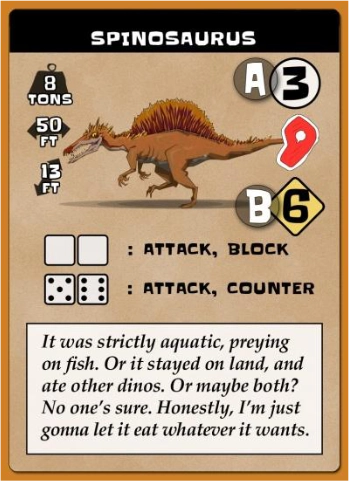
Each Dino Card represents a specific Dinosaur. Each Dino
Card indicates a Breaking Point (A): when it suffers this
number of Hits in a single Attack, it may lose one of its
Action Cards. This Breaking Point is also present on each
Action Card. If a Dinosaur ever has zero Action Cards
remaining, the Dinosaur goes to the Dinosaur Hospital
where it will be fine I promise.
Each Dino Card has a Draft Ranking (B). This is simply a
numerical expression of how "good" that Dino is: the
higher the number, the better the Dino.
Additionally, the Dino Cards list the weight, length, height,
and diet of the Dino: these have no bearing on gameplay,
and are just provided so that we can pretend the game
has educational value. Note that just like people, dinosaurs
of a species can come in all different sizes, and the stats
provided represent only an estimated average or an
extreme. And even these are the subject of debate
between scientists trying to reconstruct this data from
fossils and comparisons to living animals.
Weight is measured in short tons or pounds, and height
and length in feet. (For the 94.7% of the world's human
population that doesn't use these measurements, one ton is
about 907 kilograms, one pound is about half a kilogram,
and there are about three feet in a meter.)
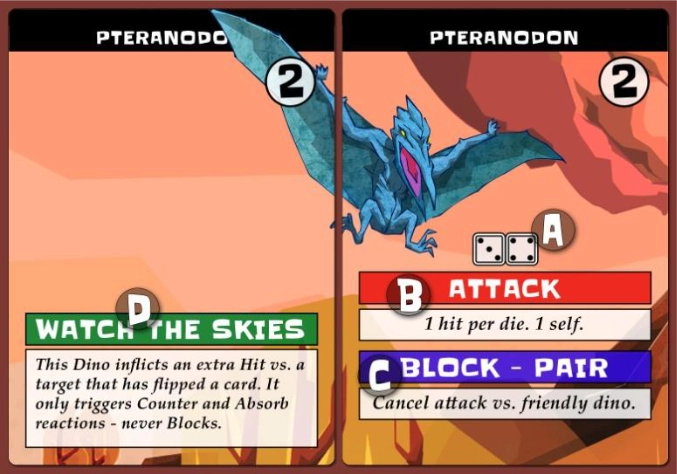
Dice Area (A)
The Dice Area is where dice are placed on the card. In
order to make an Attack (or take a Reaction) with the
card, there must be dice in the Dice Area. The Dice Area
will indicate what type of die results can be placed there:
-
Die Icons: Only dice that match one of the icons
displayed may be placed there. For example, if the
icons are ⚄⚅, then only fives or only sixes may be
placed there, but not both. Note that you could place
fives on one turn, and sixes on a subsequent turn.
-
Multiple dice of the same type may be placed on the
card during the same turn unless the die icon(s) are
enclosed by [brackets], in which case only one die
may be placed there per turn.
-
Doubles: Two blank die icons indicate Doubles;
only two matching dice may be placed there on a
single turn.
Attack Area (B)
The Attack Area tells you what the card does when it is
activated during your Attack Phase. To use the Attack, it
must have at least one die on the card (if "Pair" is
indicated, you need at least two matching dice). Using the
Attack removes all dice from the card back to your pool.
An Attack will attack a target of your choice, inflicting
Hits per the text in the Attack Area.
Reaction Area (C)
The Reaction Area tells you what the card does when it is
activated during your opponent's Attack Phase. To activate
a card, it must have at least one die on it (some specific
Reactions require at least a Pair of two matching dice).
Using the Reaction removes all dice from the card back to
your pool. Reactions come in three flavors: Absorb, Block,
Counter.
A Dinosaur's Absorb or Block Reaction can only be
activated if another friendly Dinosaur is the target of the
Attack; it cannot be used to Absorb or Block an Attack
against itself! Conversely, the Counter Reaction can only be
used by a Dinosaur that is itself the target of the Attack.
-
Absorb Reactions causes the Reacting Dinosaur to
suffer Hits instead of the target, and may reduce the
number of Hits the Reacting Dinosaur suffers.
-
Block Reactions simply "cancel" the Attack: no Hits
are inflicted on either side.
-
Counter Reactions inflict additional Hits on the
Attacking Dinosaur, and may reduce the number of
Hits the Reacting Dinosaur suffers.
Passive Abilities (D)
Some Action Cards do not have a Dice Area, Attack Area,
or Reaction Area, but instead are home to a Dinosaur's
Passive Ability. This effect modifies the rules of the game
in some way, sometimes helping the Dinosaur who has it,
sometimes helping other Dinosaurs on that side. These
Passive Ability rules always take precedence over the
rules in this book.
To begin a match, each player must choose their Dinosaurs.
For your very first match, try this suggested set-up:
-
First Player: Stegosaurus, Triceratops, Utahraptor,
Velociraptors - 12 Hit Tokens
-
Second Player: Pteranodon, Spinosaurus, Tyrannosaurus
Rex - 13 Hit Tokens
For subsequent matches, you will draft your Dinosaurs.
Shuffle all the Dino Cards together, and deal each player
five. Each player examines their cards and chooses one to
remove from the match without revealing it. Of the
remaining four cards, they each choose one card and
place it face-up in front of them. Then, they pass their
hand to their opponent.
Now, each player should have three cards, and they have
a choice: they can either place one of the cards face-up
in front of them, or they can remove one of the cards
face-up from the match - in both cases, this is done
simultaneously with the opponent. Once they have done
so, they will pass their hand again, and this will continue
until the players have no cards to pass.
As each Dino Card is placed, the player should note how
many Action Cards that Dinosaur has, keeping a running
tally for their side. Large Dinosaurs (with two sets of die
icons) have 3 Action Cards, while Small Dinosaurs (with a
single set of die icons) have 2 Action Cards. If placing a
Dinosaur would cause a player to exceed eight Action
Cards, they cannot place that Dinosaur.
Players who are new to the game might find it useful to
consider the Dino Card's Draft Ranking to aid them in
making their drafting decisions; generally speaking, the
higher the Draft Ranking, the better the Dinosaur.
However, those Draft Rankings only look at that Dinosaur
in isolation, and it is far more important to consider how
your Dinosaurs will work together, as well as which die
results they are able to accept.
Action Cards, Tokens, and Dice
Each player finds the Action Cards associated with their
Dinosaurs, and places them face-up near that Dinosaur's
Dino Card. Each player takes three Hit Tokens per
Dinosaur and places them in a common pool. A player
takes two extra Hit Tokens for each of the following:
- If they have fewer Dino Cards in play than the other.
- If they have fewer Action Cards in play than the other.
- If they have the Tyrannosaurus Rex in play.
Each player takes six dice. The player with the fewest Hit
Tokens will have the first turn. If there is a tie, consult the
Dinosaur names on each player's in-play Dino Cards: the
player with the first Dino in alphabetical order goes first.
The game is played in alternating player turns. You win
the game if, during your turn, your opponent
- Runs out of Hit Tokens AND/OR
- Has only one Dinosaur remaining in play.
The game can also end if both players each have only
one Hit Token remaining. In that case, the player with the
most face-up Action Cards wins the match; if tied, the
player who went second wins.
A player's turn consists of two phases, always performed
in this order:
During the Attack Phase, a player may, but is not
required to, make a single Attack. To do so, they must
remove all dice from a single Action Card, returning the
dice to their personal dice pool.
Targets
An Attack will require a target, which will be one of your
opponent's Dinosaurs. Some Passive Abilities might restrict
the targets available, and in other cases you might
choose freely. Only one Dinosaur may be a target of an
Attack. Some cards will refer to Large or Small Dinos;
Large Dinos are those that begin the match with 3 Action
Cards, and Small Dinos with 2.
Reactions
Once you have declared your target, your opponent must
check to see if they can React. If they can React, they
must React - even if they'd rather not! - and here's the
rub: if you React in your opponent's turn, you skip your
Attack Phase on your next turn.
-
If the Attack before Reactions would inflict zero Hits
on the target (e.g., Velociraptors with one die), it
does not trigger a Reaction.
When the player Reacts, they remove all dice from the
Reacting card to their personal dice pool.
Resolving Hits
If the Attack is not Blocked, determine how many Hits it
will inflict against the target. Usually this will simply
translate into a number of Hit Tokens being removed from
your opponent's pool. If the number of Hits meets or
exceeds the target's (or Absorbing Dinosaur's) Breaking
Point, the owning player must make a decision:
-
They can flip one of the target's (or Absorber's)
Action Cards face-down (removing any dice on that
card). If all Action Cards for a Dinosaur are face-
down, it is removed from play. No Hit Tokens are
removed for that side if this option is chosen.
-
They can resolve it normally by removing Hit Tokens.
Whenever you perform an Attack, you may suffer one Hit
yourself ("1 self"); remove a Hit Token from your supply.
One Token Left
If a player only has one Hit Token left:
-
When their Dinos Attack, they ignore "self" Hits (but
not Hits from Counters).
-
When their Dinos are Attacked, they can (and probably
should!) resolve the Hit(s) by flipping over an Action
Card, even if the number of Hits is less than its
Breaking Point. (If however your situation is hopeless,
accept your fate and remove your last token!)
Note that if both players have one Hit Token left, the
game ends immediately (see "Winning a Match" above).
After resolving (or skipping) your Attack Phase, take all
of your dice that are not currently on a Dino Card and
roll them. Once you have rolled the dice, you may, but
are not required to, place dice:
-
You may place Dice for up to two of your Dinosaurs.
-
For each Dinosaur, you may place dice on only one of
that Dinosaur's Action Cards.
-
All rules for dice placement indicated in Dice Area
above apply.
After resolving your Roll Phase, play passes to your
opponent.
For the benefit of Dino Rules Lawyers.
Attack
-
1 hit only. Enemy suffers one Hit.
-
1 hit per die. 1 self. Enemy suffers one Hit for each
die on Attacker's card. Attacker suffers 1 Hit.
-
1 hit per die plus 1 hit. 1 self. Enemy suffers one Hit
for each die on Attacker's card, plus one extra Hit.
(For example, 3 dice is 4 Hits.) Attacker suffers 1 Hit.
-
1 hit per die minus 1 hit. 1 self. Enemy suffers one
Hit for each die on Attacker's card, minus one Hit. (For
example, 3 dice is 2 Hits; 1 die is zero.) Attacker
suffers 1 Hit.
Absorb
-
Suffers 1 hit only. Absorbing Dino's suffered Hits are
reduced to one.
-
Suffers 1 less hit. Absorbing Dino's suffered Hits are
reduced by one.
-
Suffers hits (reduced by dice). Absorbing Dino's
suffered Hits reduced by one for each die on
Reacting card. Hits cannot be reduced below zero.
-
Suffers hits. Absorbing Dino suffers the normal number
of Hits.
Counter
-
1 hit. Suffers normal hits. Attacker suffers one extra
Hit. Target suffers normal Hits.
-
1 hit per die. Suffers normal hits. Attacker suffers
one extra Hit for each die on Reacting card. Target
suffers normal Hits.
-
1 hit. Reduce hits by dice. Attacker suffers one extra
Hit. Target's suffered Hits are reduced by one for
each die on Reacting card. Hits cannot be reduced
below zero.
-
1 hit. Suffers 1 less hit. Attacker suffers one extra Hit.
Target's suffered Hits are reduced by one.
Passive Abilities
-
Spinosaurus (Water Lurker): Yes, since the game
ends if you're down to a single Dino, this Dino can
never be attacked while this Passive Ability is in play
unless it's a Dino that can ignore target restrictions.
-
Brachiosaurus (Treetops): This counts as a Reaction
when used but does not negate or reduce any Hits
inflicted, requires no dice (just flipping the card), and
may only be used when another Dinosaur is the
target of the Attack.
-
Pteranodon (Watch the Skies): While this is in play,
when the Pteranodon attacks, just pretend the
enemy's Block Reactions don't exist. This part of its
power is separate from its "extra hit against Dino with
flipped card" ability: one is not contingent on the
other.
-
Velociraptors (Egg Thieves): This ability applies only
if the opposing player chooses to resolve the Hits by
removing Hit Tokens.
-
Pachycephalosaurus (Bonk): While the Reaction's
text is ignored, it still counts as a Reaction for powers
(like the T-Rex's) that depend on whether or not there
was a Reaction. Brachiosaurus's Treetops ability, which
functions as a Reaction, cannot be used in this case.
Targeting Restrictions
The following Dinosaurs have passive abilities that qualify
as targeting restrictions:
- Spinosaurus
- Stygimoloch
- Deinocheirus
The following Dinosaurs have passive abilities that ignore
targeting restrictions:
- Therizinosaurus (ignores all)
- Triceratops (ignores all when it has 3+ dice)
- Pachycephalosaurus (ignores Stygimoloch)
This is the most important expansion in history, and also prehistory. It includes six new dinos, plus new
cards for two of the base game dinos (Spinosaurus and Pteranodon - replace the old cards with the new ones).
Some dinos are classified as either Air Dinos or Wet Dinos, which have certain advantages as described on the
respective Special Rule Cards (below).

AIR DINOS never trigger Blocks. If that's the only reaction your enemy has available, they do not react!
The exception is that other Air Dinos can—but are not required to—Block other Air Dinos.
Attacking Air Dinos inflict one less hit against Wet Dinos.
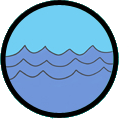
Attacking WET DINOS ignore the Passive Abilities of other Wet Dinos.
Attacking Wet Dinos inflict one less hit against Air Dinos.
Frequently Asked Questions
(This section is not part of the official rules, but the answers have been confirmed by amabel,
the game's designer.)
Q: What is the full list of dinosaurs that are part of the game?
A: Base game: Ankylosaurus, Brachiosaurus, Corythosaurus, Deinocheirus, Dreadnoughtus, Pachycephalosaurus,
Pteranodon, Spinosaurus, Stegosaurus, Stygimoloch, Therizinosaurus, Triceratops, Tyrannosaurus, Utahraptor, Velociraptors
Expansion: Gallimimus, Herrerasaurus, Liopleurodon, Microraptors, Quetzalcoatlus, Shonisaurus
Q: New versions of the Pteranodon and Spinosaurus
dinosaurs were included in the expansion. Which version of these dinosaurs is used on Yucata?
A: It depends on which game scenario that the player who created the invitation selected. We use the
updated versions of these dinosaurs from the expansion when the game was set up to include the expansion.
If you see the rules for AIR DINOS or WET DINOS when viewing the help dialog for these dinosaurs, then the
new versions of the cards are in effect.
Q: If a player chooses to flip an Action Card that would affect the attack, does that effect still happen
on that turn?
A: Yes. For example, if the Tyrant King card from Tyrannosaurus Rex is flipped, the attacker does still
suffer one extra Hit if there is no Reaction.
Q: The Deinocheirus's Bad At Fighting ability reads in part "When Attacked,
this Dino suffers one extra Hit." Does that extra Hit happen if another dinosaur Absorbs the attack? What if
the Deinocheirus is using its own Absorb ability when another dinosaur is attacked?
A: An Absorbing dinosaur becomes the target of the Attack. So it would not happen in the first
scenario, and would happen in the second.
Q: When can the Gallimimus use the Chicken Mimic ability to choose an
enemy's passive ability to mimic?
A: This can only happen instead of Attacking on the player's turn. If the player could not attack
due to a Reaction on the previous turn, they cannot set the mimic ability either. Also note that the Gallimimus
will use a mimicked ability until that card is flipped, so if the Gallimimus is already mimicking an active
ability, it cannot switch to mimicking a new ability.
Q: Is the Monstrous ability of the Stygimoloch neutralized when there is
only one small Dino on the attacker's side or on the defender's side?
A: On the defender's side.
- Under the settings tab, you can choose between two different layouts. Normally, the automatically
chosen layout is best. You can override that, but note that the overridden layout does not affect the
draft phase of the game.
Credits
Design & Card Layout: Amabel Holland
Art: Wil Alambre
Rulebook Layout & Editing: Mary Holland-Russell
Inspiration & Enthusiasm: Mary Holland-Russell