The winner is the first player
to place all 30 of his buildings on the game board or connect any two shrines with his buildings.
The starting player begins and the players continue in clockwise order.
On a player's turn, he either draws 2 new buildings or builds 3 buildings from his player board.
Draws
The player draws 1 building from any of his building stacks and looks at it.
If he wants to spend the cost to build it, he pays the building cost and places it on the game board.
Otherwise, he places it on the corresponding space on his player board.
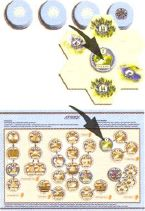
When a player chooses the draw action, he does it twice.
Builds
The player takes 1 building of his choice from his player board, places it on the game board, and pays the building cost.

When a player chooses the build action, he does it thrice.
After the player has drawn twice or built thrice, his turn ends.
Note: A player may not use the draw action and the build action in the same turn.
When can a player draw landscape cards?
A player may choose to forsake all or part of his draw or build actions to draw landscape cards.
For each draw or build action he forsakes, he draws 1 landscape card from the supply, adding it to his hand.
If a player forsakes all draw/build actions he draws 3 landscape cards.
Note: The player must always draw landscape cards after he has taken all draw or build actions he wants.
A player may not draw landscape cards and then take draw or build actions.
The hand of landscape cards is not limited to a certain number.
When the landscape card supply is exhausted: Shuffle the landscape discard stack and place it face down as the new supply.
Where can a player build a building?
A player may build a building on any empty space on the game board, regardless of whether the space has a landscape symbol or not.
A player may not build a building on a shrine or a space that already has a building.
The cost of a building is shown in landscape symbols on the building tile itself and also on the player board.
From the building cost, the player may reduce his payment by the landscape symbol shown on the space he builds and by each landscape symbol shown on empty spaces directly adjacent to the building space.
The player pays the remaining cost with corresponding landscape cards.
He places these cards face up on the discard stack.
He may play any 2 landscape cards in place of a required landscape card.
A player can completely eliminate the cost to build a building by building it in the right order.
The arrows on the player boards depict the free building order. To build for free:
The player's building from which an arrow points must already be on the game board.
The player builds his building pointed to by the above building directly adjacent to the above building.
Example:
If a player builds his tower directly adjacent to his fortress he pays no building cost.
In the following cases players may not build for free:
Inverse:
The tower has been built and the player builds the fortress.
Skipped building:
The quarry has been built and the player builds a tower.
Wrong player:
The player builds a tower next to an opponent's fortress.
Main building (white words on black background):
There exists no right order for main buildings.
To build a street, a player must pay any 5 landscape cards, reduced by the landscape symbol shown on the space he builds and by each landscape symbol shown on spaces adjacent.
Building for free: A player may build a street for free when he builds it directly adjacent to one of his streets.
What is a settlement?
A settlement is one or more connected buildings of the same player color.
A player founds a new settlement when he builds a building that is not directly adjacent to any of his other buildings.
When a player founds a new settlement, he pays a new settlement cost in addition to the building cost.
The new settlement cost is 1 of any landscape card for each other settlement the player has.
Example: A player has 2 settlements.
He founds a new settlement, and must pay an additional 2 landscape cards.
Notes: A player may connect two or more settlements with a building, thereby reducing later new settlements costs.
Buildings connected only through a shrine are not in the same settlement.
Each building belongs to one of 7 groups (e.g. defense or shipping).
When a player builds buildings from one of his groups together, he earns amphore, which can be used to extend the length of his game turns at appropriate times.
Which buildings belong to a group?
On the player cards, the buildings of each group are shown together.
Example: Quarry, fortress, and the two towers belong to the defense group.
When a player builds all buildings of a group such they are connected to each other on the game board, he earns a reward of 1 amphora, which he may use immediately or save in his play area until later.
When the supply of amphore is exhausted: The player draws a landscape card, placing it in his hand.
On Yucata, drawing this replacement card also prevents further building draws or builds in the same turn.
The player puts 1 amphora back in the supply and may take
1 additional draw (when he chose draw for his turn) or
1 additional build (when he chose build for his turn).
An amphora may also be used to draw 1 landscape card.
Reminder: A player may not draw or build after drawing a landscape card.
Example: A player draws a quarry and a tower.
He then puts 1 amphora back in the supply and draws another building.
Finally, he puts another amphora back in the supply and draws 1 landscape card.
Note: A player may use as many amphore in a turn as he wants (and has), including those he earned during the turn.
When can the game board be expanded?
When a player draws the last building tile from one of his 4 building stacks, he first places the tile on the game board, paying the building cost, or places the tile on his player board.
Then, he draws a game board tile from the stack and adds it to the game board.
He may place the tile in any orientation he chooses.
Where may he place the board game tile?
A player must place the game board tile such that it is adjacent to at least one other game board tile or 1 shrine.
Game board tiles may be placed such that there are holes in the game board.
Players may not place game board tiles on top of shrines or other game board tiles.
Buildings may be immediately placed on new game board tiles.
When the stack of game board tiles is exhausted:
The player continues his turn without placing a new game board tile.
A player wins the game when he is the first player to either place all 30 of his buildings on the game board or
to connect any two shrines with a string of his connected buildings.
The game ends immediately when a player wins.