Your goal
Place one domino on your turn. The first player unable to place a tile loses. With three or four players, players are eliminated and the last remaining player wins.
Every tile is unique. Both of its symbols must match two adjacent, empty spaces on the board.
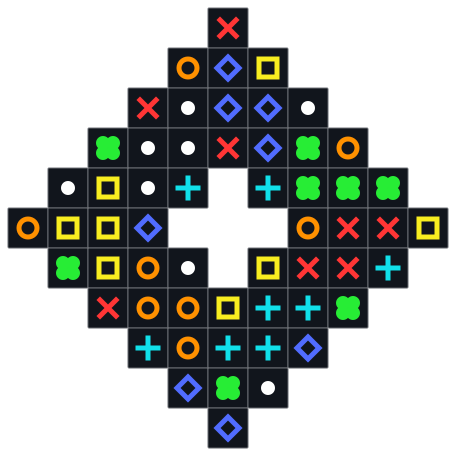 Seven symbols, each appearing eight times.
Setup
The set contains all 28 unordered pairs of seven symbols, including the seven doubles. Shuffle the tiles and deal randomly:
| Players | Tiles each | Left over |
|---|
| 2 | 14 | None |
| 3 | 9 | One tile, displayed face up and excluded |
| 4 | 7 | None |
Normally all hands are visible. The invitation can instead select hidden hands: only the owner sees their unplayed tiles. The discarded tile in a three-player game is always public.
Choose a starting player (usually the loser of the previous game). Online, the framework determines the starting player, marked with ★ after their login. Play follows the seating order.
Online option: Random
The default is the original board, with three matching placements for every tile. Choose Random in the invitation to generate a new symbol arrangement when the game starts. The board shape stays the same, each symbol appears eight times, and every tile (including doubles) has at least two matching placements on the empty board. The arrangement stays fixed throughout the game. Random games are named Heptalion (Random).
Your turn
- Select one tile in your hand.
- Choose two empty board spaces sharing an edge. Diagonal contact does not count; gaps in the board are not spaces.
- Match both symbols. You may rotate the tile or exchange its ends. Place it face down, covering both spaces.
- Confirm your turn using the standard framework button. Until confirmation, you may undo and choose a different placement.
Example
A dot/plus tile covers two adjacent spaces showing a dot and a plus, in either order. A dot/dot tile needs two adjacent dots. You may never cover an occupied space, overlap another tile, or move a tile already placed.
No legal placement
You cannot pass voluntarily. When your turn arrives and none of your remaining tiles fits, you are eliminated. With two players, your opponent wins immediately. With three or four, skip eliminated players and continue until only one player remains. Their remaining hand does not need to be empty or playable: they have already won.
The online game checks this automatically after turn confirmation. It reports the winner; all other players share second place because the rules specify no further ranking.
Playing online
Your player information always comes first. Only playable tiles and matching empty spaces become clickable. Select a tile, its first space, then its second space. Selecting another tile changes your local choice; tapping the first space again resets it. These selections do not add history entries. A complete placement is one action. The silver bar and Undo/Redo remain standard framework controls.
The most recent placed domino has a darker outline. Covered dominoes are face down. In the hidden variant, Automa+ uses only its own tiles, public placements and the public discarded tile.
Board facts and puzzles
Each symbol occurs eight times, and each of the 28 tiles has exactly three matching placements on the empty board. The 56 spaces equal the total area of the tiles, but placing all 28 tiles is impossible. How many can you fit? Can you find a genuinely different symbol distribution with the same properties, beyond renaming symbols, rotation or reflection?