Egizia lasts for 5 rounds. In each round, the players can increase the strength of their construction crews, add new
quarries or fields, take Nile and Sphinx cards, and cooperate in the building of King's Graves, Obelisks, Pyramids, and
Temples. The goal is to collect points. Players can earn points immediately for building and points at the end of the game
from the Sphinx cards.
In each round, the players pass through 7 phases, then the next round begins. The details on how the individual phases
are played are described in the following.
- Lay out Nile cards
- Place ships along the Nile
- Feed construction crews
- Produce stones
- Build
- Bonus for co-operation in building
- Determine player sequence for the next round
At the beginning of each round, the players draw 10 Nile cards from the supply and place them face-up on the 10 card spaces on the game board next to the Nile, beginning at the
source.

In rounds 1 and 2, players draw from the 1/2 supply, in rounds 3 and 4, they draw from the 3/4 supply, and in round 5, they draw from the 5 supply.
At the end of rounds 2, 4, and 5, players return unused cards from the just-completed supply back into the box.
The player with the number 1 begins and places one of his ships on the Nile space of his choice. Next, the player with the
number 2, then the player with the 3, and finally, the player with the 4. Then, placing continues again with the player
with the number 1 placing his second ship, and so on. Only 1 ship may float on each space.
The important rule: A player must always place his new ship further down-river from his already-placed ships.
A player can place his ship on the following 3 types of spaces:

-
A space with a Nile card

The player first takes the Nile card and then places one of his ships on the now-empty space where the card was.
Afterwards, he executes the action on the card or places it in his play area.
-
Round space

The player places one of his ships on a round space next to the Nile. Then he executes the action designated by the space.
-
Building space

The player places one of his ships on an empty building space of his choice. A player may only place 1 ship at each site:
the Sphinx, the Obelisk/Graves, and the Temples/Pyramid. If none of the 3 spaces at a site is empty, the player may place
his ship next to one of the spaces and speculate that in phase 5 at least one of the other players there will not or cannot build there.
If no player can or wants to place another ship, the phase ends and the players take back their ships into their play areas,
with exception of the ships in building sites. These remain on the game board for now.
Beginning with the player whose stone is in front on the scoring track, each player checks to see if he can feed
his construction crews. To do so, he compares the strength of his construction crews with how much grain he
has (grain start card + grain spaces + Nile cards). If the player has at least as much grain as the strength of his
construction crews, nothing occurs. If the player has less grain, then he must lose points on the scoring track.
His score may go below zero. The number of points he must lose depends on where his stone is on the grain
market. (Between 1-3 spaces per malnourished construction crew member, see example below).
-
The water ring
To better understand feeding, here are some examples which show how the water ring comes into play. Its location
determines which grain fields are watered and, thus, how much grain is available to feed the crews:

|

|

|
| Only the green fields supply grain. |
Only the green and the yellowish green fields supply grain. |
All grain fields supply grain. |

|
|
|
| ----- |

|
|
| ----- |
----- |

|
-
Feeding phase examples
The 4 blue construction crews:
The 4 construction crews have strengths of 1, 2, 3, 3, for a total strength of 9.
Blue has a total of 11 grain.
All green and yellowish green fields are watered and supply grain.
Blue has 2 grain fields which are both watered in this round, and from
them has enough grain to supply crews with strength up to 11. Thus, blue can feed his construction crews.
The 4 red construction crews:
The 4 construction crews have strengths of 2, 2, 2, 4, for a total of 10.
Red has a total of 8 grain. Red has also the anytime grain surplus card.
Only the green fields are watered and able to supply grain.
Red's two grain fields are watered and together can feed construction crews up to strength of 8. Red has an anytime grain
surplus card, which he discards adding 4 grain, giving him a total of 12, which is more than enough to feed his crews with a
strength of 10. The 2 surplus grain is wasted and cannot be carried over to another round, however. Had Red not had or chosen
not to use the surplus grain card, then he would have moved backward on the scoring track (see next example).
The 4 green construction crews:
The 4 construction crews have strengths of 3, 3, 4, 4, for a total of 14.
Green has a total of 19 grain but only 12 grain are watered.
All green and yellowish green fields are watered and supply grain.
Because of the position of the Water ring, green can only use the upper two grain fields. They feed construction crews up to a total
strength of 12, thus he is missing 2 grain.


The green marker stone on the grain market indicates that green must lose 2 points for each grain he is short for feeding his crews.
Thus, green loses 4 points, moving his marker on the scoring track backward 4 spaces, placing his stone behind the red stone
on the space he reaches (in this case, space 14).
Beginning with the player with number 1, each player must move his stone marker on his player tableau forward by the
number of stones he receives from his quarries. If he would have more than 25 stones, the surplus is wasted.
-
Example:
Red has 1 stone at the beginning of the 4th phase, and 2 quarries, which together supply 5 stones each round.
Red moves the marking stone forward to space 6.

Now the players build at the 3 building sites from top to bottom: first the Sphinx, then the Obelisk/Graves,
finally the Temple/Pyramid.
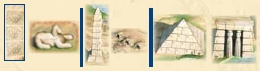
General rules for building:
- Building means the player places stones of his color on empty spaces of the obelisk, the pyramid, and the temple. It
also means that the players draw cards from the sphinx supply or take grave tiles.
- The player needs 1 construction crew and 1 or more stones for each building site.
- The player must reduce exactly the same number of stones on his tableau as he draws sphinx cards. With adding stones
to building and taking grave tiles, it is the value of the space or the tile that determines the number of stones used.
- The player can use each construction crew in each round only once.
- After using a construction crew he turns over the tile and turns it back at the beginning of the next round (thus,
construction crews are used, but not consumed).
- The player can never use the Joker construction crew alone. He can use it once per round with another construction
crew and then must, likewise, turn it over.
- If a player does not build, he takes his ship back from the building site (into his play area), thereby freeing up the space
in the building site for another player with a ship at this building site "on speculation".
A. Sphinx - take cards:
keep 0 or 1 card and score points for cards returned

- The player whose ship is closest to the Nile begins:
- He selects 1 construction crew plus, possibly, his Joker construction crew.
- He draws a number of Sphinx cards up to the strength of his construction crew, but, at most, 5 cards.
- He selects 1 card and places it face-down in his play area. He places the remaining cards face-down under the sphinx card
supply. He may also choose to keep no card.
- For each card he returns, he immediately scores one point, recording it on the scoring track.
- He reduces the number of stones on his tableau by the number of cards he drew and turns over the used crew(s).
- All Sphinx cards count only during the final scoring.
- Then, the next player (next closest to the Nile) takes his turn.
-
Example:
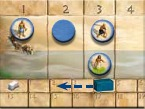
Blue uses his construction crew with strength 2. He draws the two top-most sphinx cards,
selects 1 and places it face-down in his play area. He places the other one face-down under
the sphinx and scores 1 point, recording it on the scoring track. Then he turns over the used
construction crew and reduces his stones by 2.
B. Obelisk and Graves
- score points and improve grain or stone market


- The player whose ship is closest to the Nile begins:
- He selects 1 construction crew plus, possibly, his Joker construction crew with sufficient total
strength for his building project. The strength of the construction crew must be at least as large as
the value of the spaces which he wants to build.
- He places 1 or more stones on the Obelisk and/or takes 1 or more Grave tiles (and places stone(s) on
the empty spaces left by the tiles he took).
- He turns over the used crew(s) and reduces the number of stones on his tableau by those he used.
- He records his points on the scoring track and moves one of his marking stones on either the stone market or the
grain market 1 field downward.
- Then, the next player (next closest to the Nile) takes his turn.
General rules:
When building the Obelisk, the players must build stones from bottom to top (all lower numbers must be filled,
before a next higher space can be built).
At the Graves, a player must take the first face-up tile, then the second, etc. He may not skip a tile. When a player takes a
grave tile, he turns over the next face-down tile so that there are always 4 face-up grave tiles (until all 12 are turned up).
-
Example:
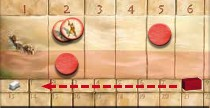

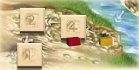
The two obelisk spaces have the values 1 and 2, the grave tile has the value 4, giving a total value of 7.
Red uses his strength 5 construction crew and his strength 2 Joker construction crew. He records 7
points on the scoring track, reduces his stones by 7 on his tableau, and turns over the two construction crews.


- The player whose ship is closest to the Nile begins:
- He selects 1 construction crew plus, possibly, his Joker construction crew with sufficient total strength for his building project.
- He places 1 or more stones on the Pyramid and/or the Temple.
- He turns over the used crew(s) and reduces the number of stones on his tableau by those he used.
- He records his points on the scoring track.
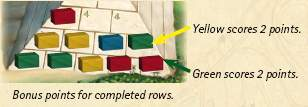
- When a player completes a row of the Pyramid, the player who built the most scores bonus points (see example below).
- Then, the next player (next closest to the Nile) takes his turn.
-
Example:
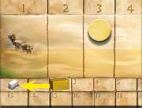
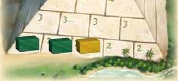
Yellow uses his strength 3 construction crew. He builds a value 2 space of the pyramid, as he
has only 2 stones available. He scores 2 points and records them on the scoring track, reduces
his stones to 0 on his tableau, and turns over the construction crew he used.
General rules:
When building the Temple, the players must build stones from bottom to top.
The two columns on the left and on the right are built separately (all lower numbers must be filled,
before a next higher space can be built).
When the columns on both the left and right are built, then the two middle columns are built, each
requiring a single stone, and, finally, the stones can be built on the top.
With the Pyramid, the players build as follows:
The 1st stone in each row must be built on the left, then without gaps players build the row to the right.
As soon as a row is completed, the player who has most stones in the row scores 1 point for each stone he has in the row.
If there is a tie, the tied player who has a stone furthest left in the row scores the point(s).
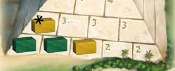
* A player can build here as the stone is supported from directly below, even though there are empty spaces in the row below.
Each player scores bonus points for participating in the building. A player is considered to have participated if he used at
least one stone from his tableau in order to take cards or tiles or build the buildings. Each player counts how many ships
he has on the 3 building sites (not still speculating). Beginning with the player whose scoring stone is in front, the players
score points according to the following table by moving their scoring stones on the scoring track.
| 1 ship |
1 point |
| 2 ships |
3 points |
| 3 ships |
6 points |
Afterwards the players take back their ships into their play areas.
General rules for scoring points:
When scoring bonus points and for the final scoring, scoring always begins with the player who is the furthest along the
scoring track. Then follows the next player along the track and so on.
When scoring points for building, the player scores the points as he builds.
The player who has the fewest points on the scoring track takes the player sequence tile 1,
the player with the next lowest points takes the player sequence tile 2 and so on.
If several players are on the same space, then the player furthest back in the space takes the smaller
numbered player sequence tile, as he arrived at the space later.
Afterwards, the next round begins with the laying out of the Nile cards.
Stone market:
On the upper spaces of the stone market nothing occurs.
When a player moves his marker, in the course of the game, to the lowest space, he adds 3 stones to his tableau.
Each time that a marker is already on the lowest space and would be moved further downward, the marker remains there
and the player adds 3 stones to his tableau.
At game end, any player with his marker on the bottom or second to the bottom space of the stone market may convert
his remaining stones into points at the rate of 2 stones for 1 point.
Grain market:
Here is where the players see how many points they lose when they cannot completely feed their
construction crews. The points lost are reduced as the players move their marking stones downward. A player whose stone is
on the bottom or second to the bottom space pays 1 victory point per unfed crew member in phase 3.
When a player arrives at the lowest space, he immediately scores 2 points. Each time that a marker is
already on the lowest space and would be moved further downward, the marker remains there and the player scores 2 points.
The game ends after the 5th round (including defining the player sequence). The final scoring follows.
Player "4" begins and executes the following 3 steps. Then player "3" does the same, and so on.
- If the player's marker is on one of the bottom two spaces of the stone market, he may sell his remaining stones. For
each 2 stones he sells, he scores 1 point (rounded down).
- The player sums the values of his Grave tiles and scores points according to the following table:

- The player checks his Sphinx cards to see which have conditions he has fulfilled and scores those points accordingly. For
complete descriptions of the Sphinx cards, see page 11.
The player with the most points is the winner. If players are tied, the player whose stone is in front on that space of the
scoring track is the winner.
With 2 or 3 players only use 2 spaces at each building site.
To make this clear, cover the 3rd building space with a stone of an unused color.
The player's markers on both the stone market and the grain market each move down 1 space.
The player's depicted construction crews each move 1 space to the right.
The player's Joker construction crew moves 1 space to the right.
Additionally, he may move the water ring 1 space to the left or the right. However, the water ring must always be
on one of the 3 round fields on the board.
The player's depicted construction crews each move 1 space to the right.
The player's depicted construction crews each move 1 space to the right.
Any one of the player's 4 construction crews moves 1 space to the right.
The player then adds 2 stones to the stone marker on the tableau.
This works exactly as with Passalon.
Additionally, it is not allowed to use the Nile card "You can place a ship on an occupied round space" here.
According to the game developer, it is also not allowed to use the anytime Nile card "Double benefits of a round space" here!
There are 3 different types of Nile cards. Depending upon type, they are used in different phases:
Anytime: (German: Jederzeit)
The player may use this card at any time on one of his turns. Afterwards, he returns it to the box.
Permanent: (German: Permanent)
These cards are valid for the entire game and are placed face-up in the player's play area.
Grain fields and quarries are also permanent cards.
Immediately: (German: Sofort)
The player must use this card immediately and completely. Afterwards, he returns it to the box.
1/2
(1)
3/4
(1)
1/2
(1)
3/4
(1)
3/4
(1)
Green grain field
is always watered and will always feed the player's construction crews.
1/2
(1)
1/2
(1)
3/4
(1)
3/4
(1)
Yellow-green grain field
will feed the player's construction crews only if the water ring is in the
center or on the right.
1/2
(1)
1/2
(1)
3/4
(1)
5
(1)
Brown grain field
will feed the player's construction crews only if the water ring is completely on the right.
Additional functionalities
(immediately and only once)
card "6":
The player's marker on the grain market moves 1 space downward.
card "7":
The player's marker on the stone market moves 1 space downward.
card "8":
The player scores 3 points.
card "9":
The player adds 4 stones to the stone marker on the tableau.
1/2
(2)
3/4
(2)
1/2
(3)
3/4
(1)
3/4
(1)
Quarry
gives the player 2, 3 or 4 extra stones in each round.
The player can use the card as 4 grain when feeding his crews.
The player can add 3 strength to a construction crew being used.
The player can add 4 strength to a construction crew being used.
The player can add 5 strength to a construction crew being used.
The player can execute the action designated by a round space twice. Cannot be used on Heliopolis!
Before the next player takes a turn, the player may place a second ship.
The player may use 2 yet unused construction crews plus possibly the Joker construction crew.
A player who placed a ship next to the regular fields to speculate can build.
On each building site where the player has a ship, he can build first. If he has a speculative ship, all players may build.
Keep the card in play area until all builds are done.
The player may keep 2 cards from the Sphinx.
The player adds 6 stones to the stone marker on the player tableau.
The player can sell stones for 1 point per stone up to 10, ignoring the usual stone sales condition.
The player allocates this card to a grain field to improve its ability to produce by 1 level
in all cases for the entire game.
Once per round, the player may place a ship on a round space that already has a ship,
other than the last gray bordered space Heliopolis.
Each round, the player may move any construction crews one space to the right (even after the feeding phase).
The player may exchange stones for grain at the rate of 1:1 in order to feed construction crews (reducing stones accordingly).
The player may draw 2 additional Sphinx cards (maximum still 5). He pays no stones for the additional cards.
He may draw just 2 cards and use 0 stones.
This can only be used if the player has a ship on a building space of the Sphinx.
Each round, the player can spend 2 stones from his tableau to move one of his construction crew to the right
1 space on his tableau. He can even do this after the feeding phase.
Once per round, a player may place a ship upstream (closer to the Nile source), than his last ship.
Afterwards, the normal rules apply.
The player may take one of the cards remaining on the Nile at the end of each round.
The player adds this card during the final scoring to his collected grave tiles.
The player's marker on the stone market moves 2 spaces downward.
The player's marker on the grain market moves 2 spaces downward.
The player moves any 2 construction crews 1 space to the right or any one crew 2 spaces to the right.
The player's shown construction crews each move 1 space to the right.
The player's shown construction crews each move 1 space to the right.
The player's stones in the shown buildings score 1 point each.
The player's stones in the shown buildings score 1 point each.
(used during the final scoring)
The players collect the Sphinx cards face-down and try to fulfill as much as possible before game end.
Invitation variants
The standard game includes both optional cards. The invitation can instead remove the Nile card granting two bonus Sphinx draws, the Sphinx objective worth 10% of the other final score, or both cards. All other rules remain unchanged.