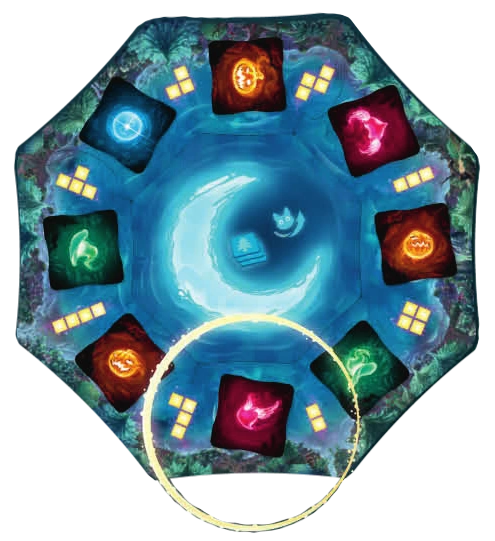
Players take turns beginning with the
starting player and continuing clockwise
around the table. You will take several
turns during the round. A typical turn
looks like this:
1. Choose a wisp.
Choose one of the wisps available on
the pond.
2. Choose one of the 2 shapes.
Your chosen wisp is between 2 shapes.
You choose one of these.
Take your chosen wisp and enough tree tiles
to make your chosen shape.
The wisp can be anywhere in the shape.
The shape can be mirrored or rotated in
any orientation.
3. Add the shape to your forest.
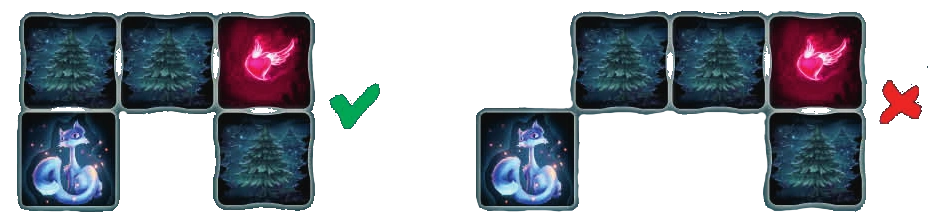
At least 1 tile of your shape must be placed beside a tile already in your forest.
|
round 1
|
round 2
|
round 3
|
|
4×4
|
5×5
|
6×6
|
Turn by turn, your forest will grow.
The tiles must stay inside a 4×4 grid.
Tip: You can use your grid guide to help
you plan the growth of your forest. For
later rounds, the grid will be bigger.
Watch out for witches.
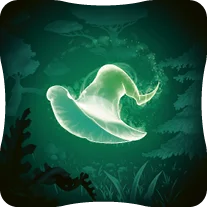
The goal card for witches gives a
special rule about where witches can
be placed. You are not allowed to take
a witch tile that cannot be placed
according to its rule. See here.
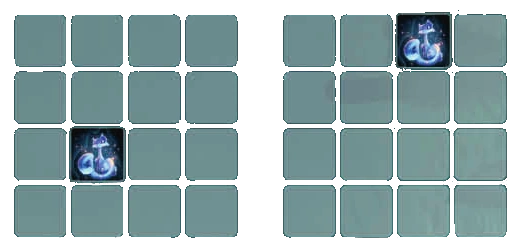
Note: When you start the game, your
forest is just your cat. And you don't
know if your cat is in the corner of
your forest or in the middle. You don't
know if your cat is on the north edge
or the south. So, you can grow your
forest in any direction, as long as it
always fits inside some 4×4 grid.
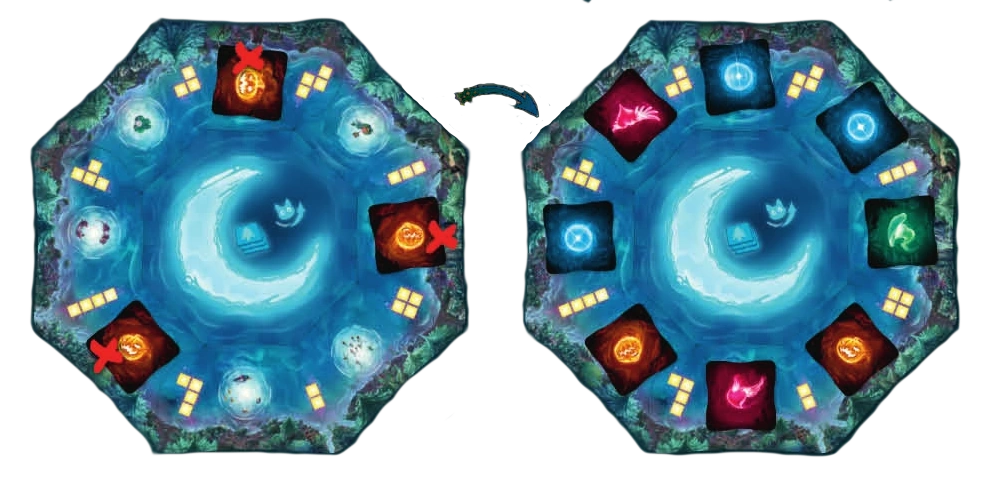
Dwindling Wisps
When a player takes a wisp tile, it is not automatically replaced. This means each
following player will have fewer wisps to choose from.
Dealing New Wisps
At the start of your turn, if all available wisps are the same type, you may discard them
all and randomly deal out 8 new wisps. And if you start your turn with no available
wisps, you must randomly deal out 8 new ones.
After you deal new wisps, continue your turn as usual.

Discard Pile
Keep discarded wisps face up in a messy pile somewhere far away
from the stacks of tree tiles. You are unlikely to run out of tree
tiles, but if you ever do, flip the discarded wisps over, mix up the
tiles, and make new stacks of tree tiles.
Note: If your cat is hidden, you cannot take either of these cat actions. If you want to make
your cat ready again, you will need to take a "tree turn", which is described below.

1. Take 1, 2, or 3 tree tiles.
Place them one by one into your
forest. Each must be placed beside
another tile, and you must stay inside
the grid for the current round (4×4 for
round one).
In particular, you might want to fill
holes that would be impossible to fill
using any of the 8 shapes.
Note: When taking a tree turn, you must
always take at least 1 tree tile.

2. Then, make your cat ready.
If your cat is currently hidden, flip
it back to its "ready" side. You may
do this even if you used your cat to
deal new wisps this turn.
Note: Sometimes a basic turn will be impossible because you have no legal way to add
any of the available wisps to your forest. In this case, you must take a tree turn.
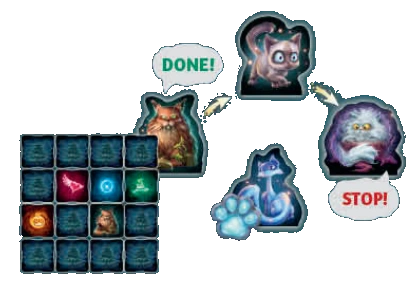
The round ends when one player has filled all
spaces in their grid. Those who play later get to
take a final turn.
This ensures all players have the same number
of turns. The last turn will always be taken by
the last player – the one sitting to the right of
the starting player marker. If the last player
is the first one to finish their grid, then no one
gets another turn.
Before proceeding to the next round, do the following:
1. Score your grid.
Count up your score for the round. Scoring
will be explained here.
2. Move your cat.
You may move your cat to a different tree tile or leave
it where it is.
3. Remove all trees.
Return all your tree tiles to the stacks. No one has seen
their wisp side, so they are still just random tiles that can
be dealt on someone's turn. (Do not return the tile under
your cat. Your cat is very possessive of that particular tile.)
Your wisp tiles stay where they are.
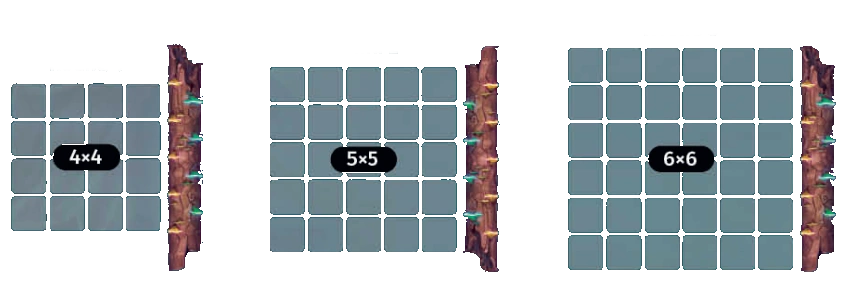
The game lasts 3 rounds. Each round has a larger forest. In the first round you are
limited to a 4×4 grid, round two uses a 5×5 grid, and round three goes up to 6×6.
Don't reset everything between rounds.
-
All wisps on the pond remain there, and new ones are not automatically added.
-
All hidden cats remain hidden.
-
Although trees are removed, you start the new round with old wisps still in your forest.
This means in later rounds you will have to figure out how to fit the shapes into a forest
that is already inhabited by some wisps!
Expanding Your Forest
In later rounds, you can expand your forest on any side.
Some wisps may start the new round disconnected from your cat (or any other wisps).
This is okay. New tiles can be placed beside any tile still in your forest.
NOTES ON GOAL CARDS
In most cases, any questions you have about a goal card can be answered by studying the example
shown on the card. However, some players may want to check these notes to reassure themselves
that they are interpreting the card correctly.
Note that some cards give you points for each wisp while others reward you for each group. Be sure
to read each condition carefully. The terms BESIDE, SURROUNDING, and GROUP are illustrated
here.
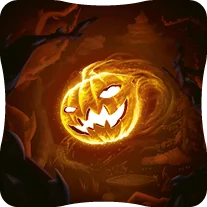
Pumpkin Patchwork, Pumpkin Seedoku, Double Cross
For these three cards, count all the jacks that meet the condition described by the
card. Then look that number up in the table to see how many points you score.
Pair of Jacks
A pair is the same as a "group of two". It is two jacks beside each other, but not
beside any other jacks.
Oh My Gourd
Count each group exactly once. If a group has multiple jacks, count it once. But
don't forget that a jack all by itself also counts as one group.
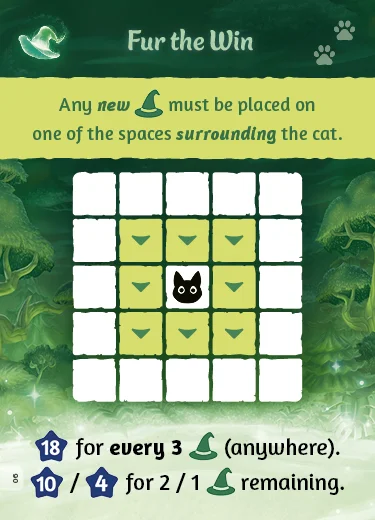
Witches work differently from the other wisps.
Each witch card shows where you can
place a witch in your forest. If you
can't place the witch where you are
supposed to, you are not allowed to
take it.
Tip: When you move your cat between
rounds, you can put it somewhere that
gives you space to place more witches.
All witch cards follow the same
scoring system, which goes by threes
and then gives some extra points for
extra witches.
When you score witches, count them
all! Count the ones you placed this
round and the ones you placed earlier,
regardless of where your cat is now.
Checkershire Cat
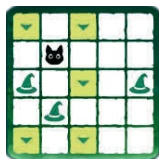
If you can trace a zigzag path (always diagonal, never horizontal or vertical)
from your new witch to the cat, and if each square in this path already has
a witch, then your new witch is diagonally connected as required by the
card. The card shows one witch off by itself, but that's because the cat was
moved between rounds.
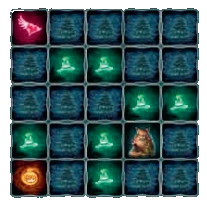 Example:
 You score all
7 witches, even though some
of them no longer meet the
placement condition. The
first three witches earn
18 points, the next three
add another 18, and the last
witch contributes 4 points.
You score 18+18+4 = 40 points
in total.
Orbs are always concerned about types of
wisps. Remember that trees are not wisps.
A Light Following, Merry Glow Round, Sign of Light
You count types of wisps. For example,
a group with 1 orb and 3 jacks has exactly
2 types of wisps.
Energy Synergy
An orb with no wisp beside it does not score.
Hide & Glow Seek
The placement of the wisps doesn't matter
for this card – you only care about how many
there are.

All these goal cards work the same way: For
each heart in your forest, count up the trees
that meet the condition and score points for
each of them. Even when the example shows
just one heart, you still count all of your
hearts, each one separately. It's possible for
one tree to be counted multiple times (by
different hearts).
Way of Light
Think of a beam of light, horizontal or vertical,
coming from the heart, shining through the
trees.
The beam doesn't stop until it hits an
empty space, your cat, or a wisp.
When counting trees for tree goals or wisp
goals, ignore the tree tile with your cat on it.
That square is not a tree, it is your cat.
Lower Branch, One Grove to Rule ...
If groups are tied for size, just pick one. For
Lower Branch, if you have only one group, then
you score 0 points.
You can play Wispwood by yourself, attempting to score more
points than a ghost player, Catty. Set up the game as for more players,
but with these changes:
Catty always plays first.

Instead of building a forest, Catty will collect wisps
and score them according to points shown on a scoring guide.
The scoring guides are on the back sides of the grid guides.
Each offers a different difficulty level – higher numbers are for
harder games. If you are new to Wispwood, start with the easiest
scoring guide – it is marked with only one paw:
Set aside one wisp of each type and randomly assign them to the
4 levels of the scoring guide. The highest wisp is worth the most
points for Catty, so it is the type Catty wants the
most.
The scoring guide is only for scoring Catty's wisps, not yours.
You score points for 5 goal cards, as usual.
Deal 8 wisps to the pond, as normal. Then,
choose a cat for Catty and replace
one wisp with the cat (discard the wisp).
During the game, Catty's cat will wander
clockwise around the pond, collecting wisps.
Keep this in mind when choosing the cat's
starting space.
Mix up the firefly tokens face down. Make a stack
of 4 at random for round one. Set the others
aside without looking at them. For round two,
you will mix them all together again and choose
6 at random. And round three uses all 8.
-
Flip over the top firefly token. That number is how many
wisps Catty's cat can see this turn. Look ahead
clockwise at that many wisps. (Do not count empty spaces.)
-
If there are not that many wisps on the pond, remove all
wisps (not the cat) and deal 7 new wisps at random.
-
From the wisps the cat can see, Catty takes the one that
scores the most points. If there are more wisps of that type,
Catty takes the one closest to the cat (the one the cat
would meet first, walking clockwise). Put Catty's new
wisp on the right side of the scoring guide, in the row for
that wisp type.
-
Move the cat into the space the wisp was taken from.
You always take your turn after Catty's turn. If you deal new
wisps, leave the cat where it is and deal 7 wisps at random.
If you complete your grid, the round
ends immediately. Otherwise, after Catty
resolves the final firefly, you take
your last turn, and the round ends then.
At the end of each round, you score
points as usual, including points for
trees and completing your grid. Catty
scores points only for the 4 types
of wisps. Each wisp is worth the points
shown on the scoring guide.
Like you, Catty keeps its wisps
between rounds and scores them again
in the following round.
Play 3 rounds and add up scores, as usual.
If you meet or exceed Catty's score, you win!
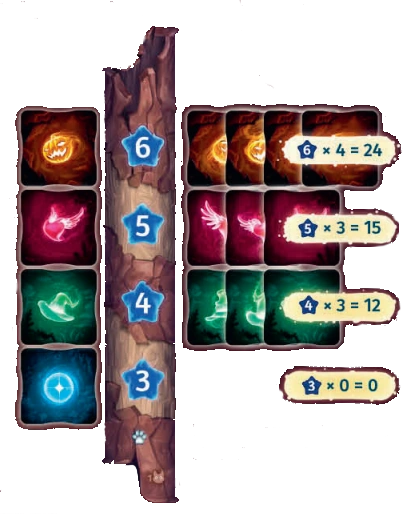
Catty scores 51 points at
the end of round two.