Contents
City Blocks
A board game for 2 players by J. Alan Henning
Art by Xavier Carrascosa
Introduction
Metro City is redeveloping an old industrial district for mixed use (residential, commercial and industrial) and the mayor is offering bonuses to two developers for aesthetic completion of key streets. Can you win greater bonuses than your competitor by strategically building homes, offices, stores, courthouses, schools and malls in ways that upset your opponent's plans for the city?
Contents
The game takes place on a board that represents a map of the city district to be developed. The board has a grid of city streets, 6 columns wide by 5 rows tall.
The bonuses that you may win are represented by 15 small Currency tokens, numbered from $1 to $15.
Each player has 20 Building tiles (light blue background for one player, light red background for the other):
- Residential Buildings (Houses), numbered 1 to 5
- Commercial Buildings (Stores), numbered 2 to 6
- Industrial Buildings (Factories), numbered 3 to 7
- Special Buildings 2 Schools, 1 Power Plant, 1 Mall, 1 Courthouse, all without numbers
Setup
Eleven randomly selected Currency tokens are placed face up to the left of the five rows and above the six columns. The four remaining tokens are not used. On Yucata, the starting player is selected automatically.
Each player's 20 Building tiles are shuffled. Five form the starting hand; the other fifteen form that player's hidden reserve.
Game Play
On a player's turn, they may place any one of the tiles from their hand to the city grid, in one of three ways:
- Develop an empty city block. They may place their Building tile on any empty city block (this is the most typical turn). If this was the last empty block on this street, they will need to award the mayor's bonus (see below).
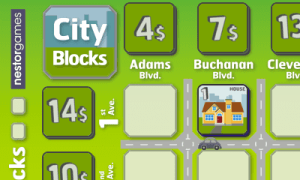
Example: Blue places a '1 house' tile.
- Redevelop an occupied block. They may pay their lowest Currency token to redevelop a city block on which they have already built. When redeveloping, they discard their Currency token and their past Building tile, removing both from the game.
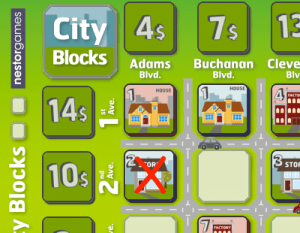
Example: Blue pays a 3$ token and removes a blue '2 store' tile from the board.
- Play a Courthouse. Each player has one Courthouse. When they place this, they may swap two unclaimed Currency tokens, revaluing the respective streets. (If the Courthouse completes a street, this is done before awarding that street's bonus.)
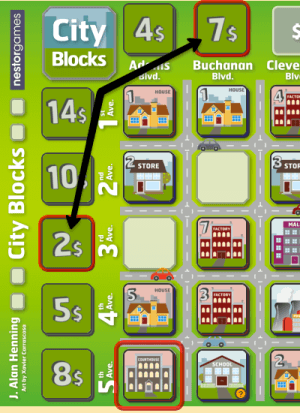
Example: Red places a Courthouse and swaps two currency tokens.
Confirming the turn draws one new Building tile while the player's reserve still contains tiles. Once the reserve is empty, continue with the remaining hand; a player with no tiles in hand passes.
Awarding a bonus
Whenever a player develops the last empty block in a street (a row or column), the mayor's bonus is awarded. Each player tallies the total of the numbers of their Buildings on the street: the highest score wins the bonus. However, certain tiles limit scoring. If one or more Schools or Malls are in the street, Industrial buildings don't count towards either player's score for that street; if one or more Power Plants or Malls are in the street, Residential buildings don't count towards either player's score. Note that Commercial buildings always count towards the score. Special Building tiles such as the Power Plant, Mall, School and Courthouse are all worth 0 points towards the score.
In the event of a tie, no one wins the bonus, and the Currency token for that street is discarded.
Sometimes developing an empty block will complete streets on both a column and a row. Score each street separately and award its bonus appropriately.
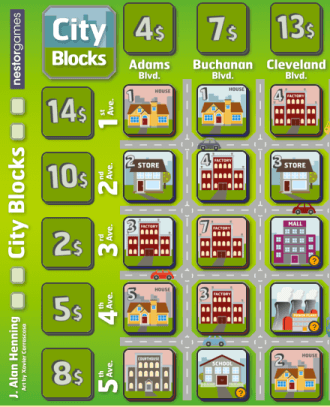
Example awards of bonuses:
Adams Blvd.: Red wins, 6 to 5. (The Courthouse is worth 0.)
Buchanan Blvd.: Blue wins, 1 to 0. (The School means Factories in this street, of either player, don't count towards the bonus.)
Cleveland Blvd.: Blue wins, 3 to 0. (The Power Plant and Mall both mean that Houses in this street don't count towards the bonus. The Mall also means that Factories don't count towards the bonus.)
Winning the game
When the last empty block is developed and the remaining streets are scored, each player totals their remaining Currency tokens. Whoever has the most money wins the key to the city. Equal totals are a draw.
Acknowledgements
Special thanks to Evan Rattner, Victor Manuel Gonzalez Miguel, David Ells, David Dolzan, David Lyons and Nathan Morse among others, for fueling the game on nestorbooster. Politician icon by Pete Fecteau from The Noun Project.