Regolamento

Regolamento - Carson City

Carson City

Introduction

1858. A new city rises - Carson City. You have rounded up a team of courageous cowboys, and your plan is to buy up the best parcels of land in this new town, then build them up with the most prosperous ranches, mines, saloons, etc. You will need guts to challenge your opponents to duels in order to secure and hold the best properties. You will also need to recruit and use the help of the most interesting 'personalities' in Carson City to aid your cause. The winner will be the most prominent citizen in Carson City, measured by victory points that can be won both during and after the game. At the end of the game, all players' belongings (money, buildings, parcels, mountains, houses) will be converted into victory points as well.

Rules adjusted to yucata

  • On Yucata, players may build roads only when constructing a building that requires a road connection.

Game Content

  • 1
    Board

    The board represents the territory of the future town of Carson City.
    Above the map of the city, the different actions of the game are depicted. The board on the reverse side includes the Carson River used when playing the variant 'The River'. In the first game, players should use the standard board.

  • 7
  • 51
    Cowboys (10 per color + 1 white representing the sheriff)
  • 10
    Markers (2 per color)

    to be used on the turn order track and to score victory points

  • 20
    Houses
  • 9
    Mountains
  • 25
    Roads
  • 30
    Buildings (6 ranches, 6 mines, 4 drugstores, 4 banks, 3 saloons, 3 hotels, 2 churches, 2 prisons)
  • 60
    property tiles (12 per color)

    to show the owner of each acquired parcel

  • 1
    Bag
  • 27
    Revolver
  • 1
    special '3 guns' chip
  • 30
    duel tiles

    used only with variant 'Might Is Right'

  • 30
    $1 coins
  • 20
    $5 coins
  • 22
    $10 coins
  • 6
    $20 bills
  • 1
    Round counter
  • 2
    Dice

Game Setup

  • Every player gets $15, 1 revolver, 1 road and 12 property tiles and 3 cowboys. Roads and cowboys constitute the personal reserve of this player.
  • The remaining money is piled near the board and constitutes the Central Bank. Houses, victory points, roads and remaining cowboys are placed near the board in the general reserve.
  • One ranch is placed on the $3 construction square and another on the $10 square.
  • A mine is placed on the $4 construction square and another on the $12 square.
  • 3 other buildings are drawn randomly from the bag and set on the remaining $5, $6 and $8 squares.
  • The center of Carson City is determined by rolling the dice (at the intersection of the column designated by the white die and the row designated by the black die).
  • A house is set on that parcel and four roads are placed along the house, one per side. These roads will later be extended through the rest of the town.
  • 9 mountains are placed randomly on the board (using the dice as above). If the designated parcel is already occupied, the dice are rolled again.
  • The special (3) gun tile is set on its square.
  • The turn counter is set on the start position.
  • For the first turn, randomly choose the turn order. The corresponding markers are set on the turn order track as a reminder of turn order.
  • Starting with the first player and then in turn order, each player chooses a parcel by placing a property tile on it. Next, starting from the last player and going back in reverse turn order, each player chooses a second parcel. Any parcel may be chosen, including a parcel with a mountain or the center of Carson City. The property tile will then be placed under the mountain or house tile.

How To Play

A game is divided into four rounds, each composed of four phases:
  1. Choice of personality

    • All personality cards are placed near the board. Then, each player according to turn order chooses one of them. Certain choices may be directly followed by an action depending on the personality.
    • When all players have chosen a personality, the turn order is modified. The markers are placed on the upper turn order track in ascending order, according to the number indicated on the personality cards that have been chosen.
  2. Cowboy Placement

    Turns are taken in player order. Each turn you choose one action:
    • Choose an action:
      Place a cowboy from your reserve onto one of the action squares above the city's map.
    • Choose a parcel of land:
      Place a cowboy from your reserve onto one of the parcels.
    • Attack/defend a building:
      Place a cowboy from your reserve onto a building to attack it (or defend it if this building is yours).
    • Pass:
      Move your marker onto the first free position of the lower turn order track. Your turn is over. You are not allowed to place additional cowboys during this round.
    None of these options is obligatory. But you have to choose one of them unless you have passed. For each action (except pass), the player must always place exactly one cowboy. During a round the player may place cowboys on several action squares and/or parcels. You may place a cowboy on a square or a parcel already occupied by another player's cowboy. This will lead to a duel. On some squares, one player can place several cowboys.
  3. Performing The Actions and Duels

    • After all players have passed, the actions are performed one by one according to the sequence on the board, following the winding path. As soon as an action is completed, the cowboy goes back to the general reserve.
    • If several players have placed a cowboy on the same square or parcel, a duel occurs. Every player involved rolls a die. The number obtained is added to the number of revolvers and cowboys in the respective player's reserve.
      The winner is the player with the highest total. The winner has won the right to perform the action. The winner's cowboy goes into the general reserve. The loser(s) will not perform the action. Their cowboys return to their personal reserves.
      In case of a tie, the player (among the ones involved in the tie) with the lowest turn order (closest to zero) number on the turn order track is the winner (ie the player who passed earliest).
  4. End of Round

    After all actions have been performed:
    • The round counter is moved one square forward (left), blocking this square and any to the right of it from being used for the rest of the game.
    • Each player receives new cowboys (in the respective player color). They are taken from the general reserve to be placed into the respective personal reserves. At the end of the 1st round each player gets 4 cowboys, and at the ends of the 2nd and 3rd rounds, each player gets 5 cowboys. The maximum number of cowboys in your personal reserve is 10.
    • Money beyond your cash limit (indicated in red on the personality card in your possession) must be given up, even in the last round. You get 1 victory point per $10 that you must give up. You are allowed to spend more money, but you always receive 1 victory point per $10.
    • The buildings that have not been bought are shifted sequentially towards the squares with lower prices (as far as possible). For each remaining available position one building is drawn randomly from the bag and placed on the Action track before the beginning of the next turn.
    • Put the personality cards back next to the board. The white cowboy goes back in the general reserve.
    • The special '3 guns' tile goes back to the relevant action square.

End Of The Game

The game ends at the end of the fourth round, after the players have given up the money that was beyond the cash limit of their personality card for that round. In addition to the victory points acquired during the game:
  • Each building, house and mountain gives 2 victory points to their respective owner.
    Empty private parcels as well as buildings in the player's reserve do not reward victory points.
  • Any remaining money is also used to buy victory points (at $6 per victory point).
The winner is the player with the highest number of victory points. In case of a tie, the player (among those involved in the tie) with the lower number on the turn order track wins (ie the player who passed earliest).


Actions

A player may decide to not perform an action (for example, if they realize that they will not have enough money for everything), even after winning a duel for that action. Regardless, their cowboy goes to the general reserve. The actions are always performed in the sequence indicated on the board:

Wages

Wages

No duel on this square. Each player receives $4 for each of their cowboys on this square, which means that a player can place multiple cowboys on this square.
Ammunition

Ammunition

The player who wins this action receives the special 3 guns chip for the rest of the round.
3 Roads

3 Roads

The player who wins that action receives 3 new roads to put in their personal reserve.
The roads in the personal reserve are available for construction and may be placed on the board at any time during the game (attention: this is changed at yucata).
Road

Road

No duel on this square. Each player receives one road for each of their cowboys on this square, which means a player can place multiple cowboys here.
Important: A newly constructed road must always extend previously placed roads.
Parcel purchase

Parcel purchase

To buy an owner-free parcel, a player must have put a cowboy on it (and not on the parcel purchase square) during the cowboy setting phase. They may buy it now. If several players try to buy the same parcel, a duel determines the winner. This parcel may already contain a house or a mountain.
The parcel price is $1 plus $1 for every building, mountain or house situated on this parcel or next to it (including diagonally). The amount is paid to the Central Bank and the player must place a property tile. The cowboy goes to the general reserve.
On Yucata, if several parcel purchases require duels, the player who passed first that round chooses their order. The publisher's 2024 rules give that choice to the earliest passer involved in at least one of those duels.
Building construction

Building construction

There are seven 'building construction' squares, each giving the right to build one building at the price indicated on the bottom of the square. The building process consists of the player placing a building on one of their property tiles with two conditions:
  1. The parcel must be reached by a road. At least one road must touch one corner of the parcel. If there is no road reaching the parcel yet, the player is allowed to place one or more roads on the board from their personal reserve.
    Exception: ranches and mines do not need to be reached by a road before being built.
  2. When building a drugstore, a hotel, a bank, a saloon, a church or a prison the player must also place a house for the new inhabitants attracted by this new activity. This house has no cost and must be placed on a free parcel (no building, no mountain, no house) reached by a road. This parcel may already belong to the player. The house may also be built on a parcel already belonging to another player (upon agreement) or on an owner-free parcel. In this last case, the parcel may still be bought later.
Important: Instead of building it immediately a player may also keep the purchased building in front of them and build it later (for example, because the parcel has no road connection yet or because they cannot find a position for the required house). To place it on the board, they must wait until the end of the 'building construction actions'. If more than one player wants to build a building from their reserve, this is done in player turn order. All players may have several buildings in front of them.
Parcel income

Parcel income

The player who wins this action gets $2 per parcel they own. They count all parcels, even the ones with buildings on them.
Cowboy income

Cowboy income

The player who wins this action gets $2 for each firepower point. A player's firepower is the number of cowboys and revolvers in their personal reserve.
Gambling income

Gambling income

The player who wins this action rolls two dice and receives the rolled amount in cash.
On Yucata, the eligible player must roll the dice.
Estate income

Estate income / attacks on buildings

Each building earns money for its owner, depending on the buildings and houses in the vicinity. This action is automatic; there is no need to put a cowboy on a square to get this income.
It is possible to put a cowboy on a building of another player to attack it. It is also possible to place a cowboy on your own building to protect your income. The attack succeeds if the building is not defended or if the attacker wins the duel. If the attack succeeds, the attacker steals half of the income of that building (rounded down) from its owner. If a duel must be carried out for more than one attack, the player who has passed first decides in which order the duels will take place.
Important: When a house does not belong to a specific player (when it is built on an owner-free parcel), it can increase the values of all neighboring buildings, whoever the owners are. However, when built on a parcel belonging to a player, this house will only benefit the buildings of that player. In the same way a mountain owned by a player does not count towards the income for an adjacent mine belonging to another player.
Parcels victory points

Parcels victory points

The player who wins this action gets a number of victory points corresponding to half the amount of parcels they own (rounded down). These parcels do not have to be adjacent. The player counts all parcels even the ones with buildings on them.
Cowboy victory points

Cowboy victory points

The player who wins this action gets an amount of victory points corresponding to half their firepower (rounded down). A player's firepower is the number of cowboys and revolvers in their personal reserve.
Estate victory points

Estate victory points

The player who wins this action gets an amount of victory points corresponding to the number of buildings that are placed on their parcels (mountains and houses excluded).
Buying victory points

Buying victory points

The player who wins this action may buy victory points at the price of $2, $3, $4 or $5 per victory point.

Buildings

Wohnhaus

House

Setting conditions: The parcel on which the house is built must be reached by a road.
Income: -
Special rules: Houses are never bought. They come into play when other buildings are built.
Bank

Bank

Setting conditions: The parcel on which the bank is built must be reached by a road and the player must also build a house.
Income: $3 per neighboring house (without owner or owned by the player) and per mine (owned by the player). The mines do not need to be neighboring the bank.
Ranch

Ranch

Setting conditions: No placement restriction.
Income: $1 for every neighboring free parcel, no matter the owner of the free parcel. Minimal income: $1. Several ranches may benefit from the same free parcel. A free parcel is a parcel not occupied by a building, a mountain or a house.
Special rules: A ranch adds 1 point to firepower (+1 revolver). A ranch is considered a house when calculating drugstore, bank and saloon incomes. The player who builds a ranch takes a revolver and adds it to their personal reserve.
Saloon

Saloon

Setting conditions: The parcel on which the saloon is built must be reached by a road and the player must also build a house.
Income: $5 per neighboring house (without owner or owned by the player).
Drugstore

Drugstore

Setting conditions: The parcel on which the drugstore is built must be reached by a road and the player must also build a house.
Income: $3 per neighboring house (without owner or owned by the player) and per ranch (owned by the player). The ranches do not need to be neighboring the drugstore.
Hotel

Hotel

Setting conditions: The parcel on which the hotel is built must be reached by a road and the player must also build a house.
Income: $6
Special rules: A hotel is considered two houses when calculating drugstore, bank and saloon incomes.
Silbermine

Mine

Setting conditions: No placement restriction.
Income: $3 per neighboring mountain. Several mines may benefit from the same mountain. Once you own a mountain, it no longer benefits other players' mines.
Special rules: A mine adds 1 point to firepower (+1 revolver). The player who builds a mine takes a revolver and adds it to their personal reserve.
Church

Church

Setting conditions: The parcel on which the church is built must be reached by a road and the player must also build a house.
Income: -
Special rules: A church is considered a house when calculating drugstore, bank and saloon incomes. A church allows the player to prevent other players' attacks. All buildings of yours directly adjacent to your church cannot be attacked. If you build a church near one of your buildings being attacked, the attack is cancelled. The attacker's cowboy returns to their personal reserve. You are not allowed to attack a church.
Prison

Prison

Setting conditions: The parcel on which the prison is built must be reached by a road and the player must also build a house.
Income: -
Special rules: The prison adds 2 points to firepower (+2 revolvers). The player who builds a prison takes 2 revolvers and adds them to their personal reserve.
Personalities

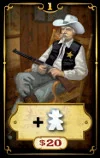
Sheriff

Sheriff

Take the special 'sheriff' cowboy from the general reserve (white cowboy). This allows you to select one action without fear of being attacked (no one challenges the sheriff to a duel). Therefore, the white cowboy must not be placed to attack a building or to challenge someone into a duel (it must be played on a cowboy-free square).
Cash limit: $20
Sheriff red Red Side:
You are not allowed to attack any building or engage in a duel (except to defend your own building). For every lost duel you receive 3 victory points.
Cash limit: $20
Chinese worker

Chinese worker

When you choose the Chinese worker, you immediately receive two roads. In addition, the price of all buildings is halved (rounded up).
Cash limit: $30
Chinese worker red Red Side:
You may immediately pay $5 and take one of the available buildings. You may build it immediately or keep it to build it later. The remaining buildings are immediately shifted towards lower prices and a new building is drawn from the bag.
Cash limit: $30
Banker

Banker

When you choose the banker, you immediately receive $9.
Cash limit: $120
Banker red Red Side:
At the end of the round before your cash limit is checked, you may purchase 3, 5 or 7 victory points for $3, $12 or $25 respectively.
Cash limit: $60
Settler

Settler

The settler immediately gives you a parcel (it must be an owner-free parcel at the moment you take it).
Cash limit: $30
Settler red Red Side:
You receive either $8 immediately or you receive 1 victory point per mountain you own at the end of the round.
Cash limit: $20
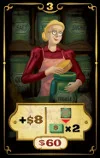
Grocer

Grocer

The grocer allows you to either:
- double the income for one particular building type (for example all banks) during the estate income phase. If a building with double income is attacked then you and the attacker receive normal income.
- or receive $8 (immediately or during estate income phase).
Cash limit: $60
Grocer red Red Side:
You receive either $8 immediately or 1 victory point per house you own at the end of the round (except ranches, hotels and churches).
Cash limit: $60
Captain

Captain

You may immediately pay $1 to get one extra cowboy from the general reserve or $4 to get two extra cowboys from the general reserve or $9 to get three extra cowboys from the general reserve.
Cash limit: $25
Captain red Red Side:
You pay either $3 to receive a revolver tile or $9 to receive two revolver tiles. You keep these revolver tiles until the end of the game.
Cash limit: $20
Mercenary

Mercenary

During this turn, you have 3 extra firepower points.
Cash limit: $20
Mercenary red Red Side:
During this turn, you have 2 extra firepower points.
Cash limit: $30

Variants

Rule adjustments for the variants

  • In The River variant, players may place their remaining roads after the final round, in the order of the personality cards.
  • In A New Beginning, the marksman uses the higher of the two dice.

The red sides of personality cards

In the standard game, the yellow sides of the personality cards are used. But you can also choose to play with the cards on their red side. Random choice is also available.
Additionally, the side may be chosen individually for each personality card. If this variant is chosen, each player may choose the side of each card at the beginning of the game. When all players made their choice, the personality cards will be played with the side the most players wanted to play with. In case of a tie, the side is randomly chosen.
If players want to play with particular sides, they can come to an agreement via PM or chat and simply choose the same side each.


Might Is Right

This variant proposes less randomly determined duels, replacing dice with duel tiles. To play this variant you have to use the following modifications.

During game setup:

For a 2 player game each receives 6 duel tiles numbered 0 to 5 and $15.
For a 3-5 player game take 6 duel tiles (from 0 to 5) per player and mix them. Each player receives 6 duel tiles at random and keeps them secretly. Each player announces the total sum of points on their duel tiles. As starting cash each player receives $30 minus that sum.

How to perform duels: Instead of rolling dice, each player challenged at a duel chooses and plays a duel tile which adds that number of points to their firepower. Duel tiles are discarded after use to make a new stockpile. When a player has no duel tiles left, they take three new ones at random from the stockpile.


The River

To play this variant, use the reverse board showing a river. The following modifications apply:

Setup:

- All river parcels must be kept free (no mountain and no city center).
- 6 mountains are placed instead of 9.

It is neither allowed to buy a river parcel nor to build a building or a house on a river parcel.
A river parcel is considered as a free parcel when calculating ranch incomes. (thus +$1 per river parcel).
If a mine is in contact with the river, the mine income is increased by $3, no matter the number of adjacent river parcels.
Two roads are necessary to cross the river. A double road crossing the river is called a bridge.
At the end of the game, any private parcel with a mountain, building or house in contact with a bridge brings 3 victory points instead of 2.


A new beginning

Each player begins the game with $50 and one cowboy. Then each player may secretly buy additional cowboys, revolvers, roads, parcels, victory points, special powers... or save money to begin the game. You can even choose to 'pay' 5 or 10 victory points to receive more money to spend. Choices are revealed simultaneously.

Each player may also bid for first pick of the personality cards. The highest bidder pays their bid. Draw lots to break a tie.

  • Influential Connections. Choose the side of your regular personality card when you select it.
  • Great Service Done. Once per game, choose an unclaimed personality after everyone has chosen their regular card. Use both abilities and add both cash limits together. Your earlier card sets your turn order.
  • Marksman. In a dice duel use the higher of two rolls. With duel tiles, draw five instead of three when refilling. After playing a tile, you may also discard your last one or two tiles to refill early.
With the 'Might is Right' variant, each player receives 6 duel tiles numbered from 0 to 5, the same as the game for two players.

Base game details

  • Adjacency: Parcels next to each other horizontally, vertically or diagonally count as adjacent. A parcel has a road connection if a road connected to the network touches its corner or side. New roads must connect to the existing network. On Yucata, the road-building restriction described above still applies.
  • Passing: You may pass while you still have cowboys in your personal reserve, including before placing your first cowboy. After passing, you may place no more cowboys that round. The passing order sets the order for choosing personalities in the next round and breaks ties in duels and final scoring.
  • Declining an action: Under the printed rules, the winner of a duel may decline the action. Their cowboy still goes to the general reserve. Only the losing cowboys return to their personal reserves. On Yucata, players cannot decline the gambling action.
  • Houses built with other buildings: The additional house must connect to the road network. It may be on a parcel away from the new building. Ranches and mines require no additional house.
  • Building income: Players collect building income without placing a cowboy on the income action. A successful attacker receives half the income, rounded down, and the owner keeps the rest. Houses and mountains owned by other players do not increase your buildings' income. An unowned neighboring house or mountain can benefit more than one player.
Ready to play?