The Triassic is the first of the three periods of the earth's Mesozoic Era.
Beginnning about 250 million years ago after external influences destroyed 95% of all living creatures, it lasted about 45 million years.
It was during this period that the ruling reptiles and dinosaurs made their first appearance on land.
It closed with the Jurassic, the heyday of the great dinosaurs, and the Cretaceous.
During the Mesozoic the super-continent Pangaea broke up into several individual continents.
Components
39 hexagonal tiles
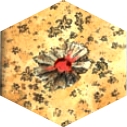
south pole |
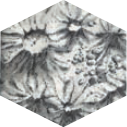
9 x mountains |
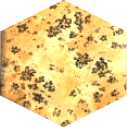
15 x plains |
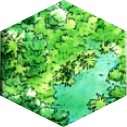
12 x woods |
2 x waters |
1 Scoring track for counting the victory points
16 wooden cubes in 5 different colours (1 wooden cube = 1 herd)
39 cards
The cards are marked with 1 or 2 on their backs.
Idea of the game
The super-continent Pangaea threatens to split into various parts.
The players represent herds of living creatures which can move and reproduce.
With skillful tactics each player tries to keep his creatures safe on the new land masses (i.e. connected land areas) and gain majorities there.
Setting up the game
The Alternate Rules for Two Players can be found at the end of this document.
The players agree to a start player.
The decks labeled 1 and 2 are shuffled separately.
Then the deck 1 is placed face down on top of the face down deck 2.
Together they are now called the deck.
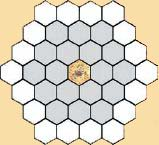
The board is built into one, big, symmetric hexagon using the hexagonal tiles.
As shown in the illustration it consists of three concentric rings with the south pole in the middle.
All land tiles are shuffled. 16 of these plus the two water tiles are randomly dealt and placed to form the two inner rings.
The third ring is built using the rest of the tiles. Two tiles will be left over; these are removed from the game.
After completing the board, remove the water tiles. All areas having no tile are considered to be water.
Each player is dealt a card face down from the deck and given 15 herd cubes.
One additional cube is placed next to the scoring track.
In anti-clockwise order, each player places 2 herds together on a vacant tile, beginning with the start player.
Continuing anti-clockwise, each player once again places 2 herds together on a vacant tile.
The last player to place 2 herds starts play of the main game.
| TIP |
Extensive dispersion of one's own herds and presence on many land tiles is an advantage.
Too much concentration in one area makes development difficult. |
| TIP |
It is mostly unwise to place too far towards the center since everything tends to move to the outer part of the board and thus too many movement points are required.
But being too much on the outside can mean one's creatures are already swimming before one has even had a turn. |
Course of the game
The direction of play is clockwise. Each turn has four phases played in a fixed sequence.
Phase 1: Mandatory Drift
Phase 2: Optional Actions
Phase 3: Swimmers/Overpopulation
Phase 4: Hand Card
General rule for the entire game
The herd capacity of each tile is limited depending on food.
This capacity may never be exceeded.
At maximum occupation the herds present constitute a blockade which prevents the tile from being entered or crossed and also prevents any herds there from reproducing.
The allowed number of herds depends on the landscape type.
2 herds
mountain |
3 herds
plain |
4 herds
wood |
| Remark | The south pole is a plain and can hold 3 herds. |
Phase 1: Mandatory Drift
Each player decides whether to play his hand card.
If he does not want to play his hand card, he may draw a card from the deck.
He must then play the drawn card.
The colour of the card indicates which type of tile drifts.
If the drawn card is the Meteorite Impact card, this player's turn is the beginning of the last round.
Drifting
A tile bordering the surrounding water (not an interior sea!) is picked up.
The picked up tile must be moved to as to border another tile and so that it is now further away from the south pole than before and at least one edge must border the surrounding water.
A tile may only be picked up from a land mass where you have at least one herd.
Taken tiles must be connected back to the same land mass again.
Special case: If removing a tile causes two or more distinct land masses to arise, the player may connect it to any of these land masses, even if he is not present there.
It is allowed to take tiles on which herds are present.
These herds remain in position, which is now in the water. They are called Swimmers.
If a player has no herds on land masses which include the type he must drift, or if he is unable to move any of these tiles further away from the south pole, he must choose a tile of another colour.
If the drifting of tiles causes any new land masses to arise, there can be interim scoring.
| Remark | If a land mass consists of only 1 tile, it may no longer drift. |
|---|
| Remark | The south pole never drifts (never moves). |
|---|
Example 1
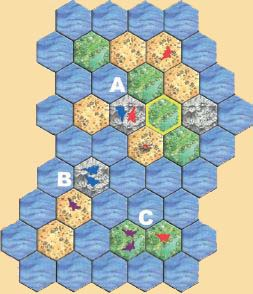 |
It is Red's turn.
He must drift a tile having the same colour as his hand card from the big land mass of size 11 or from the small land mass of size 2.
The chosen tile must be placed further away from the south pole and must be re-connected to the same land mass.
The tile with the yellow border in the middle may not be used because it does not border water.
Red cannot take any tile from the land mass consisting of 3 tiles because he is not present there. |
Phase 2: Optional Actions
Each player on his turn has four actions.
For the actions he has four different options.
He may combine these actions in any way he likes.
Thus, a particular option may be performed more than once per turn.
He is not required to use all of the actions, but unused actions are lost.
Announcement Requirement: With each action the player must announce how many actions he has already taken.
Option 1:
Kosten:
Bedeutung: |
Drift
3 actions per tile
No card is played, but you drift a qualifying tile as described in the drift rules. |
Option 2:
Kosten:
Bedeutung: |
Move
1 action per herd and tile
Movement is only possible from one tile to an adjacent tile. A herd may be moved more than once per turn. |
Option 3:
Kosten:
Bedeutung: |
Rescue
1 action for 3 swimmers
You can rescue up to 3 of your own swimmers, which need not be at the same location.
Rescue places them on a tile adjacent to their locations.
Each herd can move to a different adjacent tile, but is not required to do so. |
Option 4:
Kosten:
Bedeutung: |
Reproduce
1 action per herd
Any herd on a tile can reproduce only once in the player's turn.
This means a new herd from the player's stock is placed on the same tile.
Reproduction is independent of whether the herds have already moved or not.
Herds which have just arrived via reproduction in this turn may first reproduce only on the player's next turn. |
Phase 3: Swimmers/Overpopulation
All Swimmers and herds on overpopulated tiles of the active player are placed back into his stock.
| Remark |
Overpopulation is only possible when a tile arises under swimmers and the tile capacity is exceeded.
Fully populated or overpopulated tiles may not be entered or crossed. |
|---|
If the tile is overpopulated the player must return herds to his stock until the tile capacity is reached.
Herds of other players on this tile are only affected on their turns.
Phase 4: Hand Card
If the player used his hand card in phase 1 he receives a new card from the deck.
If this new card is the meteorite impact card, it is immediately revealed and the last round begins with the player to his left.
Each player always has exactly 1 hand card.
Last round and end of the game
In the last round there is no mandatory drift.
Each player has 2 actions. Afterwards there is final scoring.
| TIP |
If you have no more herds in your stock before your last turn, you can only move.
One or two herds in your stock can possibly still change some majorities on the land masses. |
|---|
Scoring
Scoring is indicated using the cube of the player's colour on the scoring track.
Interim scoring
If a new land mass arises after separation from the main land mass (= land mass containing the south pole), score this land mass if the drifted tile is connected to the new land mass. A connection to the main land mass will not be scored.
If division causes yet another new land mass to arise, score the land mass to which the taken tile is connected.
If through the above mentioned cases no new land mass is created, but rather this land mass is connected with another land mass or the main land mass there will be no scoring.
All players having the majority of herds on the scored land mass receive 2 victory points. All other players having the second most herds receive 1 victory point.
Example 2
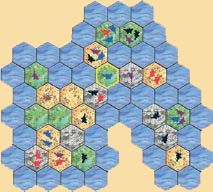 | It is Red's turn and he takes the tile with the yellow border. The herd on this tile becomes a swimmer at this position. The player now has the following options for connecting the tile: |
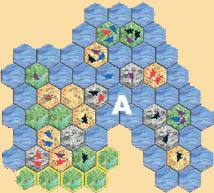 | AThere is no scoring because the land mass contains the south pole. |
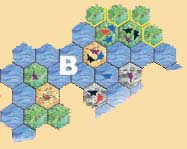 | BThe new land mass with 4 tiles is immediately scored. The blue and the black player have 3 herds each and receive 2 points. The purple player is present only twice and gets 1 point. The red player in third place with only 1, gets no points. |
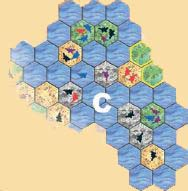 | CThere is an immediate scoring on the land mass with 3 tiles. Red is present twice and gets 2 points. Purple is present once and gets 1 point. |
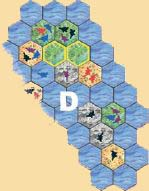 | DThis is a re-connection of two land masses and therefore there is no interim scoring. |
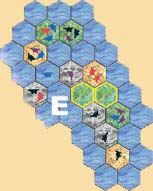 | EThis is a re-connection of two land masses and therefore there is no interim scoring. |
All other water positions are not allowed because either they are not further from the south pole or they do not border the original land mass.
Final scoring
All land masses are scored separately.
The land mass containing the south pole is not scored.
In final scoring all fractional points are rounded to the next largest integer value.
The player with the largest number of herds on the scored land mass receives 1 victory point per tile of the land mass. The player with the second largest number of herds receives half this number of points.
If a player is the only one with herds on an land mass, he receives only the points for the first rank.
If two or more players are tied for the most herds they split the sum of the victory points of the first and second places. All other players get no points.
If there is a single player in first place and two or more players are tied for second place, then the first place player receives the tile count as victory points and all second place players divide half the tile count as victory points.
| TIP |
Final scoring provides most of the points in the game and also the largest differences; nevertheless, no one should neglect the interim scorings. |
|---|
Example 3
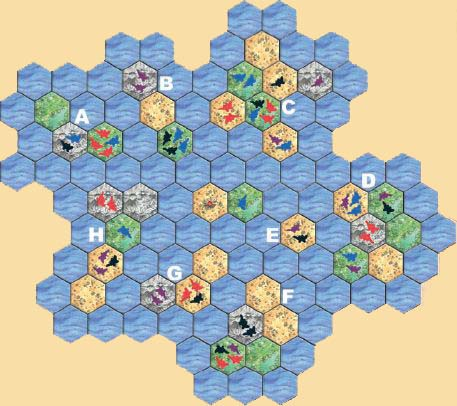
| Island | red | purple | blue | black |
|---|
| A | 3 | - | 2 | - |
|---|
| B | - | 2 | 2 | 2 |
|---|
| C | 6 | - | 6 | - |
|---|
| D | - | 5 | 5 | - |
|---|
| E | - | 1 | - | 1 |
|---|
| F | 3 | - | - | 5 |
|---|
| G | 3 | 3 | - | - |
|---|
| H | 4 | 4 | - | - |
|---|
| Total | 19 | 15 | 15 | 8 |
|---|
The points shown on this table are carried over to the scoring track.
Winner
The player with the most victory points wins.
In cases of identical points the player who has most herds in his stock wins.
If there is still a tie, the player who is present on more land masses wins.
If still tied, all such players win.
Alternate rules for 3 players
Remove a card of each landscape type (1 mountain, 1 plain, 1 wood) from deck 1.
For an even shorter game you can remove 2 cards of each landscape type.
Alternate rules for 2 players
10 herds per player plus 1 cube each for the scoring track:
south pole |
5 x mountains |
7 x plains |
6 x woods |
During phase 2 each player receives only 3 actions per turn.
There is no interim scoring.