Overview and object
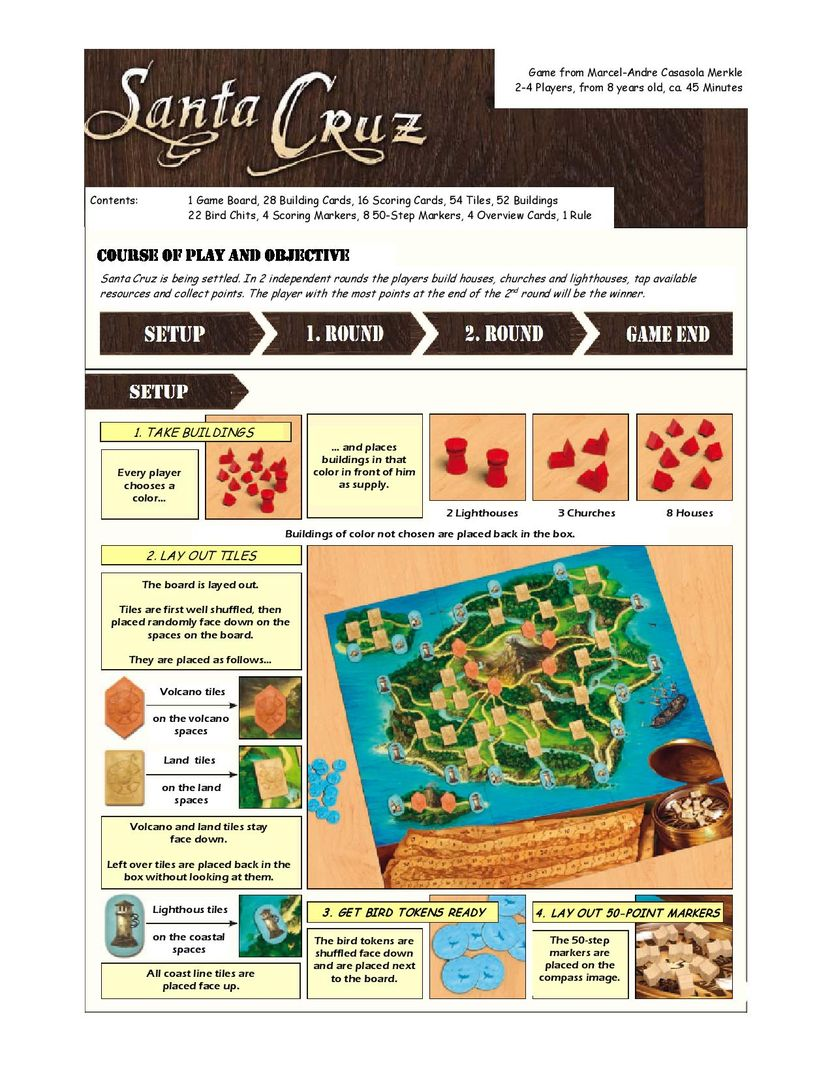
For 2–4 players, ages 8 and up · About 45 minutes.
Settle Santa Cruz in two independent rounds. Build houses, churches and lighthouses, gain access to resources and score  . After the first round the buildings are removed and you choose cards again: knowledge of the island and scoring cards gives you a second chance. Whoever is furthest ahead after the second round and the final bird-token scoring wins.
Components
1 board, 28 building cards, 16 scoring cards, 54 tiles, 52 buildings, 22 bird tokens, 4 scoring markers, 8 fifty- markers and 4 reference cards.
Round one
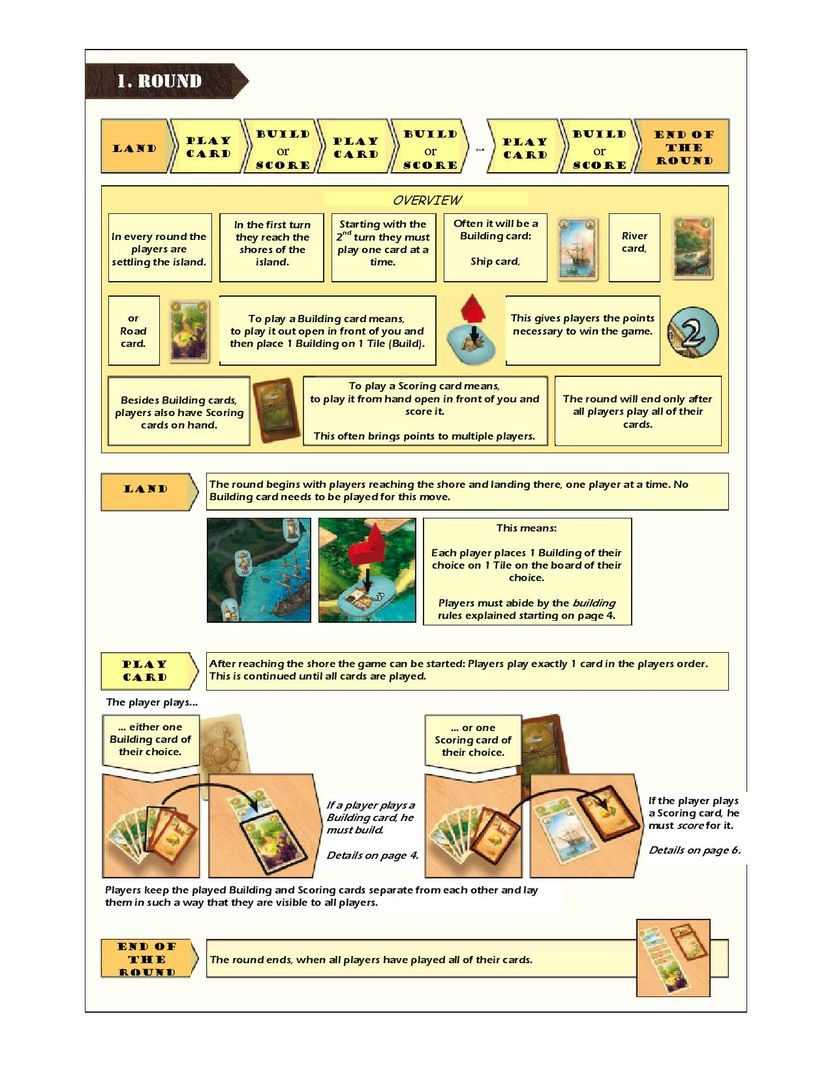
Play always proceeds clockwise. Each round starts with landing, followed by card turns until everyone has played all their cards.
Landing
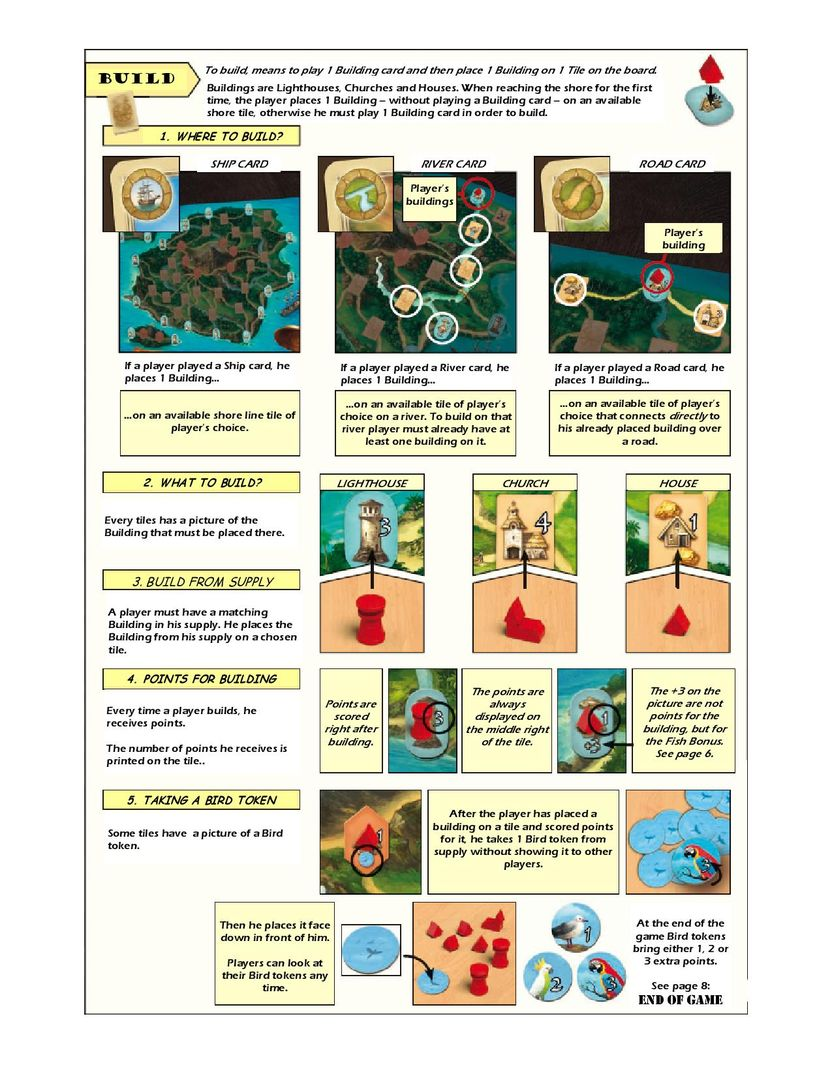
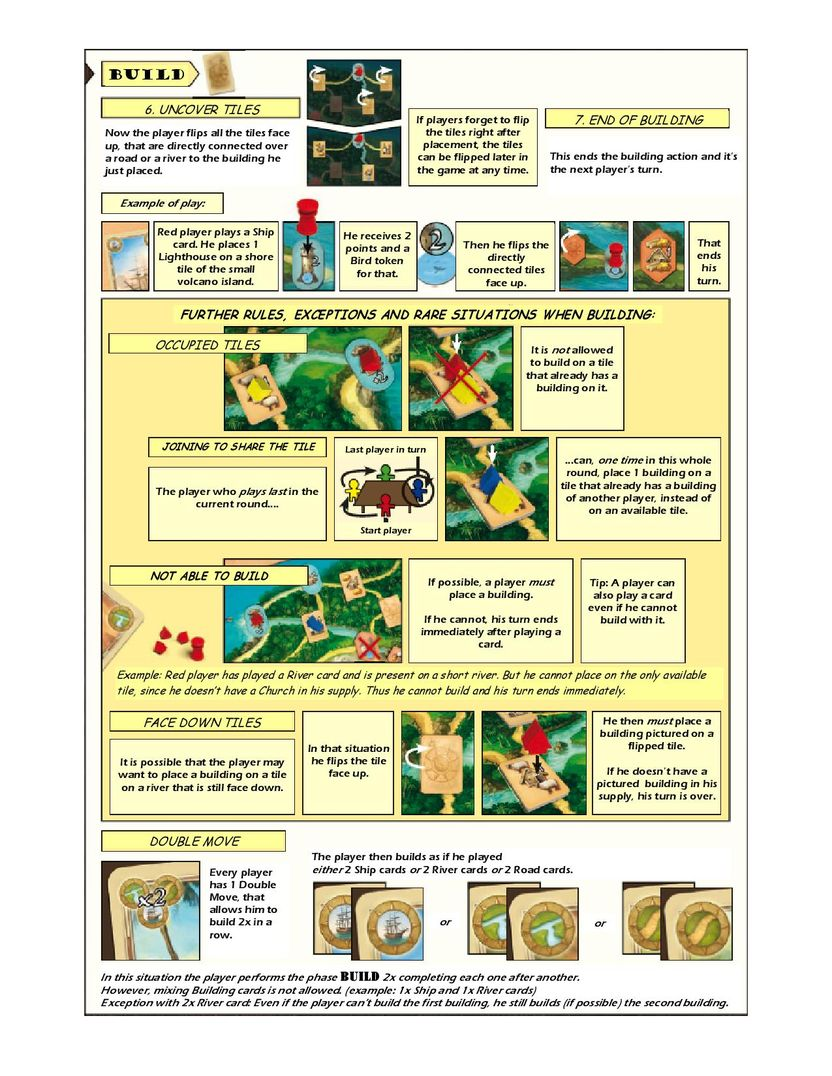
Starting with the first player, each player places a building on an available coastal tile of their choice, without playing a card. Apply the normal building rules: use the building shown, score , take a bird token if indicated and reveal adjacent tiles.
Play one card
From your second turn onward, play exactly one card face up. A building card requires you to build; a scoring card requires you to score. Keep played building and scoring cards in separate visible groups so everyone can see what has been played. The round ends only when all players have played all their cards.
Further building rules and exceptions
Occupied tiles and sharing
Normally you cannot build on an occupied tile. The player who goes last in the current round has one exception: once in the entire round, they may add a building to a tile occupied by another player. The played card must still reach that tile and all other building rules apply. This privilege may also be used when landing. You cannot share a tile with your own building.
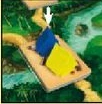 Once per round, the last player may join another player on a tile.
Unable to build
You must place a building if you can. If you cannot, that build ends immediately after playing the card. You may deliberately play a card with which no build is possible.
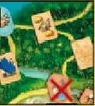 Example: Red plays river. The only available tile needs a church, but Red has none left in supply. The build is lost.
Face-down river tiles
A river card may target a face-down tile on the appropriate river. Reveal it first, then place the building shown. If you have none of the required type left, that build ends without placing a building.
Double move
The double-move card lets you build twice consecutively, as if you had played two ship cards, two river cards or two road cards. Complete the entire build, including , bird tokens and reveals, before starting the second. The second build may benefit from the first. You cannot mix types, such as ship and river.
Two-river exception: Even if the first build fails, carry out the second if possible.
Scoring
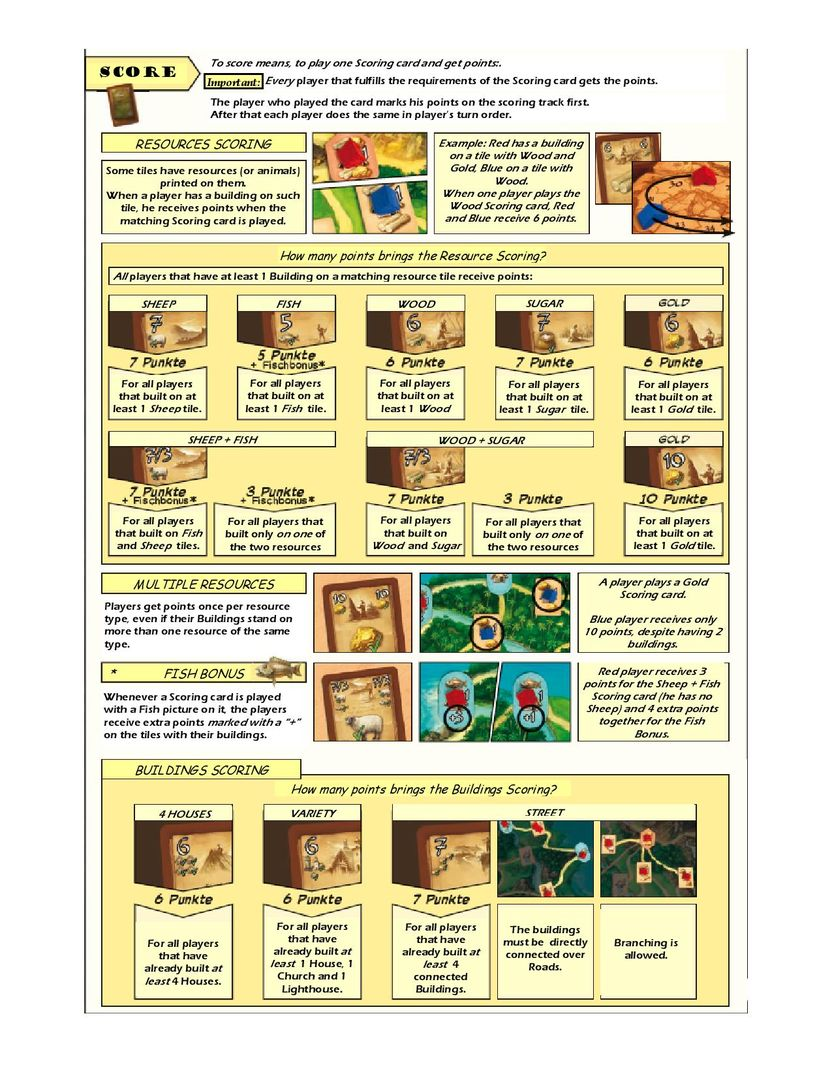
Play a scoring card face up and check its condition. Every player who meets the condition scores, including opponents. The player who played the card moves their marker first; the others follow clockwise.
Resource scoring
You have a resource or animal if at least one of your buildings occupies a tile showing it. A single-resource card pays its once, even if several of your buildings provide that resource. A combined card pays 7 for both resources or 3 for only one. Without either resource you score nothing.
Fish bonus
Whenever a card with fish is played – fish alone or sheep + fish – each player adds all bonuses marked “+” on their occupied fish tiles to their scoring-card .
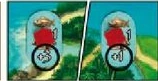 Example: Red has fish tiles marked +3 and +1 but no sheep. Sheep + fish scores 3 + 3 + 1 = 7 .
All 16 scoring cards
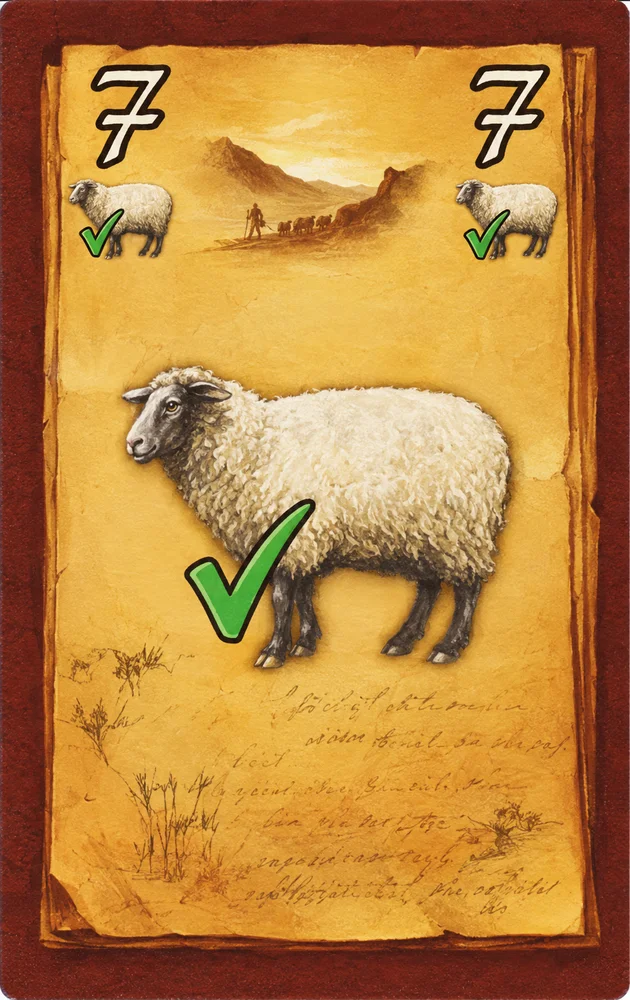 Sheep: 7 if present.
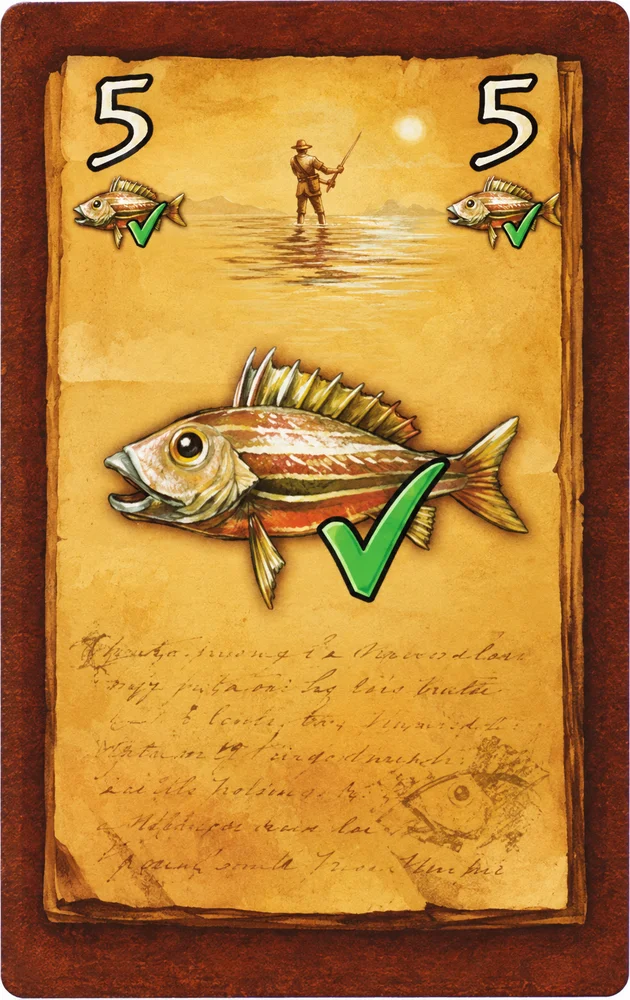 Fish: 5 plus all fish bonuses, if fish is present.
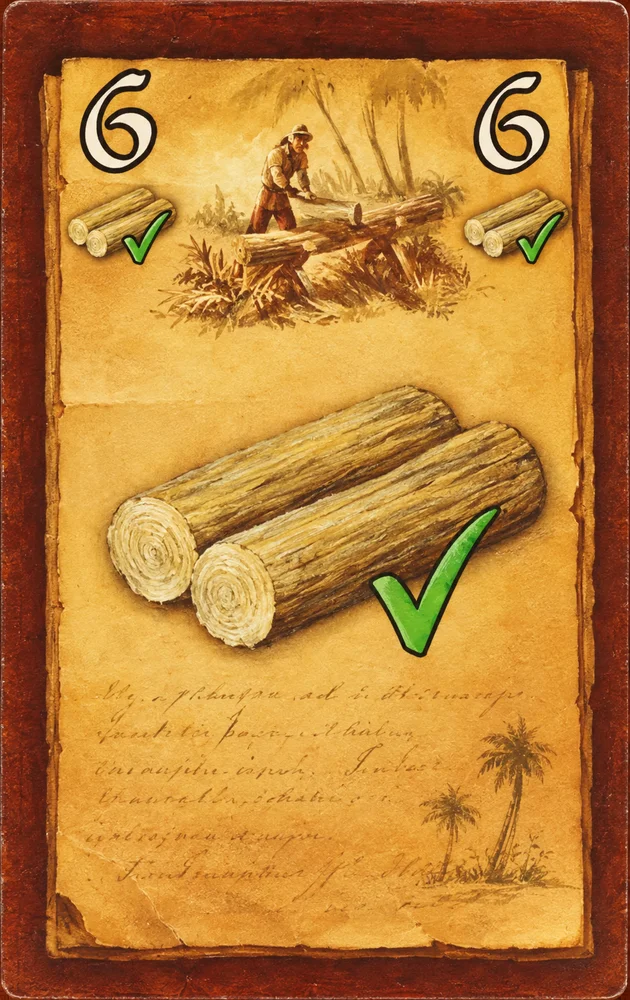 Wood: 6 if present.
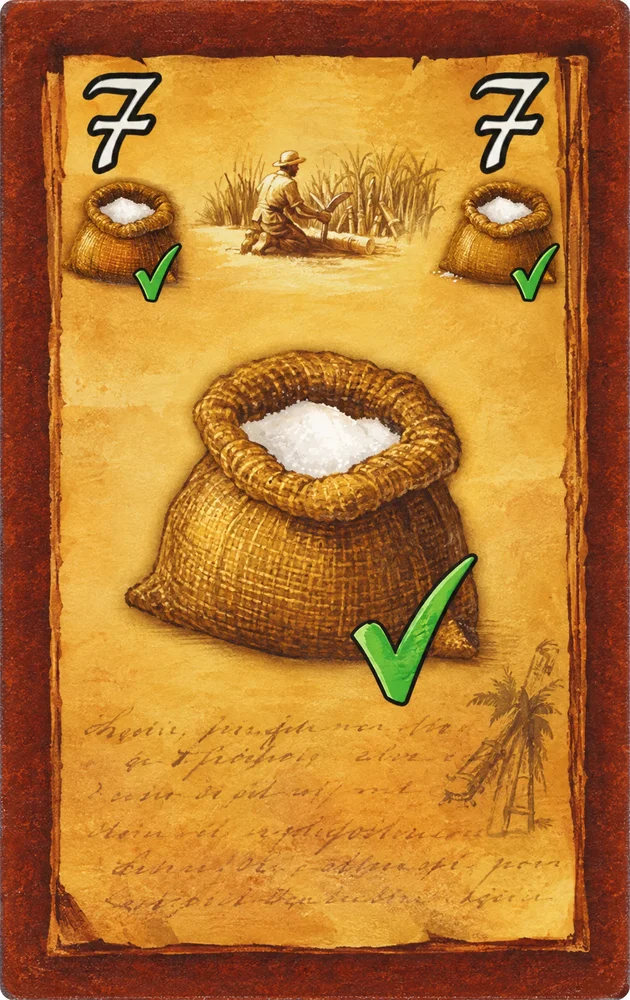 Sugar: 7 if present.
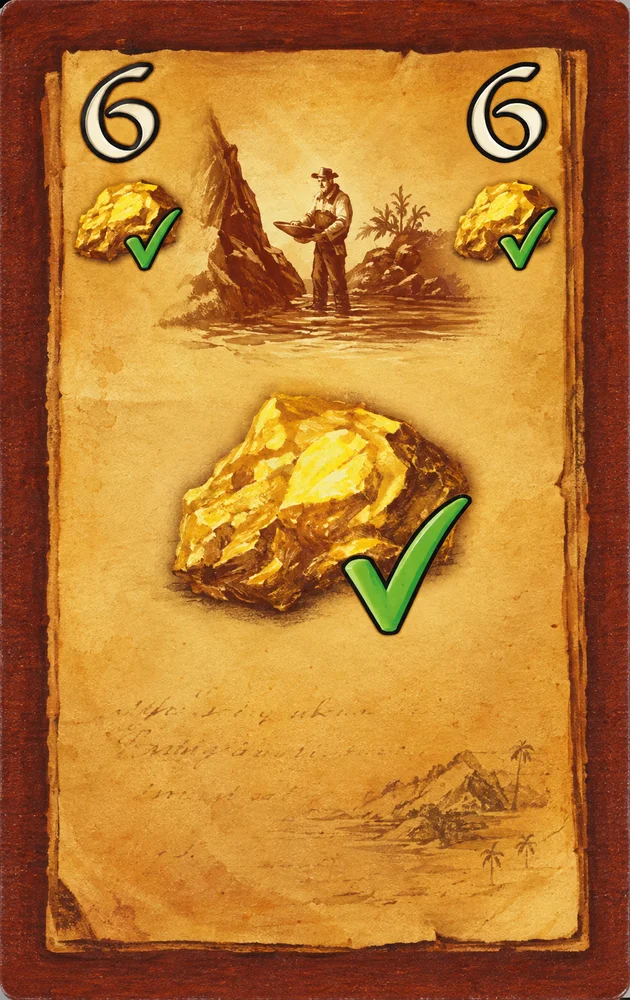 Gold: 6 if present.
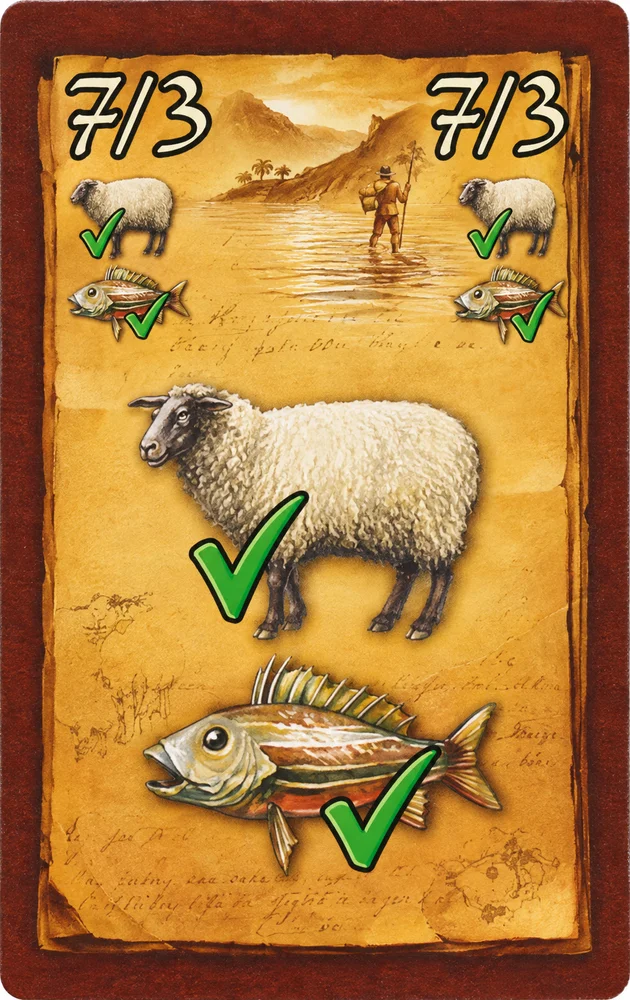 Sheep + fish: 7 for both, 3 for only one; add fish bonuses.
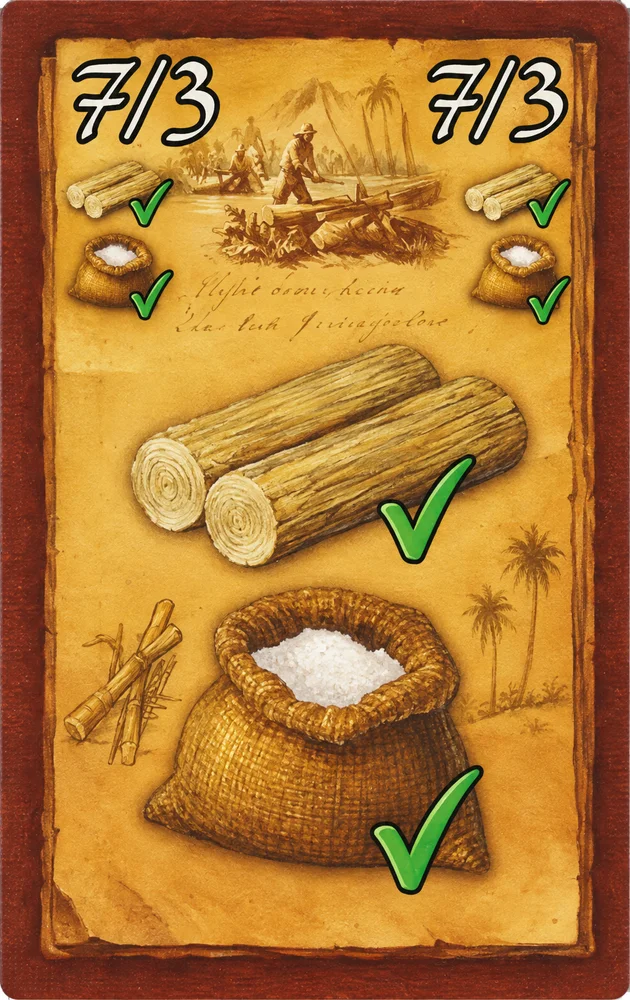 Wood + sugar: 7 for both, 3 for only one.
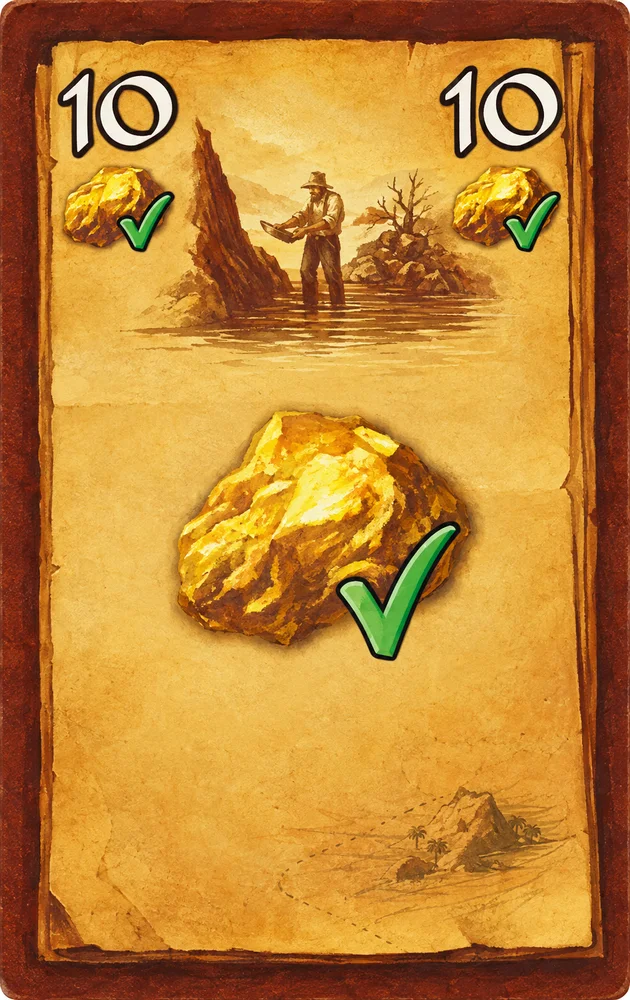 Gold: 10 if present.
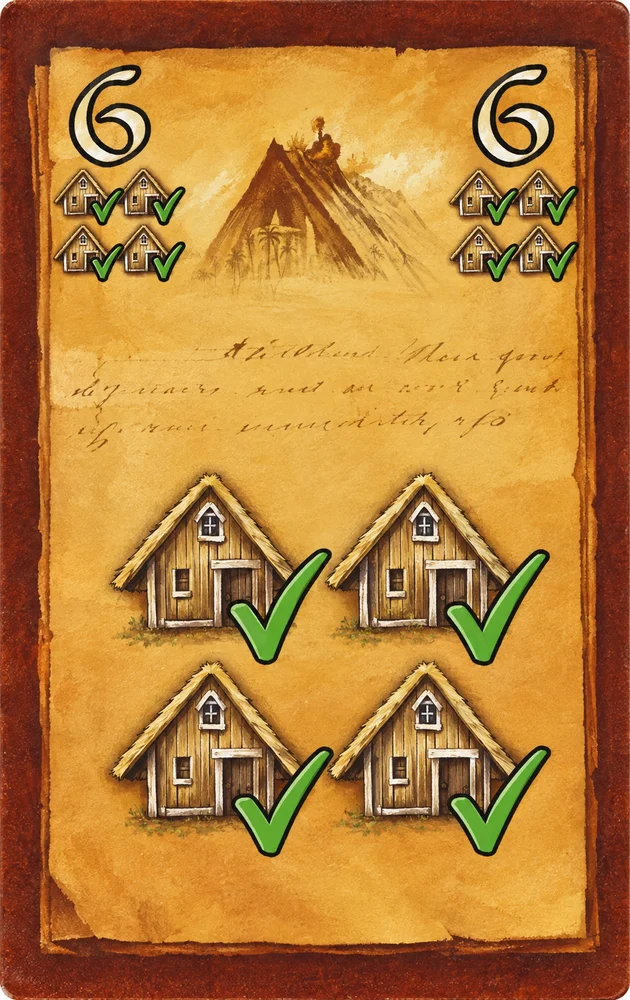 At least four houses: 6.
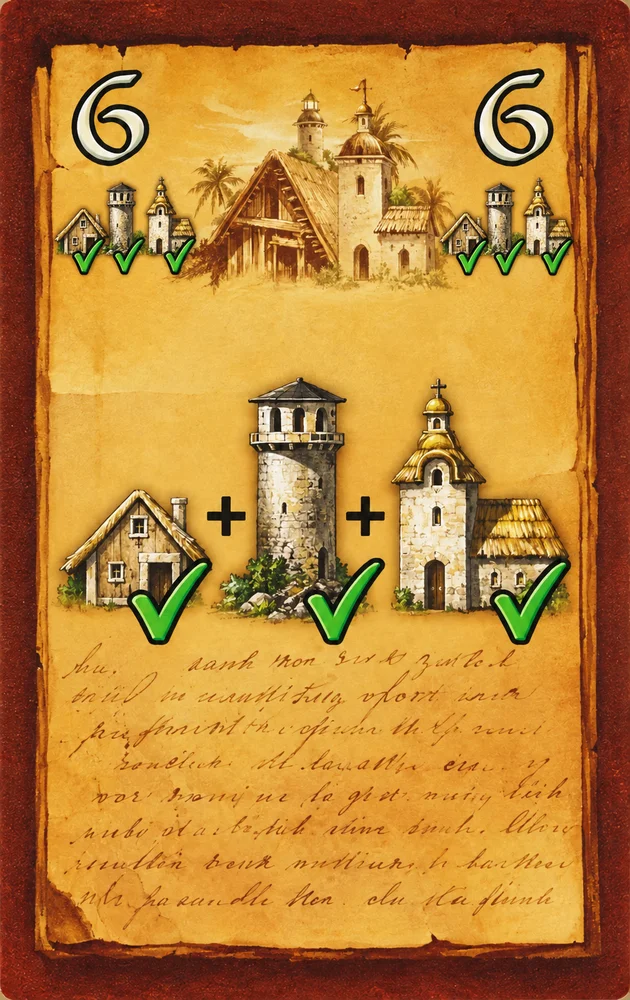 At least one house, church and lighthouse: 6.
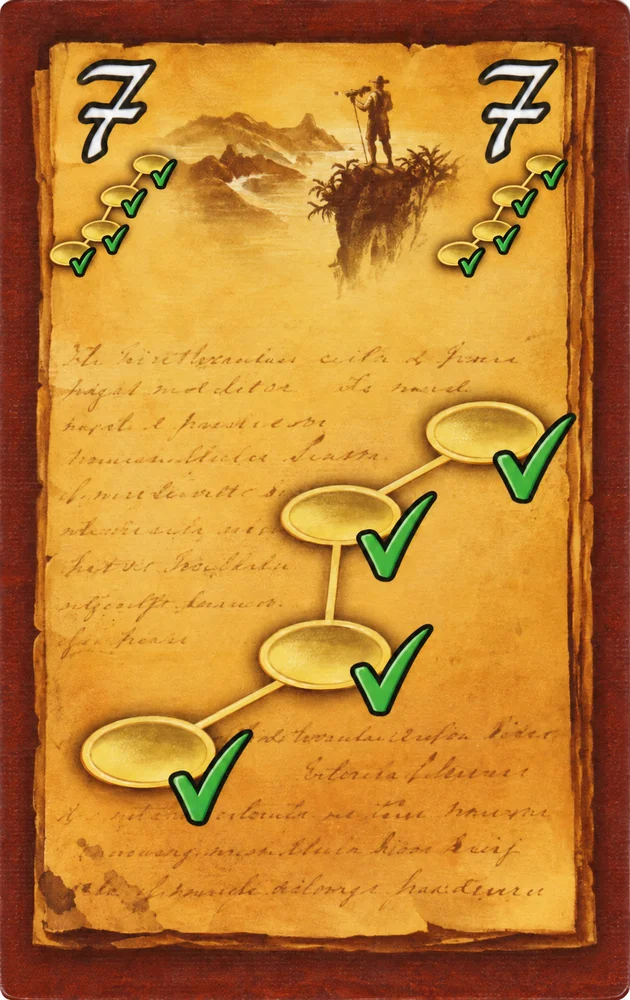 At least four buildings connected by roads: 7; branches count.
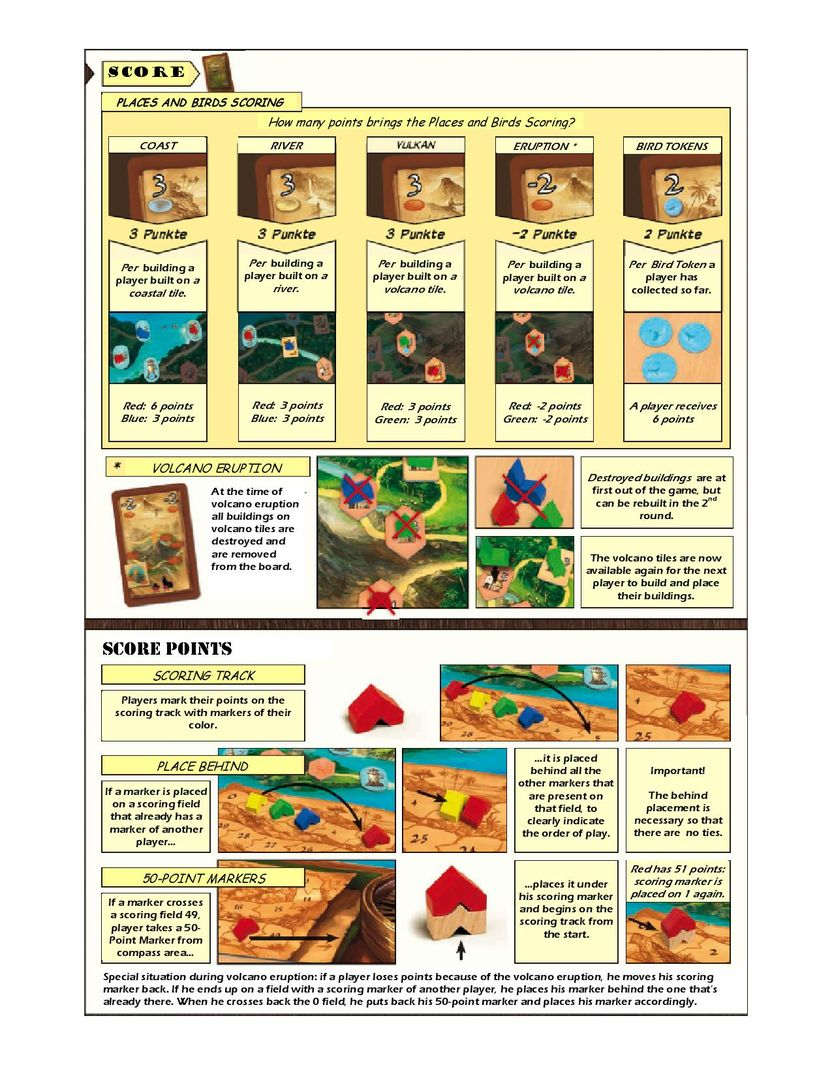
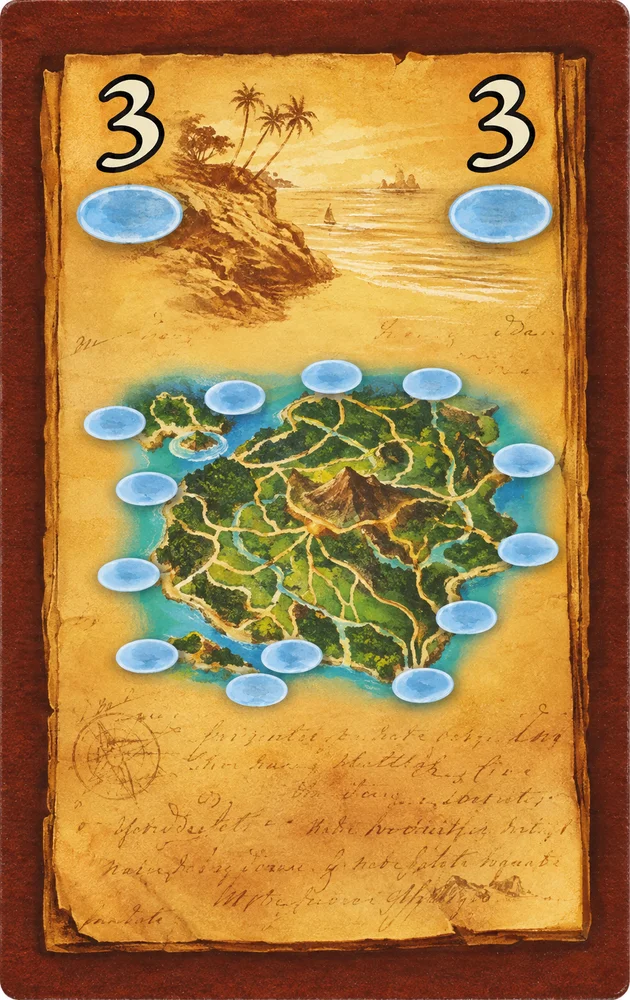 Each coastal building: 3.
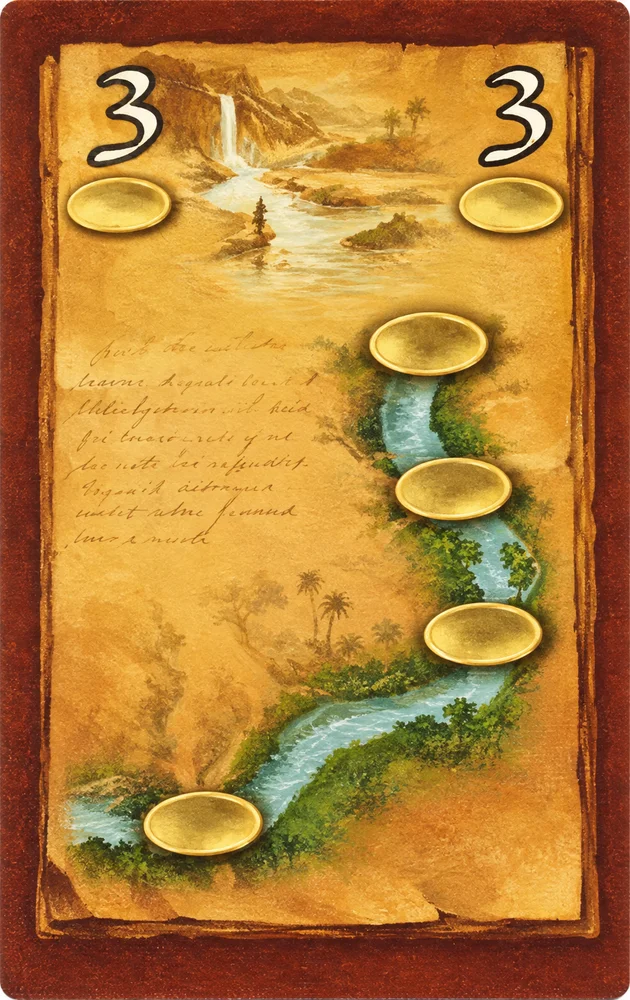 Each building on a river: 3.
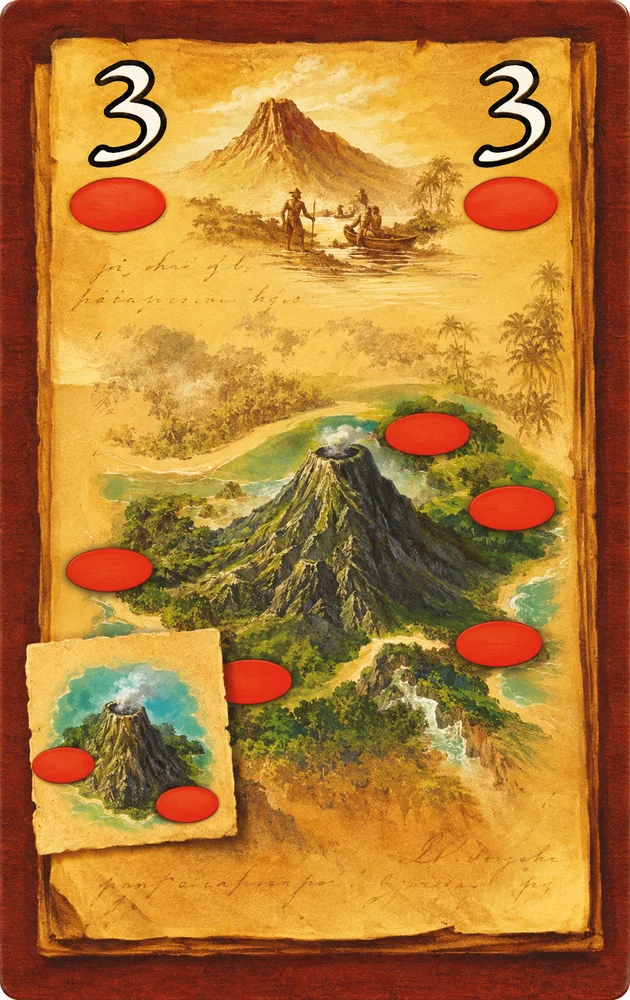 Each volcanic building: 3.
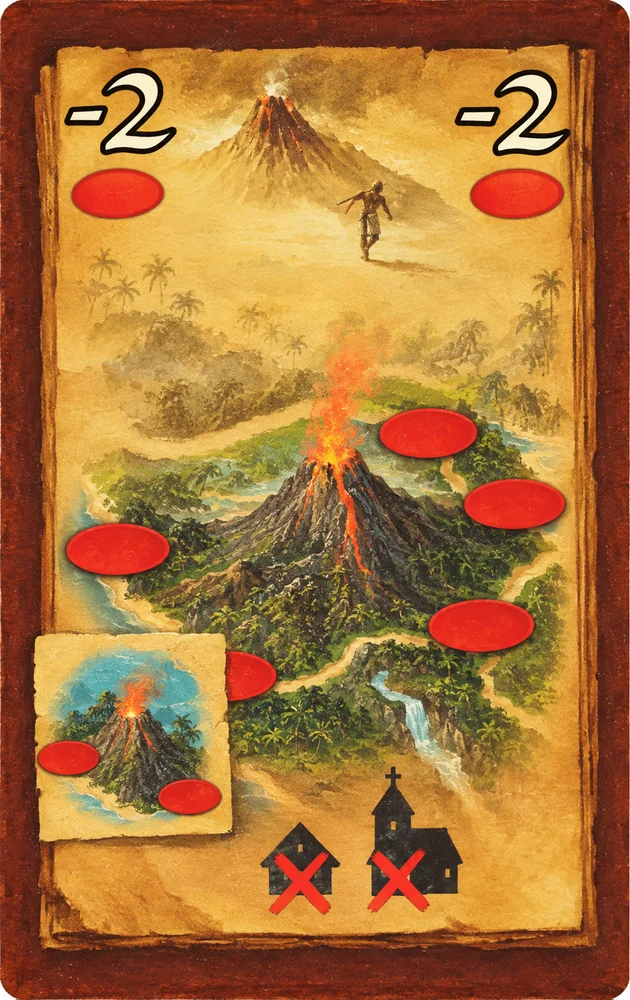 Eruption: −2 per volcanic building; destroy all such buildings until the next round. The tiles remain available for new buildings.
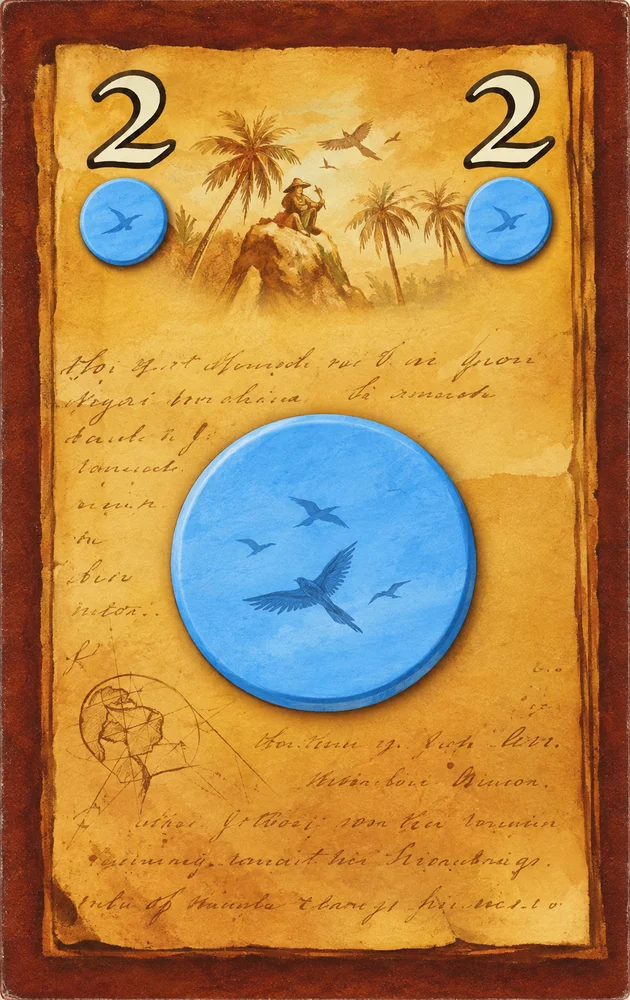 Each collected bird token: 2, regardless of its hidden value.
Building scoring
“4 houses” needs at least four built houses. “Variety” needs at least one house, one church and one lighthouse. “Street” needs at least four of your buildings connected directly by roads; branches are allowed. Each condition pays once.
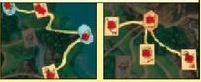 Both a chain and a branching road network qualify for street scoring.
Places and birds
Coast, river and volcano score 3 per matching building. Two coastal buildings score 6, one scores 3. Bird scoring pays 2 per token collected so far: three tokens score 6 regardless of their secret values. Keep the tokens for final scoring.
Volcano eruption
Each player loses 2 per building on volcano tiles. Then all buildings on volcano tiles are destroyed and removed. They are unavailable until round two. The tiles remain in place and can immediately be built on again. Destruction does not restore an already used sharing privilege.
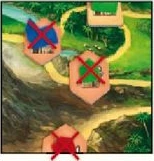 Remove the buildings; leave the revealed volcano tiles available.
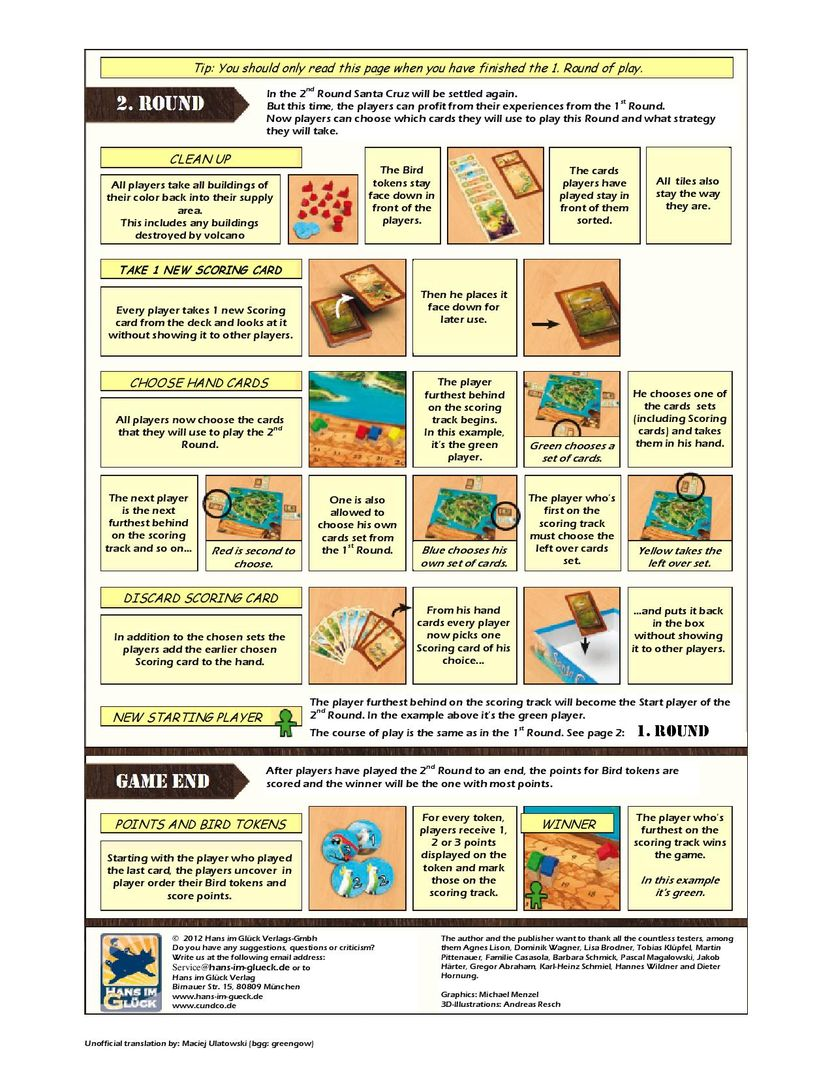
Round two
Settle Santa Cruz again, using what you learned about the island and the scoring cards.
- Clear buildings: Return every building of your colour to your supply, including destroyed ones. Keep your score and face-down bird tokens. Leave tiles exactly as they are and keep each player’s played cards grouped face up.
- Draw a new scoring card: Each player draws one from the remaining pile, looks at it privately and sets it aside for now.
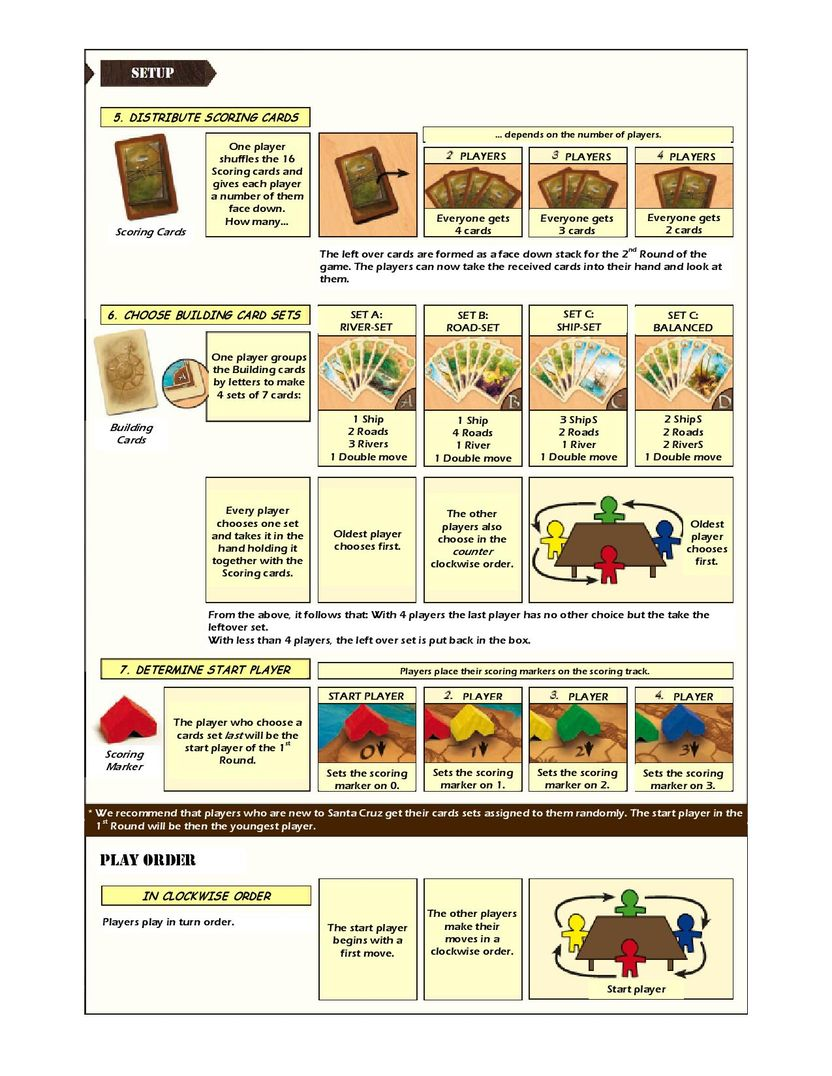
- Choose cards: The player furthest behind chooses one complete face-up card set, including the scoring cards played with it in round one. The next player from the back chooses next, and so on. You may choose your own previous set. The leader takes the remaining set.
- Discard a scoring card: Add the newly drawn card to your chosen hand. Then discard any one scoring card face down without showing it to the others. You may discard the card you just drew.
- New starting player: The player furthest behind starts. Play continues clockwise, beginning with landing without playing a card. The rest of the round follows the same rules as round one.
End of the game
After everyone has played all cards in round two, score the bird tokens. Starting with the player who played the last card and continuing clockwise, reveal your tokens and add their printed values of 1, 2 or 3 each.
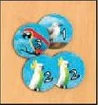 Bird tokens now score their printed values of 1, 2 or 3 .
The player furthest ahead on the scoring track wins. At the same score, the marker in front is better placed.
Original illustrated rules (English translation)