Leo Colovini · 2–3 players · 30–45 minutes
Carolus Magnus
Win the support of the noble families. Build castles, unite regions, and claim the empire.
Each action turn:1. Deploy knights2. Move the emperor3. Replenish your reserve
Your objective
Build 10 castles with two players or 8 castles with three players. If the empire shrinks to fewer than four regions first, the player with the most castles wins. Equal highest totals share the victory.
The empire takes shape
The board starts with 15 separate regions. Three knights from each of the five families are shuffled and distributed, one per region. The emperor starts in region 1. No player initially controls a family or region.
Each player receives numbered discs 1–5, an empty court, and a random reserve: seven knights in a two-player game, nine in a three-player game. Each draw has six equally likely outcomes: one of the five families or a joker. A joker must be assigned to a family before proceeding. The initial playing order is random.
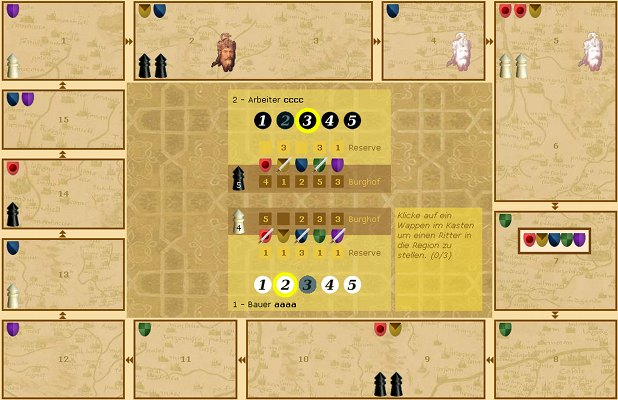 The familiar board: regions around the edge, player courts in the centre. Joined territories form one region.
Each round has two phases
1 · Choose your disc
In the current order, each player chooses an unused disc. You must choose a number that no other player has selected this round if such a disc is available. Otherwise, you may repeat a selected number.
The lowest number acts first. Equal numbers retain their relative order from the previous round. The number is also the maximum distance that player may move the emperor. Discs are used once each; after all five have been used, the complete set becomes available again.
2 · Take your action turn
- Deploy knights. Place three knights with two players, or four with three players, one at a time from your reserve. Each may go to your own court or any region. You may split them freely among destinations and families.
- Move the emperor. Advance clockwise by at least one region and at most your disc's number. A merged region counts as one step. If your disc allows a complete circuit, you may return to the starting region. Resolve control and any mergers where the emperor stops.
- Replenish. Draw three new knights with two players, or four with three players. Assign any jokers to families, then finish your turn.
Who controls what?
Noble families
A player controls a family when their court contains more knights of that colour than every other court. At a tie, the existing controller keeps control. With no existing controller, tied courts do not gain control. A sword marks control.
Regions and castles
At the emperor's destination, each player counts all knights of families they control, plus their own castles in the region. A unique highest total wins control. At a tie, nothing changes.
In an empty region, the winner builds one castle. In an occupied region, a different winner replaces all existing castles with the same number of their own. The current owner does not add a castle for retaining control.
Joining neighbours
Regions next to each other with the same castle owner merge when the emperor resolves that region. All knights and castles combine. Check both clockwise and counterclockwise neighbours, including across the board's closing boundary.
The game ends immediately
After the emperor's move and mergers, stop if any player reaches the castle target or fewer than four regions remain. There is no further reserve draw. The highest castle total wins.