Each player places their first tribe member on one their three
land tiles before the game begins. The starting player begins.
Then, the other players follow, proceeding clockwise.
Tip: Players should select land tiles which show a resource that can also be
seen on the achievement tiles in the first epoch. Whenever possible, you
should try to select a different starting resource than the other players.
- Select an action tile.
- Perform the action.
- Place the action tile at the end of the action sequence.
- The player must select an action tile from the action sequence.
-
If they choose the first action tile in the action sequence, that
action is free. However, if they choose a tile further to the right,
then they have to place a shell on each tile they skip.
-
If, later in the game, a player selects an action tile on which there already are
shells, the player will receive these shells in addition to the tile.
IMPORTANT: While the players might have only a few shells in
the beginning, they should be prepared to use them in order to be
able to perform a desired action and not be dependent on the random order
of the action sequence alone.
-
Three of the action tiles show only one action. These actions are
procreate, move, and explore.
-
The three other action tiles show one action and one hand. The
hand represents an achievement that a player can complete.
The player can choose to either perform the action or complete an
achievement with these tiles. The player cannot do both.
-
After the action or achievement has been completed, the player places
the action tile at the very end of the action sequence and pushes the
row to the left, so that the leftmost tile is now in the first position.
-
After that, the player’s turn ends and it is now the turn of the player to their left.
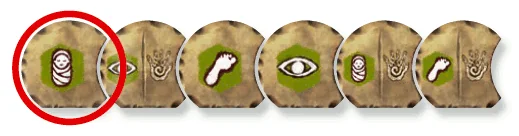
Example 1: A player wants to perform the procreate action. Since
this action tile is in the first position of the action sequence, the
player may choose this action free of charge.
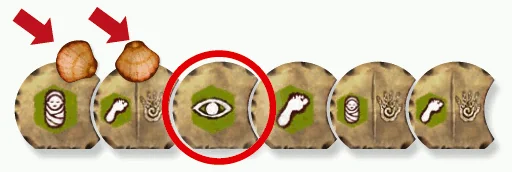
Example 2: A player wants to perform the explore action. Since this
action tile is located in the third position, the player must place one
shell on each of the two action tiles before it.
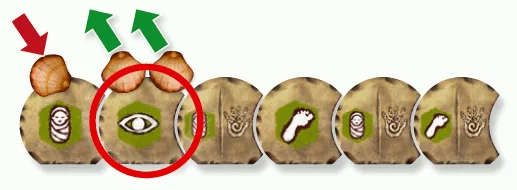
Example 3: A player wants to perform the explore action. Since this
action tile is located in the second position, the player must place
one shell on the first action tile in order to skip over it. From earlier turns,
there are already two shells on the explore tile. The player also
receives these along with the action tile.
NOTE: During the course of the game, the action sequence will
also contain event tiles, which can be selected in the same way.

Procreate
The player takes as many tribe members from their
supply as their progress marker on the
procreation progress track indicates. The higher the player’s marker
is positioned on the progress track, the more tribe members the player
receives. The player may then place the newly received tribe member(s)
on any of their land tiles on which at least one tribe member is
already standing. New tribe members may not be placed on empty land
tiles.
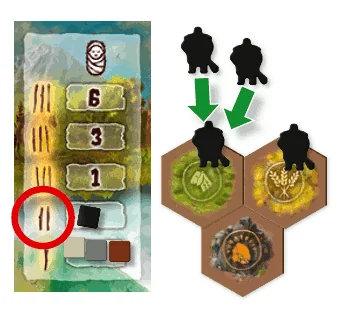
Example: Player Black may
take two tribe members. He
places both on the goat
land tile where he already has a tribe member.
He also would have been
allowed to place one new
tribe member on the goat tile
and the other on the wheat
tile where another tribe
member is located, but not on
the gold tile where there is no
tribe member yet.

Move
The player can move their tribe members as many
movement steps as their progress marker on the
movement progress track indicates. The higher the
player’s marker is positioned on the progress track, the more movement
steps the player receives. The player may use these steps for one tribe
member or split them between multiple ones. The player may
also choose to not use all or any of the movement steps.
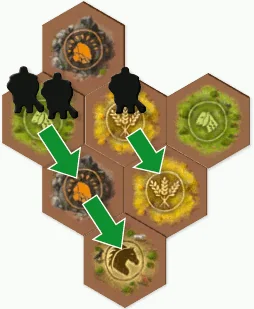
Example: Player Black
receives three
movement steps.
He moves one
tribe member
two tiles
and another
just one tile.

Explore
The player takes as many land tiles from the draw
bag as their progress marker on the exploration
progress track indicates. The higher the player’s marker
is positioned on the track, the more land tiles the player receives. After
having drawn all of the tiles, the player may place them
anywhere next to their existing land tiles.
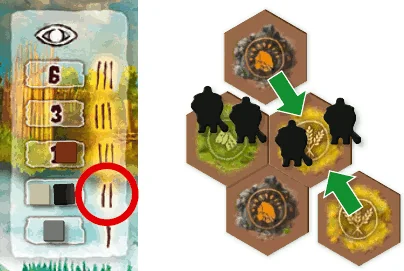
Example: Player Black may
take two land tiles
from the bag. He
gets one wheat and
one gold tile and
places both next to an
existing land tile.
NOTE: Once placed, a land tile may not be moved to another position later on.

If a player wants to complete an achievement, they must
select an action tile that has a hand symbol on it.
-
All players must start with the achievements in the bottom epoch. In
order to be able to complete an achievement, a player must have the required
resource (indicated at the top of the achievement tiles) at their disposal. To that end, they need to have at
least one tribe member on a land tile showing this resource.
The player does not lose the resource in this process.
-
The player then places one of their marking stones on the first available space
starting from the left on the achievement tile
and receives the victory points shown in that space in the form of bear
teeth, which the player collects in a pile in front of them.
-
If there is a lightning bolt above the space,
then the top event tile of the corresponding stack
for this epoch is uncovered, read aloud, and placed
at the end of the action sequence. This event is
not executed right away but only once a
player selects the tile during their turn.
-
Every achievement tile has a progress symbol
(a symbol with an arrow pointing upward)
on the right. Once an achievement is
completed, the player advances their progress marker
along the corresponding track one space upward.
This improves their ability to
perform this action in the future.
-
When a player places the first marking stone on
an achievement tile of the first or second epoch, the achievement tile in the epoch above
it is uncovered, so that all players can see which resources are
required. In the second epoch, the achievement tiles require two of the same
resource; in the third epoch, they require three of the same.
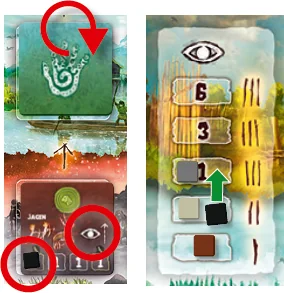
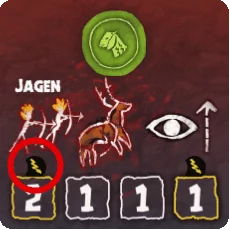
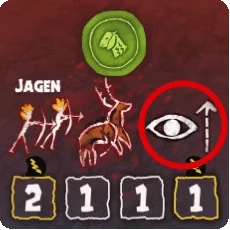
Example 1: Player Black has
earned the hunting achievement.
He is the first to complete this
achievement, so he places his
marking stone on the leftmost space of
the achievement tile. The
player receives bear teeth worth two victory points and
also moves his progress
marker one space along the
exploration progress track.
He then uncovers the
achievement tile located above in the second epoch. Because there is an event
symbol above his marking stone on the hunting tile, he
also uncovers the uppermost event tile from the stack of events and places
it at the end of the action sequence.
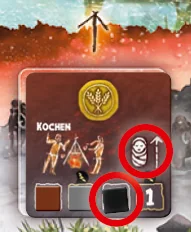
Example 2: Player Black has earned the
cooking achievement. Because players
Brown and Gray have already completed
this achievement, Black places his
marking stone on the third space from the
left. For this, he receives one bear tooth
worth one victory point and
advances one space on the procreation
progress track. Since no event symbol is
visible above his space, no event tile is
uncovered this time.
IMPORTANT: When two or three of the same resource are
needed, the player must also have at least as many land tiles of this
resource and must have at least one tribe member placed on
each of them. So a player cannot complete an achievement
in the second epoch that requires two goats if they have only two
tribe members positioned on the same goat land tile.
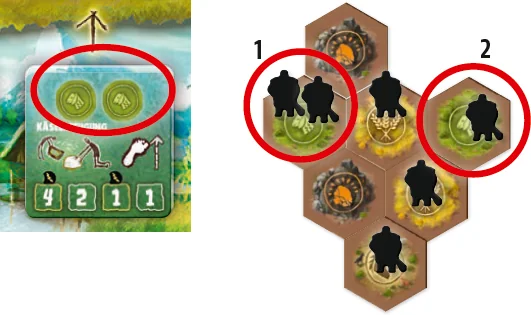
Example 3: Player Black wants to complete
the cheese making achievement, for which
he needs tribe members on two goat land
tiles. Two of his tribe members are positioned on the same goat land
tile (1). This would not be enough by itself as the tribe members must
be placed on two different land tiles. However, since the player also
has one tribe member on another goat land tile (2), he can complete
this achievement.
-
In principle, a player can only complete
an achievement of the second or third epoch
if they have already
completed the achievement beneath it
in the previous epoch. This means that
one of the player’s marking stones must
already be on it.
Continuation of Example 3: If player Black had not already earned the
cooking achievement, then the cheese making
achievement would not be available to him.
IMPORTANT: Each player may complete each achievement only once.
That means that no player can have two or more marking stones
on the same achievement tile.
-
If a player does not have the resource needed to complete an
achievement, they may exhaust land tiles.
-
For this, the player turns over a land tile on which at least one of
their tribe members is positioned
and then places the tribe member(s) back on it. The land tile is now
exhausted until the end of the game, and can no longer be used as
a resource. Tribe members may still move onto this exhausted tile, though.
IMPORTANT: In order to use a land tile as a wildcard, there must
still be at least one tribe member on the tile.
-
In the first epoch, the player can use one exhausted land tile for
any resource of their choosing.
-
In the second and third epochs, the player must have
at least one of the required resource type. The second resource and,
in the third epoch, the third one as well may be substituted with one
exhausted land tile each (which may also be of different types).
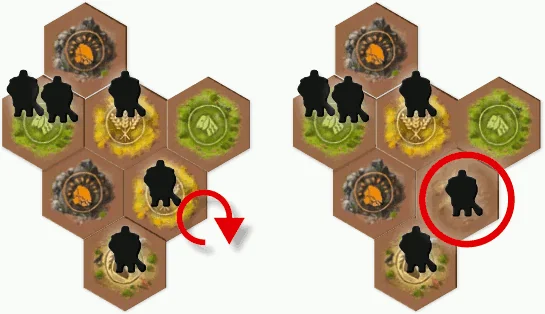
Example: If player Black does not have tribe members on two goat
land tiles (as in the previous example), he can exhaust a
wheat land tile to use it as a wildcard for the missing goat resource.
For this, he turns over the wheat tile to the exhausted side and
puts his tribe member back on it.

In principle, a player can only complete
an achievement of the second or third epoch
if they have already completed the achievement beneath it
in the previous epoch.
-
However, each player may deviate from this rule once per game
by using their arrow token.
-
For this, the player places their arrow token between an achievement on
which they already have a marking stone and a diagonally
adjacent achievement that has already been uncovered. This enables the
player to complete this achievement, even though they do not
have a marking stone on the achievement tile directly beneath it.
-
The arrow token stays in place for the remainder of the game
and can also be used by other players.
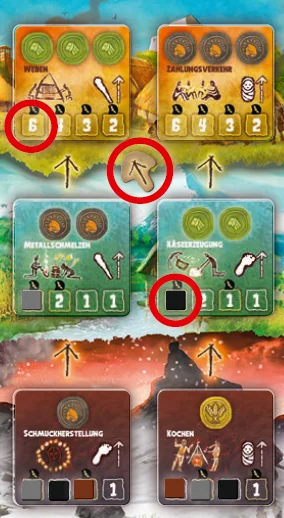
Example: Player Black
would like to complete
the weaving achievement
in order to earn the six
points shown on the
tile. He already has
the required
three goat land tiles with
at least one tribe
member on each. However,
he has not completed the
smelting achievement
yet. So he places his
arrow token between the
cheese making and weaving achievements.
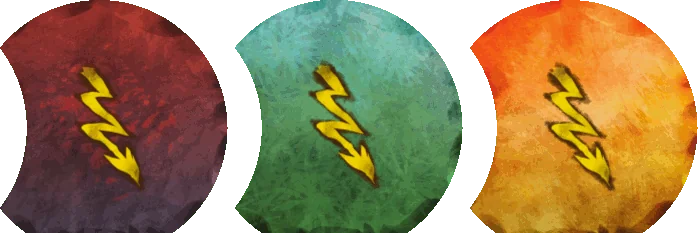
Event tiles are added to the action sequence when a player completes an
achievement and there is an event symbol above the space on
which they place their marking stone.

The event is executed only when a player
must take the event tile from the action sequence instead of an action tile
or if they select it voluntarily. If a player does not want to execute an event, they may
skip over the event tile by placing a shell on it as with the action tiles.

Most event tiles refer to the strength progress track. If a tile
says “…if your tribe is the strongest,” this refers to
the player who has advanced the furthest
on the strength progress track. Even if multiple players are the
strongest, the event applies only to the player who selects the tile on
their turn. The same applies if a tile says “…if your tribe is the weakest.”
If a player takes an event tile that does not affect them, the
event tile is removed from the game without effect.
Example: If the event tile says, “You lose 2 victory points if your tribe
is the weakest.” and the player is not the last on the
strength progress track, then they do not lose any points.
Should all players be positioned on the same space of the strength
progress track, then all their tribes are considered the weakest and/or
strongest.
If a player loses tribe members due to an event,
they can only lose so many as to be left with at least
one. They cannot lose their last tribe member.

If a player has to exhaust land tiles due to an event,
then there do not need to be any tribe members on them.
The player may turn over unoccupied tiles in this case.
If an event affects all tribes, then the player who selected the event tile
goes first and the other players follow in clockwise order.
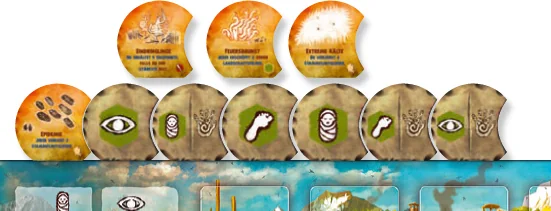
After an event has been executed, the event tile is removed from the
game. If it is an event tile from the first or second epoch, it is
put back into the box. An event tile from the third epoch (orange) is
instead put next to the board to show how many of these
events have already been executed, as they induce the end of the game.
The game ends in the round in which a
predetermined number of
event tiles of the last epoch
have been executed:
for 2 players, 2 event tiles
for 3 players, 3 event tiles
for 4 players, 4 event tiles
IMPORTANT: The events must actually have been selected and
executed. It is not enough for the event tiles to
have just been uncovered and placed in the action sequence.
After reaching the predetermined number, the current round is
played out, up to the player sitting
to the right of the starting player
(owner of the hand axe). After this, the game ends
and the victory points are totaled up.
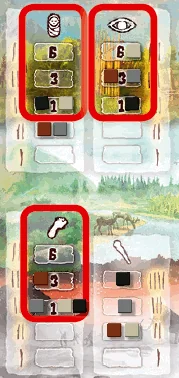
1. Progress tracks
Depending on how far a player has
advanced along the progress tracks for
procreation, exploration, and movement,
they may receive the
one, three, or six victory points shown in the upper positions.
2. Most tribe members
The player who has the most tribe members in play (and thus
the fewest pieces in reserve) receives two victory points.
3. Most land tiles
The player who possesses the
most land tiles that have not been exhausted (not turned
over) receives two victory points.
NOTE: If there is a tie for the most tribe members or land tiles, then all of
the players involved receive two victory points.
4. Bear teeth
Finally, all players add up the victory points indicated
on their collected bear teeth.
The player with the most victory points wins.
In the event of a tie, the player with the most shells wins. Should
this not break the tie, then the player who has exhausted the fewest
land tiles wins. Should there still not be a clear winner, then there are
multiple winners.