The game ends at the end of the fourth round, after the players have given up the money that was beyond the cash limit of their personality card for that round.
In addition to the victory points acquired during the game:
The winner is the player with the highest number of victory points. In case of a tie, the player (among those involved in the tie) with the lower number
on the turn order track wins (ie the player who passed earliest).
A player may decide to not perform an action (for example, if they realize that they will not have enough money
for everything), even after winning a duel for that action. Regardless, their cowboy goes to the general reserve. The actions are always performed in the sequence indicated on the board:

Wages
No duel on this square. Each player receives $4 for each of their cowboys on this square, which means that a player can place multiple cowboys on this square.

Ammunition
The player who wins this action receives the special 3 guns chip for the rest of the round.

3 Roads
The player who wins that action receives 3 new roads to put in their personal reserve.
The roads in the personal reserve are available for construction and may be placed on the board at any time during the game (
attention: this is
changed at yucata).

Road
No duel on this square. Each player receives one road for each of their cowboys on this square, which means a player can place multiple cowboys here.
Important: A newly constructed road must always extend previously placed roads.

Parcel purchase
To buy an owner-free parcel, a player must have put a cowboy on it (and not on the parcel purchase square) during
the cowboy setting phase. They may buy it now. If several players try to buy the same parcel, a duel determines the winner. This parcel may
already contain a house or a mountain.
The parcel price is $1 plus $1 for every building, mountain or house situated on this parcel or next to it (including diagonally).
The amount is paid to the Central Bank and the player must place a property tile. The cowboy goes to the general reserve.
On Yucata, if several parcel purchases require duels, the player who passed first that round chooses their order. The publisher's 2024 rules give that choice to the earliest passer involved in at least one of those duels.

There are seven 'building construction' squares, each giving the right to build one building at the price indicated on the bottom of the square.
The building process consists of the player placing a building on one of their property tiles with two conditions:
- The parcel must be reached by a road. At least one road must touch one corner of the parcel. If
there is no road reaching the parcel yet, the player is allowed to place one or more roads on the board from their personal reserve.
Exception: ranches and mines do not need to be reached by a road before being built.
- When building a drugstore, a hotel, a bank, a saloon, a church or a prison the player must also place a house for the new inhabitants
attracted by this new activity. This house has no cost and must be placed on a free parcel (no building, no mountain, no house) reached by a road.
This parcel may already belong to the player. The house may also be built on a parcel already belonging to another player
(upon agreement) or on an owner-free parcel. In this last case, the parcel may still be bought later.
Important: Instead of building it immediately a player may also keep the purchased building in front of them and build it later
(for example, because the parcel has no road connection yet or because they cannot find a position for the required house). To place
it on the board, they must wait until the end of the 'building construction actions'. If more than one player wants to build a building from their
reserve, this is done in player turn order. All players may have several buildings in front of them.

Parcel income
The player who wins this action gets $2 per parcel they own. They count all parcels, even the ones with buildings on them.

Cowboy income
The player who wins this action gets $2 for each firepower point. A player's firepower is the number of cowboys and revolvers in their personal reserve.

Gambling income
The player who wins this action rolls two dice and receives the rolled amount in cash.
On Yucata, the eligible player must roll the dice.

Estate income / attacks on buildings
Each building earns money for its owner, depending on the buildings and houses in the vicinity. This action is automatic; there is no need
to put a cowboy on a square to get this income.
It is possible to put a cowboy on a building of another player to attack it. It is also possible to place a cowboy on your own building to protect
your income. The attack succeeds if the building is not defended or if the attacker wins the duel. If the attack succeeds, the attacker
steals half of the income of that building (rounded down) from its owner. If a duel must be carried out for more than one attack, the player who
has passed first decides in which order the duels will take place.
Important: When a house does not belong to a specific player (when it is built on an owner-free parcel), it can increase the values of all
neighboring buildings, whoever the owners are. However, when built on a parcel belonging to a player, this house will only benefit the buildings of
that player. In the same way a mountain owned by a player does not count towards the income for an adjacent mine belonging to another player.

Parcels victory points
The player who wins this action gets a number of victory points corresponding to half the amount of parcels they own (rounded down).
These parcels do not have to be adjacent. The player counts all parcels even the ones with buildings on them.

Cowboy victory points
The player who wins this action gets an amount of victory points corresponding to half their firepower (rounded down).
A player's firepower is the number of cowboys and revolvers in their personal reserve.

Estate victory points
The player who wins this action gets an amount of victory points corresponding to the number of buildings that are placed on their parcels
(mountains and houses excluded).

Buying victory points
The player who wins this action may buy victory points at the price of $2, $3, $4 or $5 per victory point.

House
Setting conditions: The parcel on which the house is built must be reached by a road.
Income: -
Special rules: Houses are never bought. They come into play when other buildings are built.

Bank
Setting conditions: The parcel on which the bank is built must be reached by a road and the player must also build a house.
Income: $3 per neighboring house (without owner or owned by the player) and per mine (owned by the player). The mines
do not need to be neighboring the bank.

Ranch
Setting conditions: No placement restriction.
Income: $1 for every neighboring free parcel, no matter the owner of the free parcel. Minimal income: $1. Several ranches
may benefit from the same free parcel. A free parcel is a parcel not occupied by a building, a mountain or a house.
Special rules: A ranch adds 1 point to firepower (+1 revolver). A ranch is considered a house when calculating
drugstore, bank and saloon incomes. The player who builds a ranch takes a revolver and adds it to their personal reserve.

Saloon
Setting conditions: The parcel on which the saloon is built must be reached by a road and the player must also build a house.
Income: $5 per neighboring house (without owner or owned by the player).

Drugstore
Setting conditions: The parcel on which the drugstore is built must be reached by a road and the player must also build a house.
Income: $3 per neighboring house (without owner or owned by the player) and per ranch (owned by the player). The ranches
do not need to be neighboring the drugstore.

Hotel
Setting conditions: The parcel on which the hotel is built must be reached by a road and the player must also build a house.
Income: $6
Special rules: A hotel is considered two houses when calculating
drugstore, bank and saloon incomes.

Mine
Setting conditions: No placement restriction.
Income: $3 per neighboring mountain. Several mines
may benefit from the same mountain. Once you own a mountain, it no longer benefits other players' mines.
Special rules: A mine adds 1 point to firepower (+1 revolver). The player who builds a mine takes a revolver and adds it to their personal reserve.

Church
Setting conditions: The parcel on which the church is built must be reached by a road and the player must also build a house.
Income: -
Special rules: A church is considered a house when calculating drugstore, bank and saloon incomes.
A church allows the player to prevent other players' attacks. All buildings of yours directly adjacent to your church cannot be attacked.
If you build a church near one of your buildings being attacked, the attack is cancelled. The attacker's cowboy returns to their personal reserve.
You are not allowed to attack a church.

Prison
Setting conditions: The parcel on which the prison is built must be reached by a road and the player must also build a house.
Income: -
Special rules: The prison adds 2 points to firepower (+2 revolvers). The player who builds a prison takes 2 revolvers and adds them to their personal reserve.
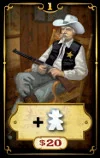
Sheriff
Take the special 'sheriff' cowboy from the general reserve (white cowboy). This allows you to select one action without
fear of being attacked (no one challenges the sheriff to a duel). Therefore, the white cowboy must not be placed to attack a building
or to challenge someone into a duel (it must be played on a cowboy-free square).
Cash limit: $20
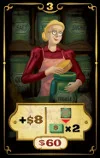
Grocer
The grocer allows you to either:
- double the income for one particular building type (for example all banks) during the estate income phase. If a building with double income
is attacked then you and the attacker receive normal income.
- or receive $8 (immediately or during estate income phase).
Cash limit: $60