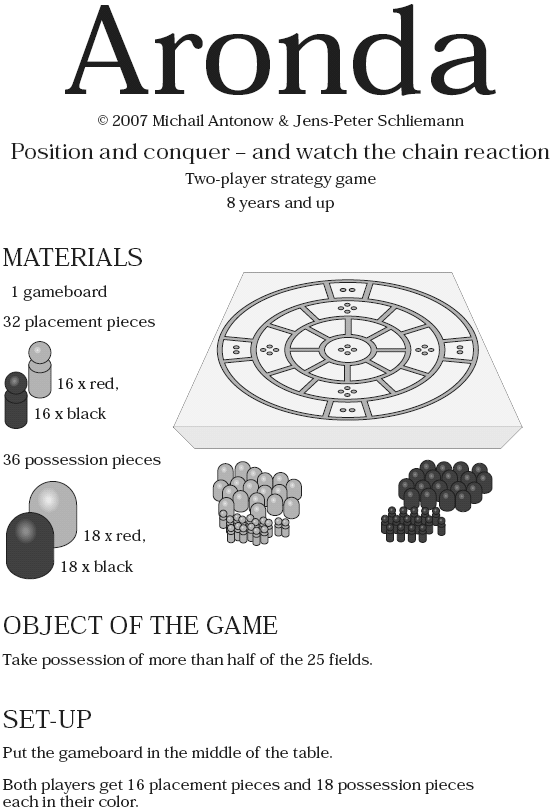
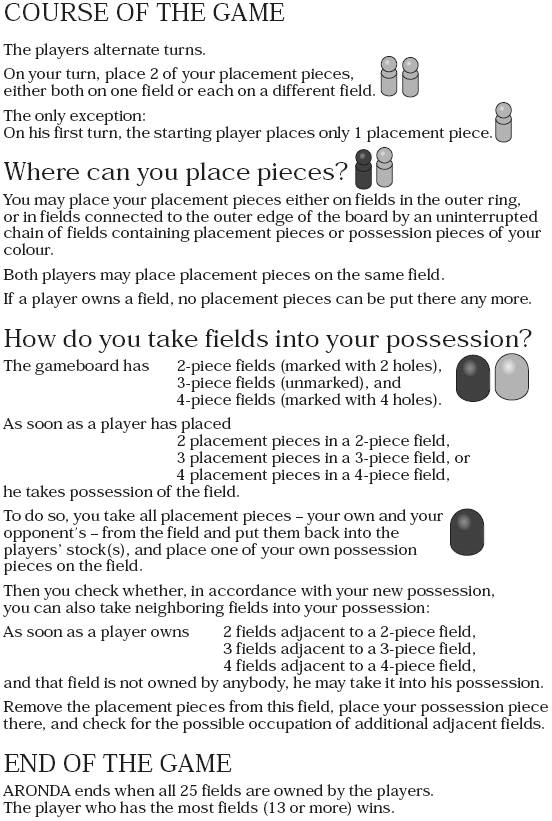
Your goal
Own more than half of the board’s 25 fields. Play continues until every field is owned, unless the online blockade rule ends the game earlier.
Setup and turn order
The board starts empty. The starting player is chosen by the framework and marked with a small star beside their login. Players alternate turns.
- The very first turn: the starting player places one stone.
- Every later turn: place two stones, one after the other. You may use the same field twice or two different fields.
- After each stone: resolve all captures and check for game end before placing another stone.
Where can you place a stone?
You may place on any unowned field of the outer ring. An inner field must touch an uninterrupted chain leading to the outer ring, with a stone or an owned field of your colour at every step. Only fields sharing an edge are adjacent. The destination itself need not already contain your stone.
Both players may have stones in the same unowned field. An opponent’s stone does not break a chain if your stone is there too. An owned field can never receive another stone or change owner.
Two ways to capture a field
2Two-hole fields
Two of your stones inside, or two neighbouring fields that you own.
3Unmarked fields
Three of your stones inside, or three neighbouring fields that you own.
4Four-hole fields
Four of your stones inside, or four neighbouring fields that you own.
From inside: when your stones reach the field’s threshold, you capture it. Remove all stones of both players from that field.
From outside: after a capture, check adjacent unowned fields. A field is captured if the number of adjacent fields you own reaches its threshold. Stones in that field do not contribute to this count. Clear both players’ stones and repeat the check: this can trigger a chain reaction. Existing ownership is permanent.
End of the game
When all 25 fields are owned, the player with 13 or more fields wins.
Author-approved online blockade rule
If the opponent has no legal placement after your stone and its capture chain, you win immediately, regardless of the number of fields owned. This also applies after the first stone of a double turn. A full board is scored by the normal majority rule first.
Examples
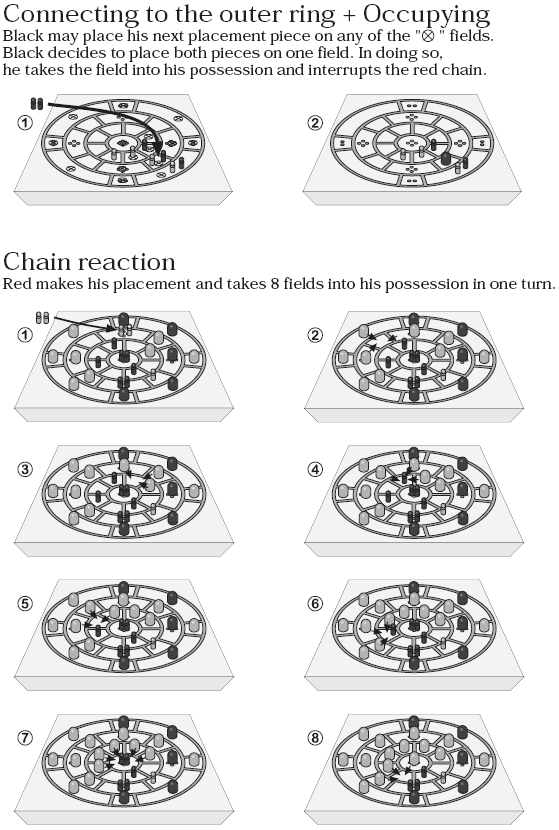 Connections, interrupted chains and successive captures.
Playing on Yucata
- The small number in an unowned field shows its capture threshold: 2, 3 or 4 of your stones or neighbouring fields you own. It is not a placement slot. Subtle sparkles mark surviving stones placed in the latest turn, including unconfirmed placements. The next turn’s first stone replaces the previous markers.
- Owned fields are coloured instead of receiving a possession piece, as in the previous online implementation. Your own player information appears first. Colours follow your framework preferences.
- Only currently legal fields are active. Every stone is a separate action. Undo, redo, confirmation and replay use the standard framework controls in their usual positions.
- The log uses c1 for the centre, i1–i8 for the inner ring, m1–m8 for the middle ring and o1–o8 for the outer ring. Numbering is clockwise, starting just right of twelve o’clock. × marks a capture from inside; + marks the following captures from outside. Select a coordinate to highlight the field.
- The old browser-specific intermediate confirmation is no longer required: capture chains contain no hidden information and remain undoable until the normal turn confirmation.
- The physical game includes 16 placement stones and 18 possession pieces per player. As in the existing online version, the virtual placement supply is not limited to 16 stones.
Original rule sheets and credits