- 1 game board
- 54 trade cards
- 12 x Winter (A)
- 13 x Spring (B)
- 13 x Summer (C)
- 15 x Autumn (D)
- 1 x "4th Fire"
- 45 goods cubes
- 9 x coffee (brown)
- 9 x tea (green)
- 9 x saffron (yellow)
- 9 x rubber (white)
- 9 x carpet (red)
- 20 workers (4 in 5 player colors each)
- 25 coins
- 5 market hall cards (in 5 player colors)
- 1 metal coin (starting player)
- 1 bag
- First, place the game board in the center of the playing area. It shows a
part of Hamburg’s warehouse district, the Speicherstadt, and includes water spaces
and building spaces, as well as a score track.
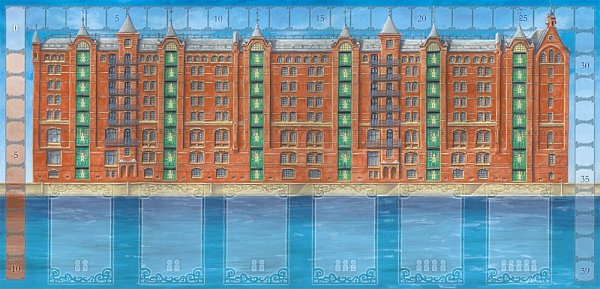
- Put all 45 goods cubes into the bag and place it next to the game board.
- Place all coins as a stock next to the game board.
- Each player receives 5 coins from the stock to place in front of him- or
herself.
- Each player chooses a color and places 1 worker of that color on the 0 space
of the score track.
- The remaining 3 workers of a color are placed in front of their respective
players.
- Each player receives the market hall of his or her color.
- Sort all trade cards by their backs:
- Winter (A)
- Spring (B)
- Summer (C)
- Autumn (D)
- 4th Fire (E)
- According to the number of players, remove the following Autumn (D) trade cards
from the pile and return them to the box. They won’t be needed:
- 2 players: port / fireman with value 3
- 3 players: Boatsmen Church / fireman with value 3
- 4 players: none
- 5 players: Boatsmen Church / fireman with value 3
- Take the 4 stacks of trade cards (1 for each season), and shuffle them thoroughly.
Then, make a drawing pile out of all trade cards, as follows: place the card
4th fire (E) first. On top of it place the autumn cards (D), on top of those the
summer cards (C), then the spring cards (B), and finally on top place the winter
cards (A). All cards are placed face-down. Place the drawing pile next to the game
board. Leave some space next to it for a discard pile.
- The player who most recently went to Hamburg becomes the first player and receives
the metal coin.
The game consists of several rounds. Each round comprises 5 phases:
- Supply
- Demand
- Purchase
- Loading
- Income
In this phase you determine the supply of trade cards that’s available for
the current round. For that purpose, take the top cards from the drawing pile
(according to the number of players) and place them in a row face-up, from
left to right on the water spaces of the Speicherstadt:
- 2 players: 3 cards
- 3 players: 4 cards
- 4 players: 5 cards
- 5 players: 6 cards
If you revealed 1 or more vessels, randomly draw for each vessel 3
goods cubes from the bag and place them on the vessel.
In this phase you determine the size of the demand for the supplied trade cards.
The player with the metal coin begins. In clock-wise turn order choose
a card by placing 1 worker of your color above that card. Place your worker
on the lowest unoccupied building space. After all players have placed 1
worker, repeat this process until all players have placed 3 workers.
You may choose cards freely for each worker. In case there are already
workers placed above the card you chose, simply place your worker on the next unoccupied
space above. You cannot forgo placing a worker. You may, however, place more than
1 of your workers above a single card. If all 8 building spaces of a card are occupied
by workers, you cannot place any further workers there.
In this way, bit by bit, rows of workers form above each card. It is also possible
that there is no demand for a card and no-one places a worker above it. As soon
as all players have placed all 3 workers, this phase ends.
Now, carry out the purchase of each card individually, from left to right.
The procedure is the same for every card.
The player whose worker sits directly above the card (that is the lowest
of the row) decides first whether or not they want to buy the card. If they do,
they pay as many coins as the total number of workers above that card. (You
can’t pay with the metal coin.) The player then takes the card and places it in
front of him- or herself. From now on that player may use the card’s function. All
workers in the row above that card return to their owners.
If the player is unwilling or unable to buy the card, take their worker
back. Now, the player whose worker is next in line may buy the card. The price has
dropped by 1 coin, since there is 1 worker less sitting above the card now. If that
player doesn’t want to buy the card either, it’s the next player’s turn, and so
on.
Thus, the card is offered to all players who have workers placed above it in turn
until one of them buys it. If no-one wants to buy the card, place it on the discard
pile. The same applies if no worker at all was placed above a card. Afterwards,
carry on with the next card.
This phase happens for the first time in Spring (B), once the first ship has been
purchased. You sell goods cubes, or you move them among various trade cards
or the market hall.
The First Player begins, the others follow in clock-wise turn order. (In
order to quicken the pace, you may also all act at the same time.)
Attention: As a rule, you may not trade or swap among
yourselves – neither coins nor goods cubes or trade cards!
You may use the following cards in this phase:
- Vessel
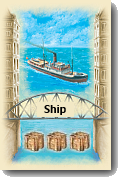
If you bought one or more vessels this round, you need to unload them
now. Take all goods cubes off the vessel. You may now choose what to do with
each goods cube individually:
- Place it on a contract
- Sell it to a merchant
- Keep it in your warehouse
- Convert, sell or keep it in your market hall
At the end of each loading, no goods cubes may remain on any vessels. Any unused
goods cubes expire. Put them to the stock and do not return them to
the bag!
- Contract
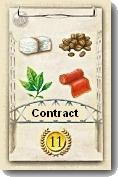
You may place any number of goods cubes from vessels, the warehouse,
or the market hall on one or more contract cards. The type of goods
must match the contract card. For instance, you may only place a brown cube on a
coffee symbol or a white cube on a rubber symbol. You may place single goods
on a contract, fulfilling it in partial steps. You may not remove goods cubes that
are already placed on contracts.
- Merchant
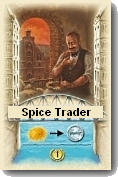
You may sell any number of goods cubes from vessels, the warehouse,
or the market hall to one or more merchants.
There are 5 different merchants:
- coffee roaster
- tea taster
- spice trader
- carpet trader
- vulcanizer
Each merchant pays 1 coin per goods cube of the depicted type of goods.
For example, the tea roaster pays 1 coin for each green goods cube. Take the coin
from the stock. Put the sold goods into the stock: do not return them
to the bag!
- Warehouse
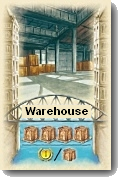
During the loading you may place goods cubes in your warehouse or remove
them from your warehouse. Here, you may keep goods cubes for use in later
rounds or for gaining points at the end of the game. There may be no more
than 4 goods cubes in a warehouse at any time, however.
- Market hall
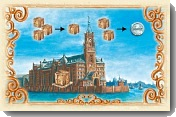
You may use the market hall for various purposes during the loading:
-
Convert:
Put any 3 goods cubes of your choice to the stock and take any 1 other
goods cube of your choice from the stock.
Note: For this purpose you may not draw goods cubes
from the bag or return them to the bag!
-
Sell:
Put any 2 goods cubes to the stock and take 1 coin from the
stock.
-
Keep:
You may keep no more than 1 goods cube in the market hall for use in a later
round.
Each player receives 1 coin. Players who bought no trade card this round
receive 1 additional coin. Afterwards, the First Player hands the metal coin
to the player on their left.
In the rare case that there are not enough coins in the stock during the income phase,
make do with tokens outside of the game, for example real coins or dice.
As soon as in phase 1) "Supply" the only card left on the drawing
pile after the drawing of the trade cards is the card 4th fire (E), your
last round has started. Proceed as per usual. Afterwards, carry out the final card
on the drawing pile, 4th fire (see "fire"). After that, the game
ends.
Attention: Occasionally it may happen that the card
3rd fire (D) is the final autumn card and sits right above the card 4th fire
(E). In that event, the round ends after revealing and carrying out the 3rd fire,
but carry out the 4th fire immediately. After that, the game ends.
Now, determine all the points you’ve collected. Use the score track
on the game board to show your points. The player with the highest score wins. In
case of a tie, the player who owns more coins wins.
We will now explain the functions of the various trade cards (in alphabetical
order) and the market hall. Each card may only be used by the player who
bought it.
The second column of the following table indicates the number of appearances of a
card in the 4 seasons (A/B/C/D).
|
Trade card
|
Stack
|
Description
|
|
A (1)
|
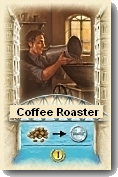
In phase 4) "Loading" you may sell any number of brown goods cubes
(coffee) to the coffee roaster. For each coffee cube sold take 1 coin
from the stock. Put the sold coffee cubes into the stock and do not
return them to the bag!
At the end of the game you will receive 1 point for the coffee roaster.
|
|
A (1)
|
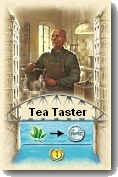
In phase 4) "Loading" you may sell any number of green goods cubes
(tea) to the tea taster. For each tea cube sold take 1 coin from the
stock. Put the sold tea cubes into the stock and do not return them
to the bag!
At the end of the game you will receive 1 point for the tea taster.
|
|
|
A (1)
|
In phase 4) "Loading" you may sell any number of yellow goods cubes
(saffron) to the spice trader. For each saffron cube sold take 1 coin
from the stock. Put the sold saffron cubes into the stock and do not
return them to the bag!
At the end of the game you will receive 1 point for the spice trader.
|
|
A (1)
|
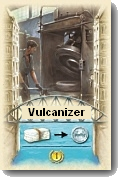
In phase 4) "Loading" you may sell any number of white goods cubes
(rubber) to the vulcanizer. For each rubber cube sold take 1 coin
from the stock. Put the sold rubber cubes into the stock and do not
return them to the bag!
At the end of the game you will receive 1 point for the vulcanizer.
|
|
A (1)
|
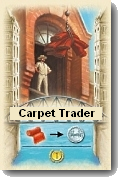
In phase 4) "Loading" you may sell any number of red goods cubes
(carpets) to the carpet trader. For each carpet cube sold take 1 coin
from the stock. Put the sold carpet cubes into the stock and do not
return them to the bag!
At the end of the game you will receive 1 point for the carpet trader.
|
|
|
B (5)
C (5)
D (5)
|
As soon as you reveal a ship in phase 1) "Supply", randomly
draw for each ship 3 goods cubes from the bag and place them on the ship.
If you buy a ship, you need to unload it in the same round. Take all
goods cubes off the ship. You may now choose what to do with each goods cube
individually:
- Place it on a contract.
- Sell it to a merchant.
- Keep it in your warehouse.
- Convert, sell or keep it in your market hall.
At the end of each loading, no goods cubes may remain on any ships. Any unused
goods cubes expire. Put them into the stock and do not return them
to the bag!
|
|
|
A (1)
|
In phase 4) "Loading" you may place goods cubes in your warehouse
or remove them from your warehouse. Here, you may keep goods cubes for use
in later rounds or for gaining points at the end of the game. There may be
no more than 4 goods cubes in a warehouse at any time, however.
At the end of the game you receive 1 point for each goods cube in
your warehouse.
|
|
A (1)
B (1)
D (2)
|
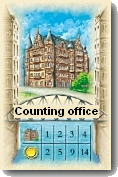
At the end of the game you will receive points for your Counting Offices,
as follows:
- 2 points if you own 1 Counting Office.
- 5 points if you own 2 Counting Offices.
- 9 points if you own 3 Counting Offices.
- 14 points if you own 4 Counting Offices.
|
|
D (1)
|
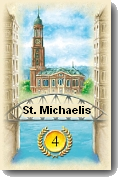
At the end of the game you receive 4 points for St. Michaelis.
|
|
D (1)
|
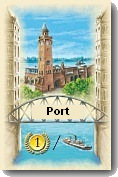
At the end of the game the port will gain you 1 point for each vessel
you own.
|
|
D (1)
|
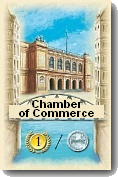
At the end of the game you will receive 1 point for each coin you
own. (You do not have to return the coins.)
|
|
C (1)
|
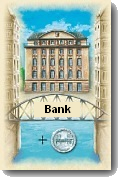
As owner of the bank you receive 1 additional coin in phase 5) "Income".
That way, you receive 2 coins if you bought at least 1 trade card this round, and
3 coins if you bought no trade cards this round.
|
|
D (1)
|
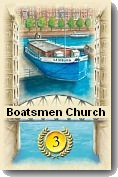
At the end of the game you will receive 3 points for the Boatsmen
Church.
|
|
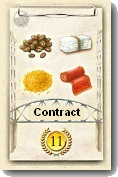
A (1)
|
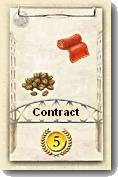
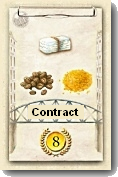
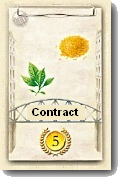
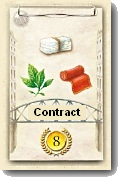
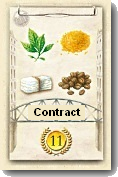
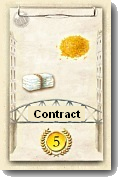
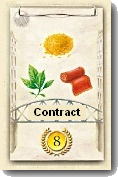
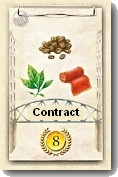
In the course of the game you should supply your contracts with goods cubes,
since you will gain points for this. Contracts come in 3 different sizes:
- Small contract: 2 goods for 5 points
- Medium contract: 3 goods for 8 points
- Large contract: 4 goods for 11 points
In phase 4) "Loading" you may place any number of goods cubes from
vessels, the warehouse, or the market hall on one or more contract
cards. The type of goods of the cube and of the contract card must
match. For instance, you may only place a brown cube on a coffee symbol or a white
cube on a rubber symbol. You may place single goods on a contract, fulfilling
it in partial steps. You may not remove goods cubes that are already placed on contracts.
At the end of the game you receive the number of points (5/8/11) shown
on the contract, but only if all required goods cubes have been placed on
it. There are no points for incomplete contracts.
|
|
A (1)
|
|
|
A (1)
|
|
B (1)
|
|
B (1)
|
|
B (1)
|
|
C (1)
|
|
C (1)
|
|
C (1)
|
|
C (1)
|
|
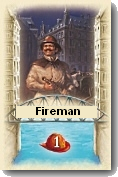
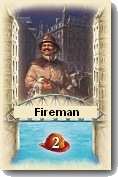
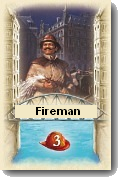
A (1)
B (1)
|
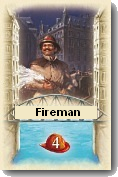
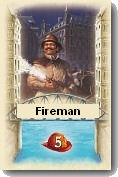
Firemen will protect you from the 4 fires that will start during the
course of the game. Each fireman has a value (1-5).
In the event of a fire, the sum of the values of your firemen will
determine whether you may receive bonus or negative points.
|
|
A (1)
B (1)
|
|
B (1)
C (1)
D (1)
|
|
C (1)
D (1)
|
|
D (1)
|
|
B (1)
|
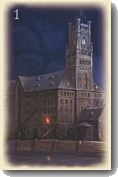
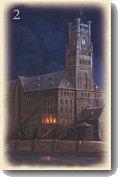
There are 4 fire cards. As soon as you reveal a fire in Phase 1) "Supply",
immediately halt the game. Each player adds the values of their firemen.
The player with the largest sum immediately receives as many points
as shown on the fire card. The player with the smallest sum immediately receives
as many negative points. Use the score track on the game board to
show your points.
In case of a tie, each participant receives the points or negative points.
In the rare case that all players possess the same sum, nobody receives any points
(positive or negative).
After carrying out the fire card, place it on the discard pile. Reveal
a further trade card to replace the fire and completely stack the water spaces.
Continue the game.
|
|
C (1)
|
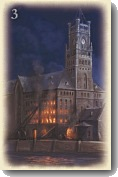
|
D (1)
|
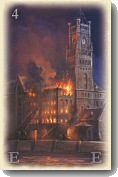
|
E (1)
|
The expansion for "The Speicherstadt"
Author: Stefan Feld
Artwork: Harald Lieske
Overview
Did you have a lot of fun with "The Speicherstadt" but felt it was over too soon? Do you wonder what else there is to
experience in the large warehouse district of Hamburg? "Kaispeicher" is full of new challenges. It includes 50 new cards, a
clever extra bidding mechanism, and "real" metal coins.
Components:
Setup
-
Set up "The Speicherstadt" in the same way as in the basic game.
-
Put all 54 goods into the bag (including the 9 new ones).
-
If you wish, you may play with the metal coins. (But place
the old coins nearby in case additional coins are needed.)
-
As in the basic game, each player receives 5 coins from the supply.
-
The 2 gray workers should be set aside, as they are needed later in the game.
-
Each player chooses a color and places 1 worker of that color on the 0 space of the score track.
-
The remaining 4 workers of each color are placed in front of their respective players.
-
From the pile of new cards, remove the "Start" card and the 2 "Break" cards and put them aside. They are needed
later in the game.
-
Then take all trade cards (old and new ones) and sort them according to their backs.
-
According to the number of players, remove the following Autumn (D) trade cards from the pile and return them to
the box. They won’t be needed:
-
2 players: Port / Fireman with the value 3 / Mayor / Truck
-
3 players: Boatsmen Church / Fireman with the value 3 / Mayor / Truck
-
4 players: none
-
5 players: Boatsmen Church / Fireman with the value 3 / Mayor / Truck
-
Proceed with all other trade cards as described in the rule book of "The Speicherstadt" in section 10 of the Setup.
-
The player who most recently went to Hamburg becomes the first player and receives the "Start" card.
Playing the game
The game still consists of several rounds, each comprising 5 phases:
-
Supply
-
Demand
-
Purchase
-
Loading
-
Income
1) Supply
Take the top cards from the draw pile and place them in a
row face-up, from left to right on the water spaces. As usual,
the number of uncovered cards equals the number of
players +1. Now, in addition, you lay out the same number of
cards above the game board. So there are always twice as
many cards to choose from as in the basic game.
2) Demand
As usual, starting with the first player and then in clockwise
direction, each player places one of his workers on the
lowest free building space above a card of his choice. But
now you also have the option of reserving a card of your
choice from the row above the board. To do this, you take
one of these cards, place it next to the lower left side of the
board, and put one of your workers onto it. If there are
already one or more reserved cards, the new card must
always be placed above the last reserved one.
The phase ends when each player has placed all his workers.
3) Purchase
As in the basic game, first carry out the purchases of all
cards from the water spaces. Then the reserved cards next
to the game board are available for purchase. Start with the
lowest card in the row. The card can only be purchased by
the player who placed his worker on it. If the player wants
to buy the card, he must return a number of coins to the
stock equal to the number of reserved cards in the row.
If the player does not want to buy the card, he pays
nothing and the card is discarded. As usual, the worker returns to
the player. Then the next lowest card from the row is available for
purchase and so on. At the end of the phase, if there are
cards left above the game board, they are discarded.
4) Loading
Loading is carried out exactly as in the basic game by selling
goods cubes or moving them to appropriate cards.
5) Income
Each player now receives 2 coins from the stock. Players who
didn’t purchase any trade cards this round receive
1 additional coin. Afterward, the first player hands the
"Start" card to the player on his left and a new round begins.
End of the game
The end of the game is identical to the end of the basic game.
Note: If you reach space 39 on the score track, you continue counting your points on the 0 (= 40 points). At the end of the game,
these 40 points are simply added to your result.
The new trade cards
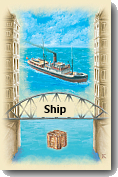
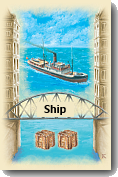
There are 6 new Ships (6: 0/2/2/2):
When a Ship is revealed during phase 1) "Supply",
draw as many goods from the bag as the Ship
shows crates and put one of those goods onto each
crate.
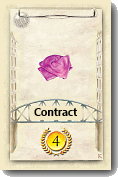
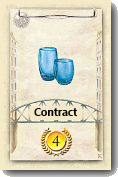
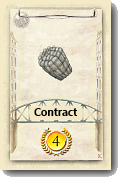
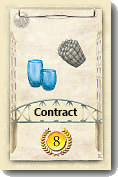
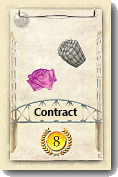
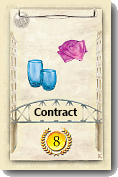
For the 3 new kinds of goods, there are
corresponding Contracts (6: 0/2/2/2):
As in the basic game, you only get points for a
completed Contract at the end of the game.
There are now 2 additional Counting Offices (2: 0/0/1/1).
No player may score more than 4 Counting Offices
at the end of the game, regardless of how many he
owns.
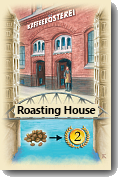
Roasting House (1: 1/0/0/0)
In phase 4) “Loading”, you may deliver any number
of brown goods cubes (coffee) to the Roasting
House. For each coffee cube that you return to the
stock you gain 2 points on the score track.
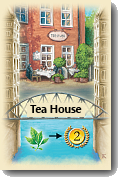
Tea House (1: 1/0/0/0)
In phase 4) "Loading", you may deliver any number
of green goods cubes (tea) to the Tea
House. For each tea cube that you return to the
stock you gain 2 points on the score track.
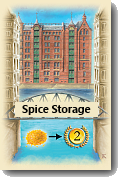
Spice Storage (1: 1/0/0/0)
In phase 4) "Loading", you may deliver any number
of yellow goods cubes (saffron) to the Spice
Storage. For each saffron cube that you return to the
stock you gain 2 points on the score track.
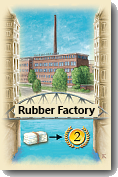
Rubber Factory (1: 1/0/0/0)
In phase 4) "Loading", you may deliver any number
of white goods cubes (rubber) to the Rubber
Factory. For each rubber cube that you return to the
stock you gain 2 points on the score track.
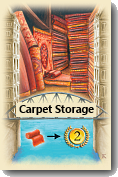
Carpet Storage (1: 1/0/0/0)
In phase 4) "Loading", you may deliver any number
of red goods cubes (carpet) to the Carpet
Storage. For each carpet cube that you return to the
stock you gain 2 points on the score track.
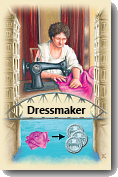
Dressmaker (1: 1/0/0/0)
In phase 4) "Loading", you may sell any number of
pink goods cubes (fabric) to the Dressmaker. For
each fabric cube that you return to the stock you
receive 3 coins.
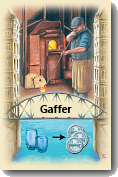
Gaffer (1: 1/0/0/0)
In phase 4) "Loading", you may sell any number of
blue goods cubes (glass) to the Gaffer. For
each glass cube that you return to the stock you
receive 3 coins.
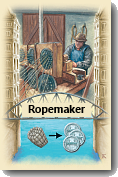
Ropemaker (1: 0/1/0/0)
In phase 4) "Loading", you may sell any number of
gray goods cubes (hemp) to the Ropemaker. For
each hemp cube that you return to the stock you
receive 3 coins.
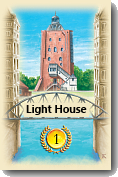
Light House (1: 0/1/0/0)
At the end of the game, you receive 1 point for the Light House.
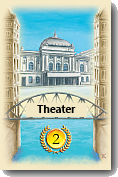
Theater (1: 0/1/0/0)
At the end of the game, you receive 2 points for the Theater.
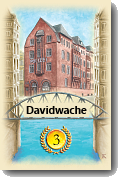
Davidwache (1: 0/0/0/1)
At the end of the game, you receive 3 points for the Davidwache.
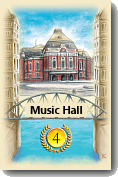
Music Hall (1: 0/0/0/1)
At the end of the game, you receive 4 points for the Music Hall.
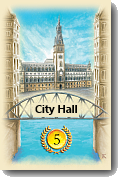
City Hall (1: 0/0/0/1)
At the end of the game, you receive 5 points for the City Hall.
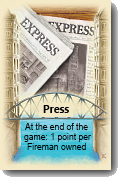
Press (1: 0/0/1/0)
At the end of the game, you receive 1 point for each
of your Firemen.
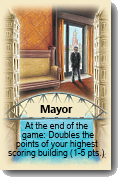
Mayor (1: 0/0/0/1)
At the end of the game, your highest scoring
building yields twice as many points. Only the
7 trade cards that have a fixed point value of 1 to 5
are considered scoring buildings (for example
Davidwache, Music Hall).
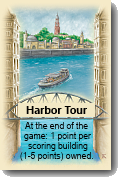
Harbor Tour (1: 0/0/0/1)
At the end of the game, you receive 1 additional
point for each of your scoring buildings. Only the
7 trade cards that have a fixed point value of 1 to 5
are considered scoring buildings (for example
Davidwache, Music Hall).
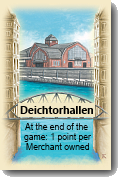
Deichtorhallen (1: 0/0/0/1)
At the end of the game, you receive 1 additional
point for each of your Merchants. Only the 8 trade
cards that convert goods to money are considered
Merchants (for example Spice Trader, Gaffer).
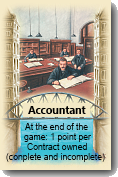
Accountant (1: 0/0/0/1)
At the end of the game, you receive 1 additional
point for each of your Contracts, regardless of
whether the Contract has been completed or not.
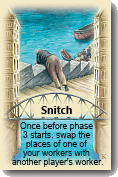

Snitch (1: 1/0/0/0)
Right before starting phase 3) "Purchase", you may
swap the places of one of your workers with the
worker of another player. After that, discard the
Snitch.
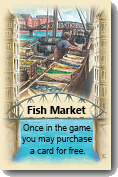
Fish Market (1: 0/1/0/0)
In Phase 3) "Purchase" you may discard the Fish
Market to pay for 1 card instead of paying with
coins.
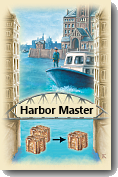
Harbor Master (1: 0/1/0/0)
In phase 4) "Loading", you may convert any
2 goods into 1 other good as many times as you
want. To do this, return 2 goods to the stock and
replace them with 1 good of your choice that is
available in the stock.
Thrift Institution (1: 0/0/1/0)
As soon as you purchase the Thrift Institution, you
immediately receive 4 coins from the stock. After
that, discard the Thrift Institution.
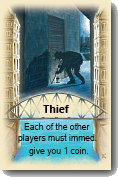
Thief (1: 0/0/1/0)
As soon as you purchase the Thief, all other players
must immediately give you 1 coin. Players with no
coins give you nothing. After that, discard the
Thief.
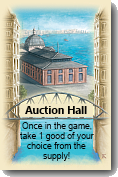
Auction Hall (1: 0/0/1/0)
At any point in the game, you may take 1 good of
your choice from the stock. You must load this good
immediately (using it with one of your cards). After
that, discard the Auction Hall.
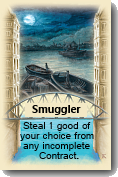
Smuggler (1: 0/0/1/0)
At any point in the game, you may steal
1 good from any incomplete Contract of another
player. You must load this good immediately (using
it with one of your cards). After that, discard the
Smuggler.
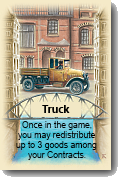
Truck (1: 0/0/0/1)
At any point in the game, you may take up to
3 goods from your Contracts and redistribute them
among any of your Contracts in any way you want.
After that, discard the Truck.
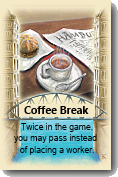
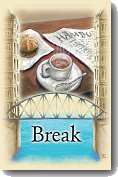

Coffee Break (1: 1/0/0/0)
When you purchase this card, you also take the two
"Break" cards that were put aside during setup.
You may now pass during phase 2) "Demand" by
discarding a "Break" card instead of placing a
worker. This gives you the advantage of stalling
and placing your workers later in the round. After
using both "Break" cards, also discard the Coffee
Break.
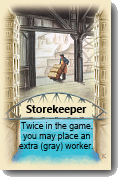
Storekeeper (1: 0/1/0/0)
When you purchase this card, you also take the two
gray workers that were put aside during setup. In
phase 2) "Demand", you may place one or both gray
workers in addition to your other workers (thus
increasing your number of workers this round).
However, if you placed a gray worker, he does not
return to you during phase 3) "Purchase" but is
removed from the game.
As soon as both gray workers have been removed
from the game, discard the Storekeeper.
Fireman (5: 2/1/1/1)
There are 5 additional Firemen with values from 1 to 5.
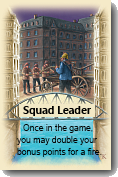
Squad Leader (1: 1/0/0/0)
Once in the game, you may double the points that
you gain during a fire. After that, discard the Squad
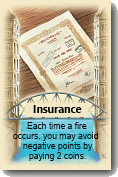
Leader.
Insurance (1: 0/1/0/0)
Each time you would get negative points during a
fire, you may avoid those negative points by
returning 2 coins to the stock.
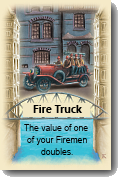
Fire Truck (1: 0/0/1/0)
During each fire, the Fire Truck doubles the value
of one of your Firemen.
Playing online
Anatomy of the Player Info
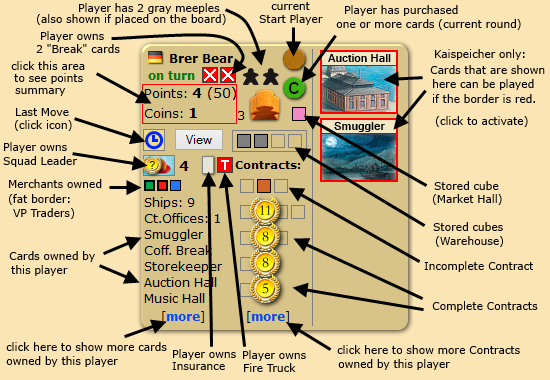
Notes regarding use of trade cards
Storekeeper
The player who owns this card will be given the possibility to place additional grey workers after all his regular workers have been placed.
Coffee Break
"Break" cards cannot be played when all opponents have already placed all of their regular workers, i.e. it is not possible that the players who owns the "Break" cards plays one of those because he thinks another player who owns grey workers will place one of those as his next action.
Harbor Master
Converting cubes 2:1 instead of 3:1 is mandatory, not optional.
Squad Leader
If a Firecard is revealed it will be scored immediately. After that, the owner of the card must decide whether or not to use the card.
If the Squad Leader can still be played by its owner after the last round has been finished, it is played automatically when Fire card #4 is scored.
(This is also true if Firecard #3 is scored right before the final card.)
Insurance
If a Firecard is revealed it will be scored immediately. After that, the owner of the card must decide whether or not to use the card.
If the card is used, the negative points that were scored will be removed.
Fire Truck
The player’s highest Fireman value is doubled. The overall Firemen value that is shown in the player info includes the doubled value.
Other Notes
-
Kaispeicher: The upper row of cards is shown on the board instead of above because of the limited space of the game window.
-
Cards of the upper row that have not been reserved are discarded right after the Demand phase is finished.
-
The In-Game-History feature is available in the Base Game only.